Ciri dan struktur
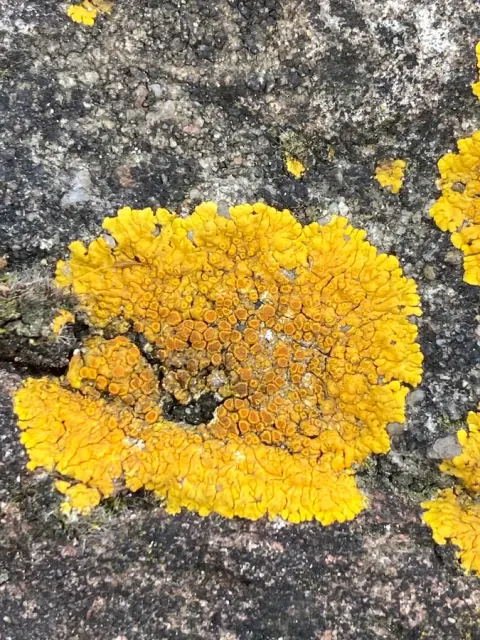
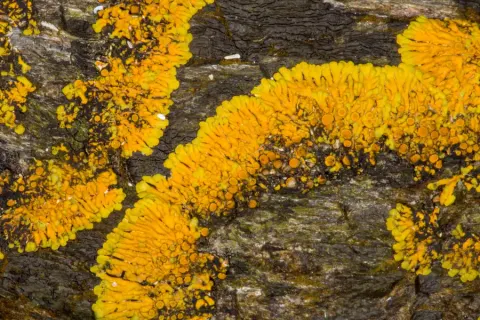
Teloschistopsis bonae-spei predominantly grows on rocks devoid of calcite. It forms expansive colonies characterised by both flat and three-dimensional structures. The thallus (body of the lichen) displays a range of yellow to yellow-orange coloured , measuring up to 5 mm in length and between 0.3 and 1 mm in width. These lobes, found at the periphery, are tightly to loosely attached to the , have irregular branching, and may overlap each other. On older parts of these marginal lobes, numerous pseudocyphellae (tiny, porous spots that facilitate gas exchange) are present. Moving towards the centre of the thallus, the lobes can be similar in adherence to the substrate or can rise up, forming a loose, shrub-like layer that stands over the crusty base of the thallus. These ascending lobes are variably flat to significantly compressed and range from 0.5 to 3 mm in width. In mature lobes, the cortex layer, which covers the surface, may crack longitudinally creating long strips filled with pseudocyphellae, mirroring the coloration of the marginal lobes. Apothecia (fruiting bodies) are distributed sporadically and can be abundant on certain lobes. They are borne on the upper side or terminally on the lobes, and have flat to slightly convex, brownish-yellow-orange . Initially, these discs are encircled by a protruding }, which soon transitions into a narrow and a more retracted, wart-divided thalline margin. The underside of these fruiting bodies is also covered with numerous pseudocyphellae. The structure within these lobes is dorsiventral, meaning they have differentiated upper and lower surfaces.
Habitat dan peran ekologis
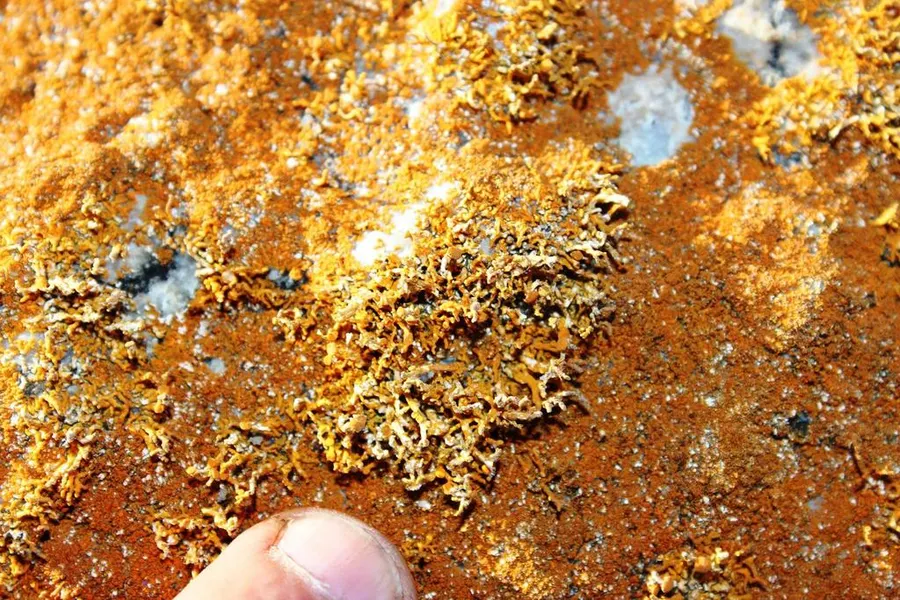
Teloschistopsis bonae-spei is a species of saxicolous (rock-dwelling), fruticose lichen in the family Teloschistaceae. It occurs in South Africa, where it grows on maritime and coastal rocks. Teloschistopsis bonae-spei predominantly grows on rocks devoid of calcite. It forms expansive colonies characterised by both flat and three-dimensional structures. The thallus (body of the lichen) displays a range of yellow to yellow-orange coloured , measuring up to 5 mm in length and between 0.3 and 1 mm in width. These lobes, found at the periphery, are tightly to loosely attached to the , have irregular branching, and may overlap each other. On older parts of these marginal lobes, numerous pseudocyphellae (tiny, porous spots that facilitate gas exchange) are present. Moving towards the centre of the thallus, the lobes can be similar in adherence to the substrate or can rise up, forming a loose, shrub-like layer that stands over the crusty base of the thallus. These ascending lobes are variably flat to significantly compressed and range from 0.5 to 3 mm in width. In mature lobes, the cortex layer, which covers the surface, may crack longitudinally creating long strips filled with pseudocyphellae, mirroring the coloration of the marginal lobes.
- Habitat atau konteks temuan
- Informasi belum tersedia pada sumber rilis ini.
- Substrat
- Informasi belum tersedia pada sumber rilis ini.
- Peran atau konteks
- Pembentuk liken
Reproduksi
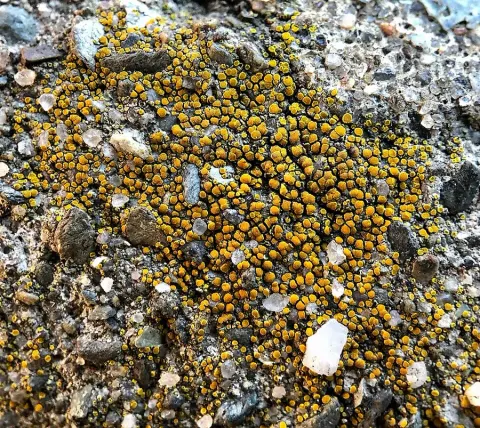
Apothecia (fruiting bodies) are distributed sporadically and can be abundant on certain lobes. They are borne on the upper side or terminally on the lobes, and have flat to slightly convex, brownish-yellow-orange . Initially, these discs are encircled by a protruding }, which soon transitions into a narrow and a more retracted, wart-divided thalline margin. The underside of these fruiting bodies is also covered with numerous pseudocyphellae. The apothecium (supporting layer of the fruiting body) mirrors the irregular structure of the thallus, lacking a distinct (outer layer of tissue around the apothecium). The hymenium (spore-producing layer) is about 70–80 μm high, with paraphyses (filamentous cells in the hymenium) that are 1.5–2 μm thick, expanding up to 5 μm at the (club-like) terminal cells.
Catatan identitas dan cakupan
- Nama diterima mengikuti Catalogue of Life Base2026-09-11; uraian mempertahankan konsep dan nama sumber aslinya.
- Original geographic, specimen and life-cycle scope retained; source import awaits individual editorial review.
- Impor dan terjemahan otomatis belum diperiksa editorial per profil. Struktur reproduktif yang disebutkan tidak membuktikan seluruh siklus hidup diketahui.
- Pengukuran pada uraian mengikuti spesimen, kultur, dan metode sumber; angka tidak diperluas ke semua populasi.
Catatan distribusi dalam narasi mengikuti sumbernya. Dokumentasi spesimen atau foto mengikuti catatan sumber. Bukti wilayah Indonesia dan penilaian konservasi tidak disimpulkan dari gambar.
Melihat dengan konteks
Dokumentasi Teloschistopsis bonae-spei menurut asosiasi foto pada record takson iNaturalist. Kredit: Tony Rebelo. Identitas mengikuti sumber; bukan penentuan spesimen independen.
- Jenis
- Fotografi
- Kredit
- (c) Tony Rebelo, some rights reserved (CC BY-SA), uploaded by Tony Rebelo
- Lisensi
- CC BY-SA 4.0
- Sumber media
- Buka entri sumber
Sumber profil
- [1] Teloschistopsis bonae-spei — Wikipedia (en)
- [2] Catalogue of Life Base2026-09-11 — Teloschistopsis bonae-spei
- [3] Dokumentasi visual — Teloschistopsis bonae-spei
Rujukan halaman ini
Fungi. Teloschistopsis bonae-spei. Rilis data fungi-2026-10-12-expansion-2. https://fungi-atlas.mgadib.chatgpt.site/jamur/teloschistopsis-bonae-spei/.
Status: impor sumber; pemeriksaan editorial per profil belum selesai. Untuk klaim biologis, gunakan rujukan pada bagian terkait dan periksa konteks sumber aslinya.