01 / Morfologi

Ciri dan struktur

Phylogenetically Trichoderma nordicum is related to T. paratroviride, but the sequence similarities of rpb2 and tef1 -α were 98.15% and 94.43%, respectively. That does not meet the sp ∃!(rpb2 99 ≅ tef1 97) standard for T. paratroviride or other known Trichoderma species. Morphologically, conidiophores of T. paratroviride consisting of a main axis and often distantly-spaced side branches, not re-branching. Conidiophores of T. nordicum are branched in a more complex manner; conidia are larger than those of T. paratroviride.

Sebagian uraian ditampilkan dalam bahasa sumber; terjemahannya belum tersedia atau belum lolos pemeriksaan.

Rujukan: [1]

Pengukuran mengikuti objek, spesimen atau kultur, dan metode yang disebutkan sumber. Baca uraian asli untuk konteks lengkap.

02 / Kehidupan

Habitat dan peran ekologis

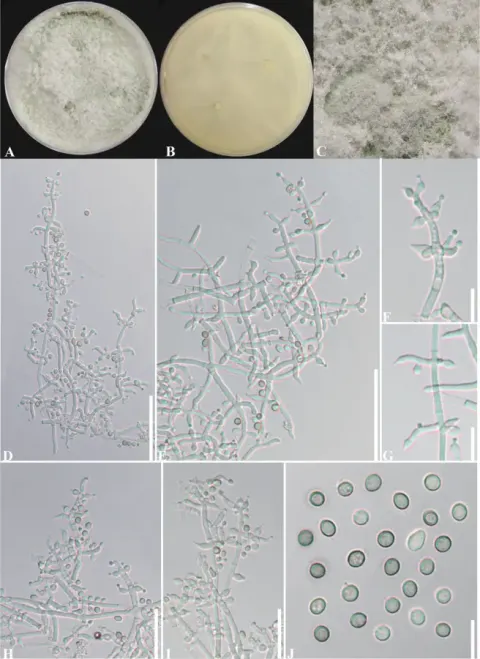
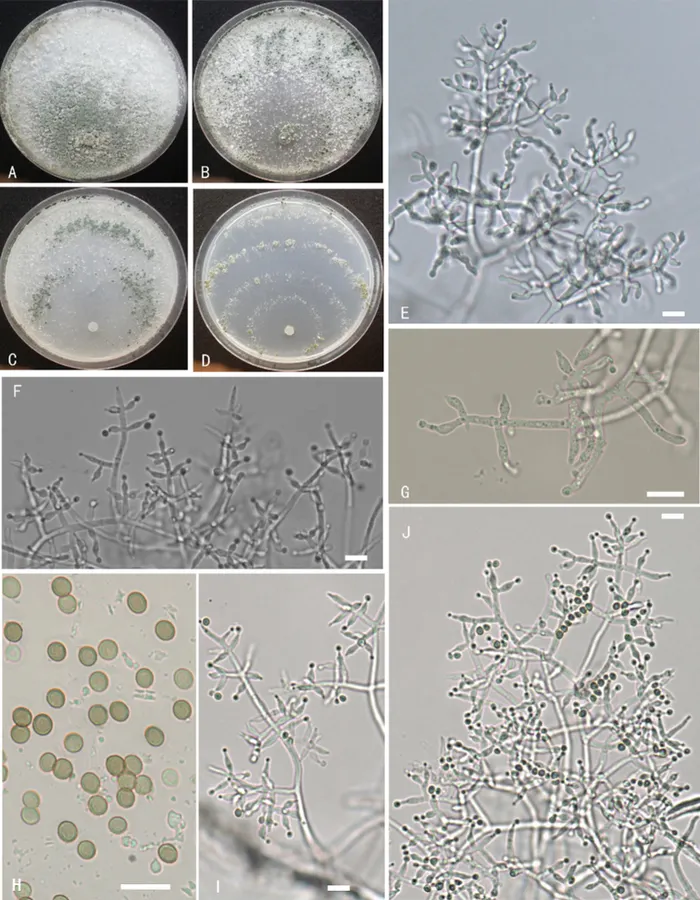
China, Beijing, Yu-yuan-tan Park, 43 m (altitude), isolated from soil, 27 October 2016, G.Z. Zhang (Holotype WT 13001), ex-type culture ACCC 39713. Unknown. Growth optimal at 25 °C, slow or limited at 30 °C, absent at 35 °C. Colonies grew fast on PDA, CMD and MEA and slow on SNA. Colony radius after 72 h at 25 °C 67–71 mm on PDA, 68–71 mm on CMD, 51–55 mm on MEA and 21–24 mm on SNA. Aerial mycelia sparse on PDA after 72 h at 25 °C under 12 h photoperiod and conidiation developed within 48 h beginning at the inoculation point and progressed around, grey-white at first and slowly turning green. Diffusing pigment or distinctive odour absent. Aerial mycelia sparse and flocculence on MEA after 72 h at 20 °C under 12 h photoperiod. Conidia developed within 48 h beginning near the colony margin on MEA, grey-white at first and slowly turning green, transparent liquid secreted. Aerial mycelia few on SNA and CMD after 72 h at 25 °C, conidia formed around the inoculation point and in distinct concentric rings after 96 h under 12 h photoperiod on SNA and CMD, diffusing pigment not produced. Conidiophores and branches narrow and flexuous, tending to be regularly verticillate forming a pyramidal structure, each branch terminating in a cruciate whorl of up to five phialides.

Sebagian uraian ditampilkan dalam bahasa sumber; terjemahannya belum tersedia atau belum lolos pemeriksaan.

Rujukan: [1]

Habitat atau konteks temuan
kultur yang didokumentasikan
Substrat
Informasi belum tersedia pada sumber rilis ini.
Peran atau konteks
Belum dikategorikan pada rilis ini.
Temukan hubungan serupa
03 / Siklus hidup

Reproduksi

Phylogenetically Trichoderma nordicum is related to T. paratroviride, but the sequence similarities of rpb2 and tef1 -α were 98.15% and 94.43%, respectively. That does not meet the sp ∃!(rpb2 99 ≅ tef1 97) standard for T. paratroviride or other known Trichoderma species. Morphologically, conidiophores of T. paratroviride consisting of a main axis and often distantly-spaced side branches, not re-branching. Conidiophores of T. nordicum are branched in a more complex manner; conidia are larger than those of T. paratroviride.

Sebagian uraian ditampilkan dalam bahasa sumber; terjemahannya belum tersedia atau belum lolos pemeriksaan.

Rujukan: [1]

04 / Batas informasi

Catatan identitas dan cakupan

  • Nama diterima mengikuti Catalogue of Life Base2026-09-11; uraian mempertahankan konsep dan nama sumber aslinya.
  • Preserve original treatment localities, hosts and substrate scope. Materials examined describe documented specimens, not the full global range.
  • Impor dan terjemahan otomatis belum diperiksa editorial per profil. Struktur reproduktif yang disebutkan tidak membuktikan seluruh siklus hidup diketahui.
  • Pengukuran pada uraian mengikuti spesimen, kultur, dan metode sumber; angka tidak diperluas ke semua populasi.

Catatan distribusi dalam narasi mengikuti sumbernya. Dokumentasi spesimen atau foto mengikuti catatan sumber. Bukti wilayah Indonesia dan penilaian konservasi tidak disimpulkan dari gambar.

05 / Dokumentasi

Melihat dengan konteks

Trichoderma nordicum A–D cultures on different media at 25 °C after 10 days (A on PDA B on MEA C on CMD D on SNA) E–G, I, J conidiophores and phialides H conidia. Notes: E on PDA F–J on MEA A–D from WT13001 E–J from WT61001. Scale bars: 10 μm (E–J).

Jenis
Pelat ilmiah
Kredit
Guang-Zhi Zhang, He-Tong Yang, Xin-Jian Zhang, Fang-Yuan Zhou, Xiao-Qing Wu, Xue-Ying Xie, Xiao-Yan Zhao, Hong-Zi Zhou
Lisensi
CC BY 4.0
Sumber media
Buka entri sumber

Gambar menunjukkan objek menurut identifikasi sumber, bukan verifikasi independen spesimen oleh Fungi. Tidak ada skala baru yang ditambahkan.

06 / Rujukan

Sumber profil

  1. [1] Five new species of Trichoderma from moist soils in China — Trichoderma nordicumBagian sumber: PMC8873192_section_25
    Tanggal penghimpunan sumber: 2026-10-12
    Teks sumber: CC BY 4.0 · Zhang GZ, Yang HT, Zhang XJ, Zhou FY, Wu XQ, Xie XY, Zhao XY, Zhou HZ.
  2. [2] Catalogue of Life Base2026-09-11 — Trichoderma nordicumBagian sumber: ColDP NameUsage.tsv ID B2MJM; accepted species; source 2073
    Tanggal penghimpunan sumber: 2026-10-12
  3. [3] Dokumentasi visual — Trichoderma nordicumBagian sumber: Individual media record; identification follows the source, not independent determination
    Tanggal penghimpunan sumber: 2026-10-12
    Media sumber: CC BY 4.0 · Guang-Zhi Zhang, He-Tong Yang, Xin-Jian Zhang, Fang-Yuan Zhou, Xiao-Qing Wu, Xue-Ying Xie, Xiao-Yan Zhao, Hong-Zi Zhou

Adaptasi teks: CC BY 4.0. Zhang GZ, Yang HT, Zhang XJ, Zhou FY, Wu XQ, Xie XY, Zhao XY, Zhou HZ. — Five new species of Trichoderma from moist soils in China — Trichoderma nordicum

Uraian asli dan riwayat sumber

Riwayat atau halaman sumber

Ringkasan sumber

Phylogenetically Trichoderma nordicum is related to T. paratroviride, but the sequence similarities of rpb2 and tef1 -α were 98.15% and 94.43%, respectively. That does not meet the sp ∃!(rpb2 99 ≅ tef1 97) standard for T. paratroviride or other known Trichoderma species. Morphologically, conidiophores of T. paratroviride consisting of a main axis and often distantly-spaced side branches, not re-branching. Conidiophores of T. nordicum are branched in a more complex manner; conidia are larger than those of T. paratroviride.

Revisi sumber

Morfologi sumber

Phylogenetically Trichoderma nordicum is related to T. paratroviride, but the sequence similarities of rpb2 and tef1 -α were 98.15% and 94.43%, respectively. That does not meet the sp ∃!(rpb2 99 ≅ tef1 97) standard for T. paratroviride or other known Trichoderma species. Morphologically, conidiophores of T. paratroviride consisting of a main axis and often distantly-spaced side branches, not re-branching. Conidiophores of T. nordicum are branched in a more complex manner; conidia are larger than those of T. paratroviride.

Revisi sumber

Ekologi sumber

China, Beijing, Yu-yuan-tan Park, 43 m (altitude), isolated from soil, 27 October 2016, G.Z. Zhang (Holotype WT 13001), ex-type culture ACCC 39713. Unknown. Growth optimal at 25 °C, slow or limited at 30 °C, absent at 35 °C. Colonies grew fast on PDA, CMD and MEA and slow on SNA. Colony radius after 72 h at 25 °C 67–71 mm on PDA, 68–71 mm on CMD, 51–55 mm on MEA and 21–24 mm on SNA. Aerial mycelia sparse on PDA after 72 h at 25 °C under 12 h photoperiod and conidiation developed within 48 h beginning at the inoculation point and progressed around, grey-white at first and slowly turning green. Diffusing pigment or distinctive odour absent. Aerial mycelia sparse and flocculence on MEA after 72 h at 20 °C under 12 h photoperiod. Conidia developed within 48 h beginning near the colony margin on MEA, grey-white at first and slowly turning green, transparent liquid secreted. Aerial mycelia few on SNA and CMD after 72 h at 25 °C, conidia formed around the inoculation point and in distinct concentric rings after 96 h under 12 h photoperiod on SNA and CMD, diffusing pigment not produced. Conidiophores and branches narrow and flexuous, tending to be regularly verticillate forming a pyramidal structure, each branch terminating in a cruciate whorl of up to five phialides.

Revisi sumber

Struktur reproduksi sumber

Phylogenetically Trichoderma nordicum is related to T. paratroviride, but the sequence similarities of rpb2 and tef1 -α were 98.15% and 94.43%, respectively. That does not meet the sp ∃!(rpb2 99 ≅ tef1 97) standard for T. paratroviride or other known Trichoderma species. Morphologically, conidiophores of T. paratroviride consisting of a main axis and often distantly-spaced side branches, not re-branching. Conidiophores of T. nordicum are branched in a more complex manner; conidia are larger than those of T. paratroviride.

Revisi sumber

Rujukan halaman ini

Fungi. Trichoderma nordicum. Rilis data fungi-2026-10-12-expansion-2. https://fungi-atlas.mgadib.chatgpt.site/jamur/trichoderma-nordicum/.

Status: impor sumber; pemeriksaan editorial per profil belum selesai. Untuk klaim biologis, gunakan rujukan pada bagian terkait dan periksa konteks sumber aslinya.