01 / Morfologi

Ciri dan struktur

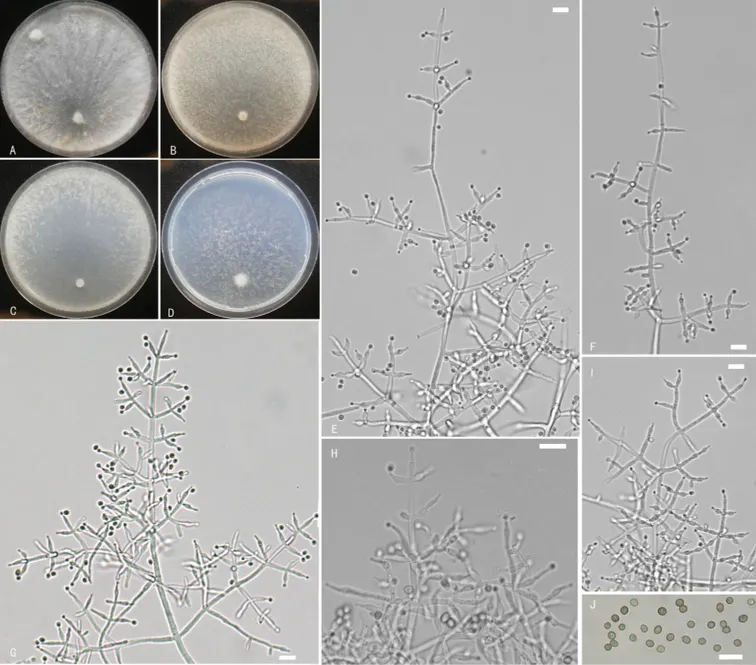
Phylogenetically, Trichoderma vadicola is related to T. caerulescens in the Viride clade (Fig. 1), but the sequence similarity of tef1 -α and rpb2 between these species was all 95%. Morphologically, colonies of T. vadicola and T. caerulescens on PDA have similar features, such as abundant aerial hyphae, forming strands and a whitish hairy or floccose mat. However, the former Trichoderma vadicola formed no or relatively few conidia and the latter forming greyish-bluish patches around the plug. On CMD, T. caerulescens peculiar greyish-blue pigment formed after 1–2 months and conidiophores simply or slightly branched; the former had no observed diffusing pigment and conidiophores branched in a complex manner in pyramidal structure or tree-like.

Sebagian uraian ditampilkan dalam bahasa sumber; terjemahannya belum tersedia atau belum lolos pemeriksaan.

Rujukan: [1]

Pengukuran mengikuti objek, spesimen atau kultur, dan metode yang disebutkan sumber. Baca uraian asli untuk konteks lengkap.

02 / Kehidupan

Habitat dan peran ekologis

China. Shandong, 2 m (altitude), isolated from soil, 13 August 2016, G.Z. Zhang (Holotype WT 10708), Ex-type culture ACCC 39716. Phylogenetically, Trichoderma vadicola is related to T. caerulescens in the Viride clade (Fig. 1), but the sequence similarity of tef1 -α and rpb2 between these species was all 95%. Morphologically, colonies of T. vadicola and T. caerulescens on PDA have similar features, such as abundant aerial hyphae, forming strands and a whitish hairy or floccose mat. However, the former Trichoderma vadicola formed no or relatively few conidia and the latter forming greyish-bluish patches around the plug. On CMD, T. caerulescens peculiar greyish-blue pigment formed after 1–2 months and conidiophores simply or slightly branched; the former had no observed diffusing pigment and conidiophores branched in a complex manner in pyramidal structure or tree-like. Unknown. Growth optimal at 25 °C, no grow at 35 °C on all media. Colony radius after 72 h at 25 °C 25–29 mm on PDA, 24–27 mm on CMD, 23–26 mm on MEA and 22–26 mm on SNA. Aerial mycelia abundant on PDA after 72 h at 25 °C under 12 h photoperiod, forming strands and floccose mat. Conidiation not formed or relatively few.

Sebagian uraian ditampilkan dalam bahasa sumber; terjemahannya belum tersedia atau belum lolos pemeriksaan.

Rujukan: [1]

Habitat atau konteks temuan
kultur yang didokumentasikan
Substrat
Informasi belum tersedia pada sumber rilis ini.
Peran atau konteks
Belum dikategorikan pada rilis ini.
Temukan hubungan serupa
03 / Siklus hidup

Reproduksi

Phylogenetically, Trichoderma vadicola is related to T. caerulescens in the Viride clade (Fig. 1), but the sequence similarity of tef1 -α and rpb2 between these species was all 95%. Morphologically, colonies of T. vadicola and T. caerulescens on PDA have similar features, such as abundant aerial hyphae, forming strands and a whitish hairy or floccose mat. However, the former Trichoderma vadicola formed no or relatively few conidia and the latter forming greyish-bluish patches around the plug. On CMD, T. caerulescens peculiar greyish-blue pigment formed after 1–2 months and conidiophores simply or slightly branched; the former had no observed diffusing pigment and conidiophores branched in a complex manner in pyramidal structure or tree-like.

Sebagian uraian ditampilkan dalam bahasa sumber; terjemahannya belum tersedia atau belum lolos pemeriksaan.

Rujukan: [1]

04 / Batas informasi

Catatan identitas dan cakupan

  • Nama diterima mengikuti Catalogue of Life Base2026-09-11; uraian mempertahankan konsep dan nama sumber aslinya.
  • Preserve original treatment localities, hosts and substrate scope. Materials examined describe documented specimens, not the full global range.
  • Impor dan terjemahan otomatis belum diperiksa editorial per profil. Struktur reproduktif yang disebutkan tidak membuktikan seluruh siklus hidup diketahui.
  • Pengukuran pada uraian mengikuti spesimen, kultur, dan metode sumber; angka tidak diperluas ke semua populasi.

Catatan distribusi dalam narasi mengikuti sumbernya. Dokumentasi spesimen atau foto mengikuti catatan sumber. Bukti wilayah Indonesia dan penilaian konservasi tidak disimpulkan dari gambar.

05 / Dokumentasi

Melihat dengan konteks

Trichoderma vadicola A–D cultures on different media at 25 °C (A on PDA after10 days B on MEA, after 7 days C on CMD after 7 days D on SNA after 7 days) E–I conidiophores and phialides J conidia. Notes: E, F, H–J on MEA G on SNA A–J from WT10708. Scale bars: 10 μm (E–J).

Jenis
Pelat ilmiah
Kredit
Guang-Zhi Zhang, He-Tong Yang, Xin-Jian Zhang, Fang-Yuan Zhou, Xiao-Qing Wu, Xue-Ying Xie, Xiao-Yan Zhao, Hong-Zi Zhou
Lisensi
CC BY 4.0
Sumber media
Buka entri sumber

Gambar menunjukkan objek menurut identifikasi sumber, bukan verifikasi independen spesimen oleh Fungi. Tidak ada skala baru yang ditambahkan.

06 / Rujukan

Sumber profil

  1. [1] Five new species of Trichoderma from moist soils in China — Trichoderma vadicolaBagian sumber: PMC8873192_section_41
    Tanggal penghimpunan sumber: 2026-10-12
    Teks sumber: CC BY 4.0 · Zhang GZ, Yang HT, Zhang XJ, Zhou FY, Wu XQ, Xie XY, Zhao XY, Zhou HZ.
  2. [2] Catalogue of Life Base2026-09-11 — Trichoderma vadicolaBagian sumber: ColDP NameUsage.tsv ID B2MJR; accepted species; source 2073
    Tanggal penghimpunan sumber: 2026-10-12
  3. [3] Dokumentasi visual — Trichoderma vadicolaBagian sumber: Individual media record; identification follows the source, not independent determination
    Tanggal penghimpunan sumber: 2026-10-12
    Media sumber: CC BY 4.0 · Guang-Zhi Zhang, He-Tong Yang, Xin-Jian Zhang, Fang-Yuan Zhou, Xiao-Qing Wu, Xue-Ying Xie, Xiao-Yan Zhao, Hong-Zi Zhou

Adaptasi teks: CC BY 4.0. Zhang GZ, Yang HT, Zhang XJ, Zhou FY, Wu XQ, Xie XY, Zhao XY, Zhou HZ. — Five new species of Trichoderma from moist soils in China — Trichoderma vadicola

Uraian asli dan riwayat sumber

Riwayat atau halaman sumber

Ringkasan sumber

Phylogenetically, Trichoderma vadicola is related to T. caerulescens in the Viride clade (Fig. 1), but the sequence similarity of tef1 -α and rpb2 between these species was all 95%. Morphologically, colonies of T. vadicola and T. caerulescens on PDA have similar features, such as abundant aerial hyphae, forming strands and a whitish hairy or floccose mat. However, the former Trichoderma vadicola formed no or relatively few conidia and the latter forming greyish-bluish patches around the plug. On CMD, T. caerulescens peculiar greyish-blue pigment formed after 1–2 months and conidiophores simply or slightly branched; the former had no observed diffusing pigment and conidiophores branched in a complex manner in pyramidal structure or tree-like.

Revisi sumber

Morfologi sumber

Phylogenetically, Trichoderma vadicola is related to T. caerulescens in the Viride clade (Fig. 1), but the sequence similarity of tef1 -α and rpb2 between these species was all 95%. Morphologically, colonies of T. vadicola and T. caerulescens on PDA have similar features, such as abundant aerial hyphae, forming strands and a whitish hairy or floccose mat. However, the former Trichoderma vadicola formed no or relatively few conidia and the latter forming greyish-bluish patches around the plug. On CMD, T. caerulescens peculiar greyish-blue pigment formed after 1–2 months and conidiophores simply or slightly branched; the former had no observed diffusing pigment and conidiophores branched in a complex manner in pyramidal structure or tree-like.

Revisi sumber

Ekologi sumber

China. Shandong, 2 m (altitude), isolated from soil, 13 August 2016, G.Z. Zhang (Holotype WT 10708), Ex-type culture ACCC 39716. Phylogenetically, Trichoderma vadicola is related to T. caerulescens in the Viride clade (Fig. 1), but the sequence similarity of tef1 -α and rpb2 between these species was all 95%. Morphologically, colonies of T. vadicola and T. caerulescens on PDA have similar features, such as abundant aerial hyphae, forming strands and a whitish hairy or floccose mat. However, the former Trichoderma vadicola formed no or relatively few conidia and the latter forming greyish-bluish patches around the plug. On CMD, T. caerulescens peculiar greyish-blue pigment formed after 1–2 months and conidiophores simply or slightly branched; the former had no observed diffusing pigment and conidiophores branched in a complex manner in pyramidal structure or tree-like. Unknown. Growth optimal at 25 °C, no grow at 35 °C on all media. Colony radius after 72 h at 25 °C 25–29 mm on PDA, 24–27 mm on CMD, 23–26 mm on MEA and 22–26 mm on SNA. Aerial mycelia abundant on PDA after 72 h at 25 °C under 12 h photoperiod, forming strands and floccose mat. Conidiation not formed or relatively few.

Revisi sumber

Struktur reproduksi sumber

Phylogenetically, Trichoderma vadicola is related to T. caerulescens in the Viride clade (Fig. 1), but the sequence similarity of tef1 -α and rpb2 between these species was all 95%. Morphologically, colonies of T. vadicola and T. caerulescens on PDA have similar features, such as abundant aerial hyphae, forming strands and a whitish hairy or floccose mat. However, the former Trichoderma vadicola formed no or relatively few conidia and the latter forming greyish-bluish patches around the plug. On CMD, T. caerulescens peculiar greyish-blue pigment formed after 1–2 months and conidiophores simply or slightly branched; the former had no observed diffusing pigment and conidiophores branched in a complex manner in pyramidal structure or tree-like.

Revisi sumber

Rujukan halaman ini

Fungi. Trichoderma vadicola. Rilis data fungi-2026-10-12-expansion-2. https://fungi-atlas.mgadib.chatgpt.site/jamur/trichoderma-vadicola/.

Status: impor sumber; pemeriksaan editorial per profil belum selesai. Untuk klaim biologis, gunakan rujukan pada bagian terkait dan periksa konteks sumber aslinya.