01 / Morfologi

Ciri dan struktur

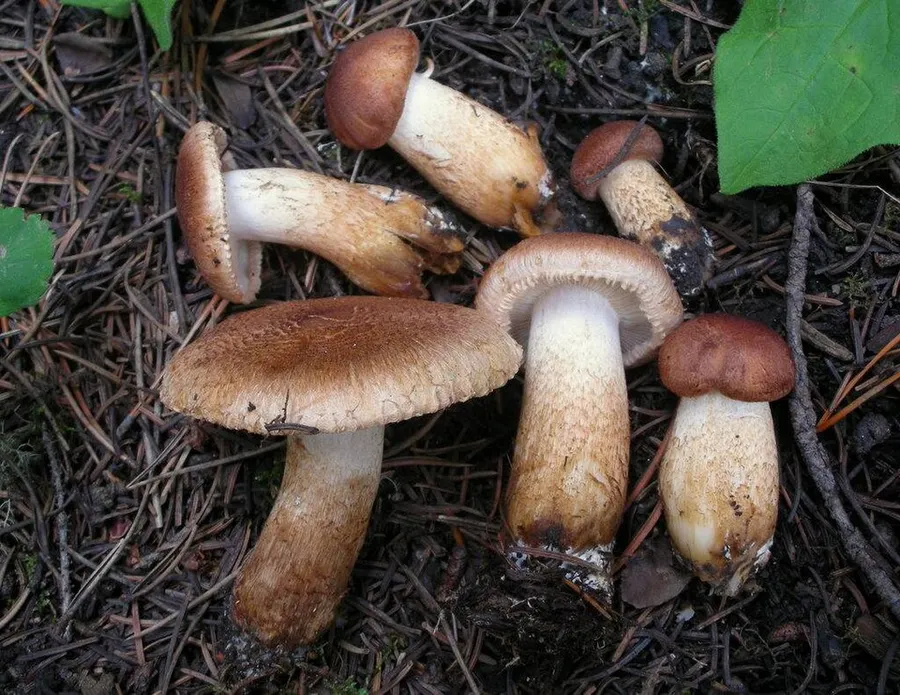
The cap of T. vaccinum is initially broadly conical, then convex and finally flattened; its diameter is usually between 2.5 and 8 cm. The cap margin is initially curved inwards, and shaggy from hanging remnants of the partial veil. The partial veil is cotton-like, and does not leave a ring on the stipe. The fibrous to scaly cap surface ranges in color from reddish-cinnamon to brownish-orange to tan. The gills have an adnate to sinuate attachment to the stipe, and are crowded closely together. There are between three and nine tiers of lamellulae—short gills that do not extend completely from the cap edge to the stipe. The gills are dingy white, and frequently stain reddish brown. The stipe is 3 to 8 cm long and 1 to 2 cm thick, and becomes hollow in age. It is roughly equal in width throughout its length and ranges in color from whitish to the same color as the cap, but lighter, and sometimes with reddish-brown stains; it is lighter in color near the apex. Like the cap, the stipe surface is fibrous to scaly. The odor of the fruit bodies is unpleasant. The mushrooms produce a white spore print, and the spores are broadly elliptical, smooth, hyaline (translucent), inamyloid, measuring 6–7.5 by 4–5 μm. The basidia (spore-bearing cells) are four-spored, without clamps, and measure 17–32 by 6.0–7.5 μm. The hymenium lacks cystidia. The arrangement of the hyphae in the cap cuticle ranges from a cutis (with hyphae that run parallel to the cap surface) to a trichoderm (hyphae perpendicular to the cap surface); these hyphae are roughly cylindrical, and measure 3.5–8.0 μm wide, with roughly cylindrical to club-shaped ends that are 6.0–11.0 μm wide.

Sebagian uraian ditampilkan dalam bahasa sumber; terjemahannya belum tersedia atau belum lolos pemeriksaan.

Rujukan: [1]

Pengukuran mengikuti objek, spesimen atau kultur, dan metode yang disebutkan sumber. Baca uraian asli untuk konteks lengkap.

02 / Kehidupan

Habitat dan peran ekologis

Tricholoma vaccinum is a mycorrhizal species, and grows in association with coniferous trees, especially pine and spruce. It forms ectomycorrhizae that have been called "Medium-Distance fringe exploration type", indicative of the ectomycorrhiza's ecological role in space occupation in the soil, their possible reach regarding nutrient acquisition and their demand of carbohydrates that have to be invested by the trees for their fungal partners. Fruit bodies usually appear in groups or clusters on the ground, sometimes with moss. The fungus fruits in late summer and autumn. It is found in northern Asia, Europe, and, in North America, is widely distributed in the United States and Canada, and has also been recorded in Mexico. It is one of the most common species of Tricholoma in Central Europe, and is often found in large groups in spruce forests. It is rare in the United Kingdom, and most records have been from Scotland. The fungus may be extinct in the Netherlands. The ectomycorrhizae of T. vaccinum has been the subject of considerable research. Ectomycorrhizae of Tricholoma species can vary considerably among species in the genus, and differences in the structure of rhizomorphs (a cordlike fusions of hyphae resembling a root) have been used to key out species.

Sebagian uraian ditampilkan dalam bahasa sumber; terjemahannya belum tersedia atau belum lolos pemeriksaan.

Rujukan: [1]

Habitat atau konteks temuan
hutan
Substrat
tanah
Peran atau konteks
Mitra tumbuhan
Temukan hubungan serupa
03 / Siklus hidup

Reproduksi

The mushrooms produce a white spore print, and the spores are broadly elliptical, smooth, hyaline (translucent), inamyloid, measuring 6–7.5 by 4–5 μm. The basidia (spore-bearing cells) are four-spored, without clamps, and measure 17–32 by 6.0–7.5 μm. The hymenium lacks cystidia. The arrangement of the hyphae in the cap cuticle ranges from a cutis (with hyphae that run parallel to the cap surface) to a trichoderm (hyphae perpendicular to the cap surface); these hyphae are roughly cylindrical, and measure 3.5–8.0 μm wide, with roughly cylindrical to club-shaped ends that are 6.0–11.0 μm wide. There are no clamp connections in the hyphae of T. vaccinum.

Sebagian uraian ditampilkan dalam bahasa sumber; terjemahannya belum tersedia atau belum lolos pemeriksaan.

Rujukan: [1]

Sinonim menurut acuan taksonomi rilis: Agaricus polyphyllus; Agaricus rufolivescens; Agaricus vaccinus; Amanita punctata var. vaccina; Cortinellus vaccinus; Gyrophila vaccina; Gyrophila vaccina var. polyphylla; Tricholoma polyphyllum; Tricholoma vaccinum var. fulvosquamosum
04 / Batas informasi

Catatan identitas dan cakupan

  • Nama diterima mengikuti Catalogue of Life Base2026-09-11; uraian mempertahankan konsep dan nama sumber aslinya.
  • Original geographic, specimen and life-cycle scope retained; source import awaits individual editorial review.
  • Impor dan terjemahan otomatis belum diperiksa editorial per profil. Struktur reproduktif yang disebutkan tidak membuktikan seluruh siklus hidup diketahui.
  • Pengukuran pada uraian mengikuti spesimen, kultur, dan metode sumber; angka tidak diperluas ke semua populasi.

Catatan distribusi dalam narasi mengikuti sumbernya. Dokumentasi spesimen atau foto mengikuti catatan sumber. Bukti wilayah Indonesia dan penilaian konservasi tidak disimpulkan dari gambar.

05 / Dokumentasi

Melihat dengan konteks

Dokumentasi Tricholoma vaccinum dari Wikimedia Commons. Fruit bodies of the agaric fungus Trichloma vaccinum (Schaeff.) P.Kumm. Specimens found in Fraser Experimental Forest, Grand Co., Colorado, USA. "Notes: Identified at the NAMA 50th Anniversary Foray in Colorado." Identifikasi mengikuti record berkas sumber.

Jenis
Fotografi
Kredit
Ron Pastorino (Ronpast)
Sumber media
Buka entri sumber

Gambar menunjukkan objek menurut identifikasi sumber, bukan verifikasi independen spesimen oleh Fungi. Tidak ada skala baru yang ditambahkan.

06 / Rujukan

Sumber profil

  1. [1] Tricholoma vaccinum — Wikipedia (en)Bagian sumber: Frozen revision 1339828256
    Tanggal penghimpunan sumber: 2026-10-12
    Teks sumber: CC BY-SA4.0 · Wikipedia contributors
  2. [2] Catalogue of Life Base2026-09-11 — Tricholoma vaccinumBagian sumber: ColDP NameUsage.tsv ID 7CRHB; accepted species; source 2073
    Tanggal penghimpunan sumber: 2026-10-12
  3. [3] Dokumentasi visual — Tricholoma vaccinumBagian sumber: Individual media record; identification follows the source, not independent determination
    Tanggal penghimpunan sumber: 2026-10-12
    Media sumber: CC BY-SA 3.0 · Ron Pastorino (Ronpast)

Adaptasi teks: CC BY-SA 4.0. Wikipedia contributors — Tricholoma vaccinum — Wikipedia (en)

Uraian asli dan riwayat sumber

Riwayat atau halaman sumber

Ringkasan sumber

Tricholoma vaccinum, commonly known as the russet scaly tricholoma, the scaly knight, or the fuzztop, is a fungus of the agaric genus Tricholoma. It produces medium-sized fruit bodies (mushrooms) that have a distinctive hairy reddish-brown cap with a shaggy margin when young. The cap, which can reach a diameter of up to 6.5 cm wide, breaks up into flattened scales in maturity. It has cream-buff to pinkish gills with brown spots. Its fibrous, hollow stipe is white above and reddish brown below, and measures 4 to 7.5 cm long.

Revisi sumber

Morfologi sumber

The cap of T. vaccinum is initially broadly conical, then convex and finally flattened; its diameter is usually between 2.5 and 8 cm. The cap margin is initially curved inwards, and shaggy from hanging remnants of the partial veil. The partial veil is cotton-like, and does not leave a ring on the stipe. The fibrous to scaly cap surface ranges in color from reddish-cinnamon to brownish-orange to tan. The gills have an adnate to sinuate attachment to the stipe, and are crowded closely together. There are between three and nine tiers of lamellulae—short gills that do not extend completely from the cap edge to the stipe. The gills are dingy white, and frequently stain reddish brown. The stipe is 3 to 8 cm long and 1 to 2 cm thick, and becomes hollow in age. It is roughly equal in width throughout its length and ranges in color from whitish to the same color as the cap, but lighter, and sometimes with reddish-brown stains; it is lighter in color near the apex. Like the cap, the stipe surface is fibrous to scaly. The odor of the fruit bodies is unpleasant. The mushrooms produce a white spore print, and the spores are broadly elliptical, smooth, hyaline (translucent), inamyloid, measuring 6–7.5 by 4–5 μm. The basidia (spore-bearing cells) are four-spored, without clamps, and measure 17–32 by 6.0–7.5 μm. The hymenium lacks cystidia. The arrangement of the hyphae in the cap cuticle ranges from a cutis (with hyphae that run parallel to the cap surface) to a trichoderm (hyphae perpendicular to the cap surface); these hyphae are roughly cylindrical, and measure 3.5–8.0 μm wide, with roughly cylindrical to club-shaped ends that are 6.0–11.0 μm wide.

Revisi sumber

Ekologi sumber

Tricholoma vaccinum is a mycorrhizal species, and grows in association with coniferous trees, especially pine and spruce. It forms ectomycorrhizae that have been called "Medium-Distance fringe exploration type", indicative of the ectomycorrhiza's ecological role in space occupation in the soil, their possible reach regarding nutrient acquisition and their demand of carbohydrates that have to be invested by the trees for their fungal partners. Fruit bodies usually appear in groups or clusters on the ground, sometimes with moss. The fungus fruits in late summer and autumn. It is found in northern Asia, Europe, and, in North America, is widely distributed in the United States and Canada, and has also been recorded in Mexico. It is one of the most common species of Tricholoma in Central Europe, and is often found in large groups in spruce forests. It is rare in the United Kingdom, and most records have been from Scotland. The fungus may be extinct in the Netherlands. The ectomycorrhizae of T. vaccinum has been the subject of considerable research. Ectomycorrhizae of Tricholoma species can vary considerably among species in the genus, and differences in the structure of rhizomorphs (a cordlike fusions of hyphae resembling a root) have been used to key out species.

Revisi sumber

Struktur reproduksi sumber

The mushrooms produce a white spore print, and the spores are broadly elliptical, smooth, hyaline (translucent), inamyloid, measuring 6–7.5 by 4–5 μm. The basidia (spore-bearing cells) are four-spored, without clamps, and measure 17–32 by 6.0–7.5 μm. The hymenium lacks cystidia. The arrangement of the hyphae in the cap cuticle ranges from a cutis (with hyphae that run parallel to the cap surface) to a trichoderm (hyphae perpendicular to the cap surface); these hyphae are roughly cylindrical, and measure 3.5–8.0 μm wide, with roughly cylindrical to club-shaped ends that are 6.0–11.0 μm wide. There are no clamp connections in the hyphae of T. vaccinum.

Revisi sumber

Rujukan halaman ini

Fungi. Tricholoma vaccinum. Rilis data fungi-2026-10-12-expansion-2. https://fungi-atlas.mgadib.chatgpt.site/jamur/tricholoma-vaccinum/.

Status: impor sumber; pemeriksaan editorial per profil belum selesai. Untuk klaim biologis, gunakan rujukan pada bagian terkait dan periksa konteks sumber aslinya.