01 / Morfologi

Ciri dan struktur

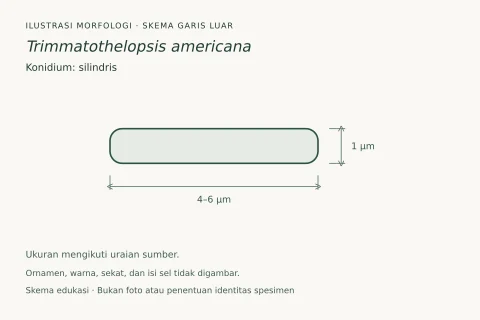
The thallus consists of scattered to locally merging (small surface patches) that arise directly from the rock and may form patches up to about 5 cm across. Individual areoles are broadly attached, round to irregular, typically about 0.5–1.0 mm wide and usually less than about 0.4 mm tall. The upper surface is waxy white and glossy, turning green when wet. Young areoles often show a small red dot at the center, interpreted as either a pycnidium (an asexual structure) or a developing apothecium beneath the surface. Apothecia usually develop one per areole. They form beneath the surface and later break through, so the first appears as a tiny point-like () red-brown spot and later expands to a small concave disc (to about 0.4 mm across). Under the microscope, the hymenium (spore-bearing layer) is tall (reported around 170–200 μm, with higher values noted as possible), and the paraphyses (sterile filaments among the asci) are narrow (about 1 μm wide). Asci contain many spores (often more than 100), and the ascospores are hyaline (colorless) and mostly globose, typically about 7–10(–12) μm in diameter (or broadly ellipsoid, about 7–9 × 5–7 μm). Pycnidia are rare. The conidia (asexual spores) are rod-shaped and were reported as about 5–6 × 1–1.3 μm in the original description, while a later summary gave conidia as 4–5 × 1–1.5 μm. No secondary metabolites were detected; standard spot tests were negative (K−, C−, KC−, P−, UV−).

Sebagian uraian ditampilkan dalam bahasa sumber; terjemahannya belum tersedia atau belum lolos pemeriksaan.

Rujukan: [1]

Pengukuran mengikuti objek, spesimen atau kultur, dan metode yang disebutkan sumber. Baca uraian asli untuk konteks lengkap.

02 / Kehidupan

Habitat dan peran ekologis

Trimmatothelopsis sphaerosperma is a calciphile (calcium-loving), occurring on calcium-rich rocks. In North America it is known from the Ozarks (including Arkansas and multiple sites in Missouri), with an additional record from Ohio; recorded substrates include dolomite, limestone, chert, and calcareous rubble or pebbles in alkaline settings. A 2021 treatment expanded the documented range to Europe (Czech Republic) and summarized the substrate range more broadly as dolomite, limestone, marlite, chert, speculite, and opoka (a calcareous sedimentary sandstone).

Sebagian uraian ditampilkan dalam bahasa sumber; terjemahannya belum tersedia atau belum lolos pemeriksaan.

Rujukan: [1]

Habitat atau konteks temuan
Informasi belum tersedia pada sumber rilis ini.
Substrat
Informasi belum tersedia pada sumber rilis ini.
Peran atau konteks
Pembentuk liken
Temukan hubungan serupa
03 / Siklus hidup

Reproduksi

The thallus consists of scattered to locally merging (small surface patches) that arise directly from the rock and may form patches up to about 5 cm across. Individual areoles are broadly attached, round to irregular, typically about 0.5–1.0 mm wide and usually less than about 0.4 mm tall. The upper surface is waxy white and glossy, turning green when wet. Young areoles often show a small red dot at the center, interpreted as either a pycnidium (an asexual structure) or a developing apothecium beneath the surface. Apothecia usually develop one per areole. They form beneath the surface and later break through, so the first appears as a tiny point-like () red-brown spot and later expands to a small concave disc (to about 0.4 mm across).

Sebagian uraian ditampilkan dalam bahasa sumber; terjemahannya belum tersedia atau belum lolos pemeriksaan.

Rujukan: [1]

Sinonim menurut acuan taksonomi rilis: Acarospora sphaerosperma
04 / Batas informasi

Catatan identitas dan cakupan

  • Nama diterima mengikuti Catalogue of Life Base2026-09-11; uraian mempertahankan konsep dan nama sumber aslinya.
  • Original geographic, specimen and life-cycle scope retained; source import awaits individual editorial review.
  • Impor dan terjemahan otomatis belum diperiksa editorial per profil. Struktur reproduktif yang disebutkan tidak membuktikan seluruh siklus hidup diketahui.
  • Pengukuran pada uraian mengikuti spesimen, kultur, dan metode sumber; angka tidak diperluas ke semua populasi.

Catatan distribusi dalam narasi mengikuti sumbernya. Dokumentasi spesimen atau foto mengikuti catatan sumber. Bukti wilayah Indonesia dan penilaian konservasi tidak disimpulkan dari gambar.

05 / Dokumentasi

Melihat dengan konteks

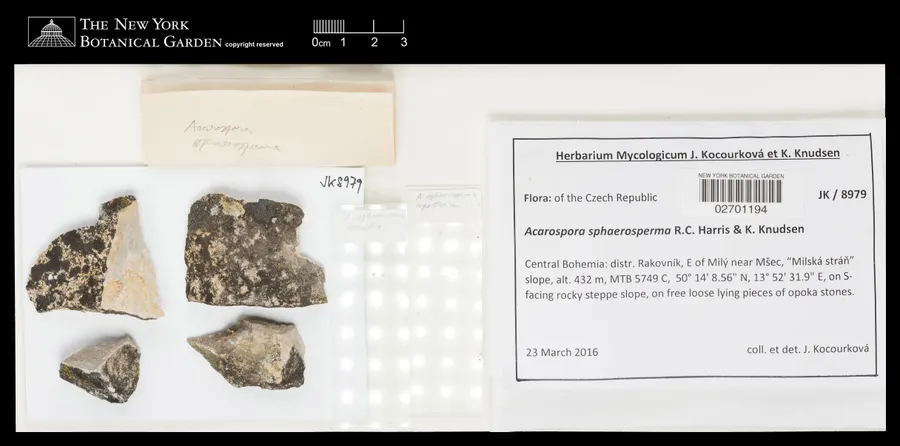
Voucher herbarium Acarospora sphaerosperma (2701194), The New York Botanical Garden. Identifikasi mengikuti record spesimen sumber. Foto bahan, kemasan, atau label herbarium sebagaimana tersedia pada record institusi; bukan foto lapangan atau penentuan spesimen independen.

Jenis
Voucher herbarium
Kredit
The New York Botanical Garden
Lisensi
CC BY 4.0
Sumber media
Buka entri sumber

Gambar menunjukkan objek menurut identifikasi sumber, bukan verifikasi independen spesimen oleh Fungi. Tidak ada skala baru yang ditambahkan.

06 / Rujukan

Sumber profil

  1. [1] Trimmatothelopsis sphaerosperma — Wikipedia (en)Bagian sumber: Frozen revision 1341959498
    Tanggal penghimpunan sumber: 2026-10-12
    Teks sumber: CC BY-SA4.0 · Wikipedia contributors
  2. [2] Catalogue of Life Base2026-09-11 — Trimmatothelopsis sphaerospermaBagian sumber: ColDP NameUsage.tsv ID B32K5; accepted species; source 2073
    Tanggal penghimpunan sumber: 2026-10-12
  3. [3] Dokumentasi visual — Acarospora sphaerospermaBagian sumber: Individual media record; identification follows the source, not independent determination
    Tanggal penghimpunan sumber: 2026-10-12
    Media sumber: CC BY 4.0 · The New York Botanical Garden

Adaptasi teks: CC BY-SA 4.0. Wikipedia contributors — Trimmatothelopsis sphaerosperma — Wikipedia (en)

Uraian asli dan riwayat sumber

Riwayat atau halaman sumber

Ringkasan sumber

Trimmatothelopsis sphaerosperma is a species of crustose lichen in the family Acarosporaceae. Originally described in 2011 as Acarospora sphaerosperma from dolomite in Arkansas, it was transferred to the genus Trimmatothelopsis in 2021 based on morphological and anatomical features, because DNA sequencing attempts were unsuccessful in that treatment. The species forms scattered waxy white (small surface patches) with small red-brown apothecial and is distinguished by its tall hymenium (spore-bearing layer); asci that contain more than 100 mostly spherical ascospores; and long, rod-shaped conidia (asexual spores).

Revisi sumber

Morfologi sumber

The thallus consists of scattered to locally merging (small surface patches) that arise directly from the rock and may form patches up to about 5 cm across. Individual areoles are broadly attached, round to irregular, typically about 0.5–1.0 mm wide and usually less than about 0.4 mm tall. The upper surface is waxy white and glossy, turning green when wet. Young areoles often show a small red dot at the center, interpreted as either a pycnidium (an asexual structure) or a developing apothecium beneath the surface. Apothecia usually develop one per areole. They form beneath the surface and later break through, so the first appears as a tiny point-like () red-brown spot and later expands to a small concave disc (to about 0.4 mm across). Under the microscope, the hymenium (spore-bearing layer) is tall (reported around 170–200 μm, with higher values noted as possible), and the paraphyses (sterile filaments among the asci) are narrow (about 1 μm wide). Asci contain many spores (often more than 100), and the ascospores are hyaline (colorless) and mostly globose, typically about 7–10(–12) μm in diameter (or broadly ellipsoid, about 7–9 × 5–7 μm). Pycnidia are rare. The conidia (asexual spores) are rod-shaped and were reported as about 5–6 × 1–1.3 μm in the original description, while a later summary gave conidia as 4–5 × 1–1.5 μm. No secondary metabolites were detected; standard spot tests were negative (K−, C−, KC−, P−, UV−).

Revisi sumber

Ekologi sumber

Trimmatothelopsis sphaerosperma is a calciphile (calcium-loving), occurring on calcium-rich rocks. In North America it is known from the Ozarks (including Arkansas and multiple sites in Missouri), with an additional record from Ohio; recorded substrates include dolomite, limestone, chert, and calcareous rubble or pebbles in alkaline settings. A 2021 treatment expanded the documented range to Europe (Czech Republic) and summarized the substrate range more broadly as dolomite, limestone, marlite, chert, speculite, and opoka (a calcareous sedimentary sandstone).

Revisi sumber

Struktur reproduksi sumber

The thallus consists of scattered to locally merging (small surface patches) that arise directly from the rock and may form patches up to about 5 cm across. Individual areoles are broadly attached, round to irregular, typically about 0.5–1.0 mm wide and usually less than about 0.4 mm tall. The upper surface is waxy white and glossy, turning green when wet. Young areoles often show a small red dot at the center, interpreted as either a pycnidium (an asexual structure) or a developing apothecium beneath the surface. Apothecia usually develop one per areole. They form beneath the surface and later break through, so the first appears as a tiny point-like () red-brown spot and later expands to a small concave disc (to about 0.4 mm across).

Revisi sumber

Rujukan halaman ini

Fungi. Trimmatothelopsis sphaerosperma. Rilis data fungi-2026-10-12-expansion-2. https://fungi-atlas.mgadib.chatgpt.site/jamur/trimmatothelopsis-sphaerosperma/.

Status: impor sumber; pemeriksaan editorial per profil belum selesai. Untuk klaim biologis, gunakan rujukan pada bagian terkait dan periksa konteks sumber aslinya.