01 / Morfologi

Ciri dan struktur

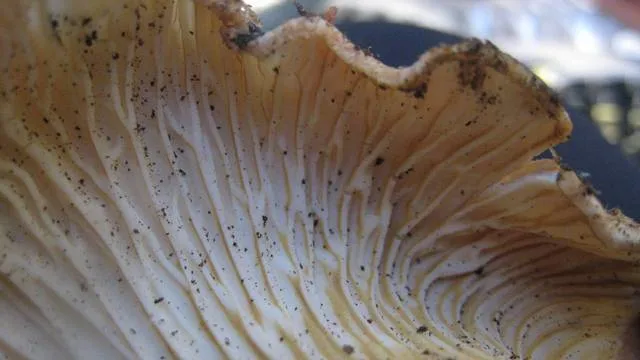
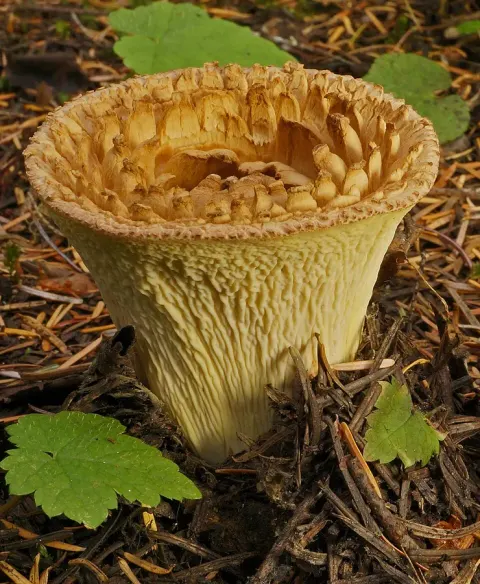
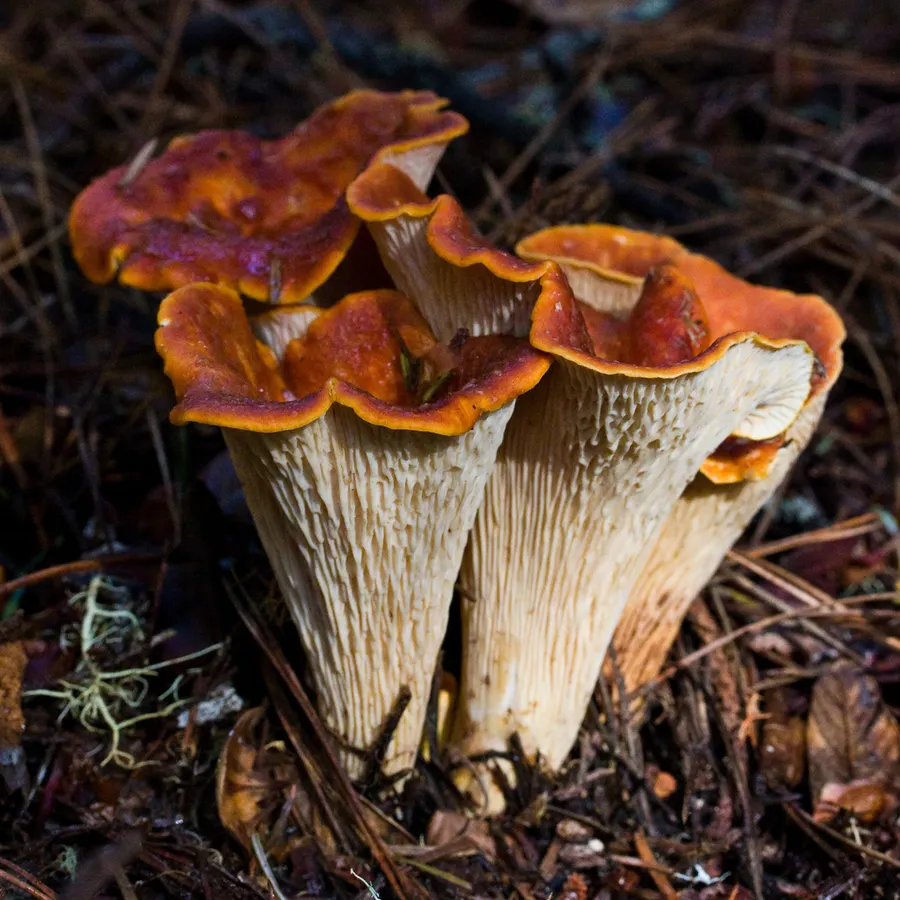
Adult fruit bodies are initially cylindrical, maturing to trumpet- or vase-shaped and reaching up to 30 cm (12 in) in height and width. There is no clear demarcation between the cap and stipe. The stipe can be up to 15 cm (6 in) tall and 6 cm wide, though it tapers to a narrower base. It is solid in younger specimens, though is often hollowed out by insect larvae in older. At higher elevations, two or three fruit bodies may arise from one stipe. Colored various shades of reddish- to yellowish-orange, the cap surface is broken into scales, with the spaces between more yellow and the scales themselves more orange. The most colorful specimens occur in warm humid weather. Older specimens are often paler. The white flesh is fibrous and thick, though thins with age. Somewhat brittle, it can sometimes turn brown when cut or bruised. The smell has been reported as indistinct or "earthy and sweet", and the taste "sweet and sour". The spore-bearing undersurface is irregularly folded, forked or ridged rather than gilled and is pale buff or yellowish to whitish in color. These ridges are up to 4 mm high, and are decurrent—they extend below and run down the cap's attachment to the stipe, though irregularly so. The spore print is brownish, the spores ellipsoid with dimensions of 12.4–16.8 × 5.8–7.3 μm. The spore surface is roughened with ornamentations that can be made visible under the microscope by staining with methyl blue. The fruit bodies can last for some considerable time, growing slowly over a month. Mushrooms in subalpine and alpine areas are typically heavy-set with a short stipe, their growth slower in the cold climate.

Sebagian uraian ditampilkan dalam bahasa sumber; terjemahannya belum tersedia atau belum lolos pemeriksaan.

Rujukan: [1]

Pengukuran mengikuti objek, spesimen atau kultur, dan metode yang disebutkan sumber. Baca uraian asli untuk konteks lengkap.

02 / Kehidupan

Habitat dan peran ekologis

Jamur ini tampaknya membentuk hubungan simbiotik (ektomikoriza) dengan berbagai konifer termasuk Douglas-fir (Pseudotsuga menziesii), fir (Abies) spesies seperti momi fir (Abies firma), European silver fir (A. alba) dan Khinghan fir (A. nephrolepis), pinus (Pinus) spesies seperti Pinus densiflora dan hemlock barat (Tsuga heterophylla). Di Meksiko, jamur yang terkait dengan Abies religiosa ⁇ asosiasi mikoriza antara dua spesies ini telah disintesis dalam kondisi laboratorium yang terkontrol. T. floccosus lebih banyak ditemukan di tempat-tempat pohon yang lebih tua dan tempat-tempat di mana ada kayu yang lebih banyak terurai di lantai hutan. Spesies ini ditemukan di hutan konifer di Amerika Utara, terutama di negara bagian barat pada akhir musim panas dan musim gugur. It is most abundant in rainy parts of the Pacific Northwest, northern California and the Sierra Nevada. Hal ini juga terjadi di seluruh Asia, telah tercatat dari Jepang, Korea Utara, China, Tibet, India, Nepal and Pakistan. Turbinellus floccosus has been occasionally recorded from introduced conifer plantations in Australia.

Sebagian uraian ditampilkan dalam bahasa sumber; terjemahannya belum tersedia atau belum lolos pemeriksaan.

Rujukan: [1]

Habitat atau konteks temuan
hutan
Substrat
Informasi belum tersedia pada sumber rilis ini.
Peran atau konteks
Mitra tumbuhan
Temukan hubungan serupa
03 / Siklus hidup

Reproduksi

The white flesh is fibrous and thick, though thins with age. Somewhat brittle, it can sometimes turn brown when cut or bruised. The smell has been reported as indistinct or "earthy and sweet", and the taste "sweet and sour". The spore-bearing undersurface is irregularly folded, forked or ridged rather than gilled and is pale buff or yellowish to whitish in color. These ridges are up to 4 mm high, and are decurrent—they extend below and run down the cap's attachment to the stipe, though irregularly so. The spore print is brownish, the spores ellipsoid with dimensions of 12.4–16.8 × 5.8–7.3 μm. The spore surface is roughened with ornamentations that can be made visible under the microscope by staining with methyl blue.

Sebagian uraian ditampilkan dalam bahasa sumber; terjemahannya belum tersedia atau belum lolos pemeriksaan.

Rujukan: [1]

Sinonim menurut acuan taksonomi rilis: Cantharellus bonarii; Cantharellus canadensis; Cantharellus floccosus; Cantharellus floccosus f. excavatus; Cantharellus floccosus f. rainieriensis; Cantharellus floccosus f. wilsonii; Cantharellus princeps; Cantharellus wilkinsiae; Chanterel floccosus; Craterellus canadensis; Gomphus bonarii; Gomphus bonarii f. novamexicanus; Gomphus bonarii f. wilkinsiae; Gomphus bonarii f. wilsonii; Gomphus canadensis; Gomphus floccosus; Gomphus floccosus f. coccineobasalis; Gomphus floccosus f. cystidiophorus; Gomphus floccosus f. excavatus; Gomphus floccosus f. olivaceus; Gomphus floccosus subsp. rainieriensis; Gomphus wilkinsiae; Merulius floccosus; Merulius princeps; Neurophyllum floccosum; Trombetta canadensis
04 / Batas informasi

Catatan identitas dan cakupan

  • Nama diterima mengikuti Catalogue of Life Base2026-09-11; uraian mempertahankan konsep dan nama sumber aslinya.
  • Original geographic, specimen and life-cycle scope retained; source import awaits individual editorial review.
  • Impor dan terjemahan otomatis belum diperiksa editorial per profil. Struktur reproduktif yang disebutkan tidak membuktikan seluruh siklus hidup diketahui.
  • Pengukuran pada uraian mengikuti spesimen, kultur, dan metode sumber; angka tidak diperluas ke semua populasi.

Catatan distribusi dalam narasi mengikuti sumbernya. Dokumentasi spesimen atau foto mengikuti catatan sumber. Bukti wilayah Indonesia dan penilaian konservasi tidak disimpulkan dari gambar.

05 / Dokumentasi

Melihat dengan konteks

Dokumentasi Turbinellus floccosus menurut asosiasi foto pada record takson iNaturalist. Kredit: Ken-ichi Ueda. Identitas mengikuti sumber; bukan penentuan spesimen independen.

Jenis
Fotografi
Kredit
(c) Ken-ichi Ueda, some rights reserved (CC BY)
Lisensi
CC BY 4.0
Sumber media
Buka entri sumber

Gambar menunjukkan objek menurut identifikasi sumber, bukan verifikasi independen spesimen oleh Fungi. Tidak ada skala baru yang ditambahkan.

Dokumentasi tambahan

06 / Rujukan

Sumber profil

  1. [1] Turbinellus floccosus — Wikipedia (en)Bagian sumber: Frozen revision 1370524146
    Tanggal penghimpunan sumber: 2026-10-12
    Teks sumber: CC BY-SA4.0 · Wikipedia contributors
  2. [2] Catalogue of Life Base2026-09-11 — Turbinellus floccosusBagian sumber: ColDP NameUsage.tsv ID 59MTC; accepted species; source 2073
    Tanggal penghimpunan sumber: 2026-10-12
  3. [3] Dokumentasi visual — Turbinellus floccosusBagian sumber: Identitas mengikuti sumber dokumentasi; bukan penentuan spesimen independen.
    Tanggal penghimpunan sumber: 2026-10-17
    Media sumber: CC BY 4.0 · (c) Ken-ichi Ueda, some rights reserved (CC BY)
  4. [4] Dokumentasi visual — Turbinellus floccosusBagian sumber: Identitas mengikuti sumber dokumentasi; bukan penentuan spesimen independen.
    Tanggal penghimpunan sumber: 2026-10-17
    Teks sumber: CC BY-SA 4.0 · (c) Janet Hsiao, some rights reserved (CC BY-SA)

Adaptasi teks: CC BY-SA 4.0. Wikipedia contributors — Turbinellus floccosus — Wikipedia (en)

Uraian asli dan riwayat sumber

Riwayat atau halaman sumber

Ringkasan sumber

Turbinellus floccosus, commonly known as the scaly vase, or sometimes the shaggy, scaly, or woolly chanterelle, is a cantharelloid mushroom of the family Gomphaceae. It was known as Gomphus floccosus until 2011, when it was found to be only distantly related to the genus's type species, G. clavatus. It was consequently transferred from Gomphus to Turbinellus. The orange-capped vase- or trumpet-shaped fruiting bodies may reach 30 cm (12 in) high and 30 cm (12 in) wide. The lower surface, the hymenium, is covered in wrinkles and ridges rather than gills or pores, and is pale buff or yellowish to whitish.

Revisi sumber

Morfologi sumber

Adult fruit bodies are initially cylindrical, maturing to trumpet- or vase-shaped and reaching up to 30 cm (12 in) in height and width. There is no clear demarcation between the cap and stipe. The stipe can be up to 15 cm (6 in) tall and 6 cm wide, though it tapers to a narrower base. It is solid in younger specimens, though is often hollowed out by insect larvae in older. At higher elevations, two or three fruit bodies may arise from one stipe. Colored various shades of reddish- to yellowish-orange, the cap surface is broken into scales, with the spaces between more yellow and the scales themselves more orange. The most colorful specimens occur in warm humid weather. Older specimens are often paler. The white flesh is fibrous and thick, though thins with age. Somewhat brittle, it can sometimes turn brown when cut or bruised. The smell has been reported as indistinct or "earthy and sweet", and the taste "sweet and sour". The spore-bearing undersurface is irregularly folded, forked or ridged rather than gilled and is pale buff or yellowish to whitish in color. These ridges are up to 4 mm high, and are decurrent—they extend below and run down the cap's attachment to the stipe, though irregularly so. The spore print is brownish, the spores ellipsoid with dimensions of 12.4–16.8 × 5.8–7.3 μm. The spore surface is roughened with ornamentations that can be made visible under the microscope by staining with methyl blue. The fruit bodies can last for some considerable time, growing slowly over a month. Mushrooms in subalpine and alpine areas are typically heavy-set with a short stipe, their growth slower in the cold climate.

Revisi sumber

Ekologi sumber

The fungus appears to form symbiotic (ectomycorrhizal) relationships with various conifers including Douglas-fir (Pseudotsuga menziesii), fir (Abies) species such as momi fir (Abies firma), European silver fir (A. alba) and Khinghan fir (A. nephrolepis), pine (Pinus) species such as Pinus densiflora and western hemlock (Tsuga heterophylla). In Mexico, the fungus associates with Abies religiosa—the mycorrhizal association between these two species has been synthesized under controlled laboratory conditions. T. floccosus is more abundant in older stands of trees and places where there is more decomposed wood on the forest floor. The species occurs in coniferous forests in North America, particularly the western states in late summer and autumn. It is most abundant in rainy parts of the Pacific Northwest, northern California and the Sierra Nevada. It also occurs across Asia, having been recorded from Japan, North Korea, China, Tibet, India, Nepal and Pakistan. Turbinellus floccosus has been occasionally recorded from introduced conifer plantations in Australia.

Revisi sumber

Struktur reproduksi sumber

The white flesh is fibrous and thick, though thins with age. Somewhat brittle, it can sometimes turn brown when cut or bruised. The smell has been reported as indistinct or "earthy and sweet", and the taste "sweet and sour". The spore-bearing undersurface is irregularly folded, forked or ridged rather than gilled and is pale buff or yellowish to whitish in color. These ridges are up to 4 mm high, and are decurrent—they extend below and run down the cap's attachment to the stipe, though irregularly so. The spore print is brownish, the spores ellipsoid with dimensions of 12.4–16.8 × 5.8–7.3 μm. The spore surface is roughened with ornamentations that can be made visible under the microscope by staining with methyl blue.

Revisi sumber

Rujukan halaman ini

Fungi. Turbinellus floccosus. Rilis data fungi-2026-10-12-expansion-2. https://fungi-atlas.mgadib.chatgpt.site/jamur/turbinellus-floccosus/.

Status: impor sumber; pemeriksaan editorial per profil belum selesai. Untuk klaim biologis, gunakan rujukan pada bagian terkait dan periksa konteks sumber aslinya.