Ciri dan struktur
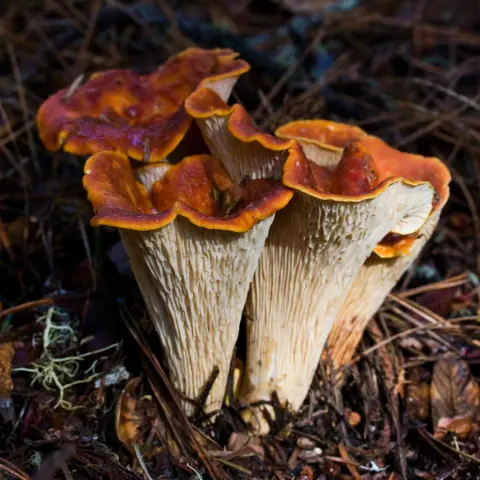
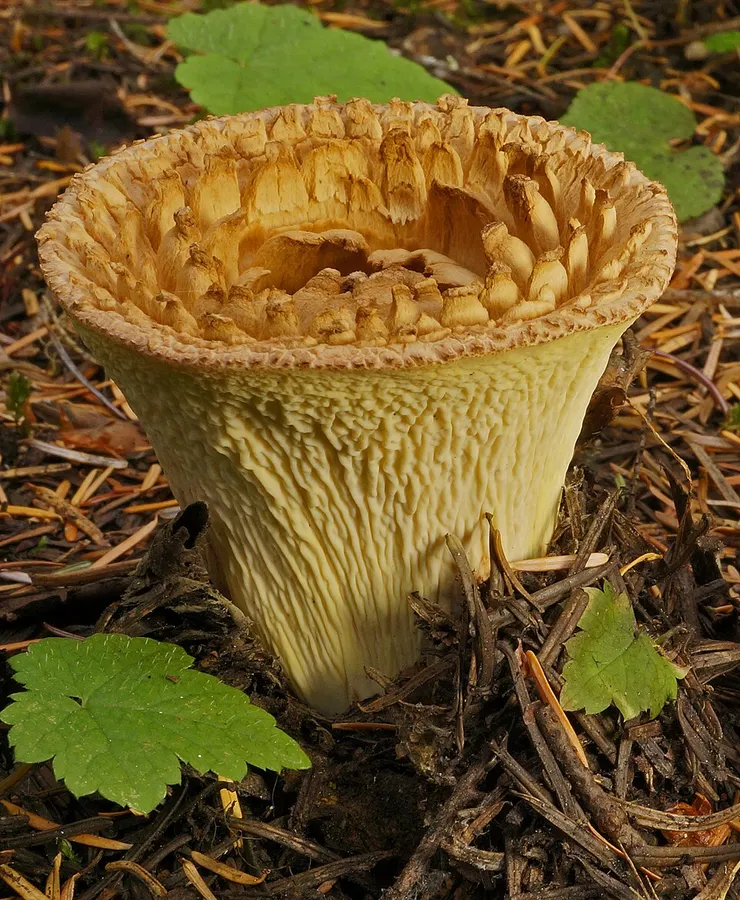
The cap is generally 10-20 cm in diameter, though rarely can be up to 35 cm across. The cap is olive to brown, with the surface splitting into olive- to clay-coloured scales as it ages, with white flesh between. The overall shape of the fruitbody is vase-shaped. The flesh is thick and white. The spore-bearing surface is yellow when young and ages to a buff-pink, and stains wine-coloured when bruised in younger specimens. The hymenium is decurrently attached to the stipe. The stipe is generally 8-15 cm high and 2-4 cm wide, though can be as tall as 40 cm. The spore print is ochre-coloured. Younger specimens also have a pungent smell, and the flesh can have an acrid taste. Laboratory experiments have shown that T. kauffmanii contains norcaperatic acid, though at lower concentrations than T. floccosus. Norcaperatic acid increases tone of guinea pig smooth muscle of the small bowel (ileum), and that when given to rats, leads to mydriasis, skeletal muscle weakness, and central nervous system depression. It is likely the agent responsible for toxic (gastrointestinal) symptoms that occur in T. floccosus.
Habitat dan peran ekologis
Turbinellus kauffmanii is native to the Pacific Northwest and northern California, where it is found in coniferous forests on soil rich in humus, with fruitbodies more common in warm wet summers. It has also been recorded from Amanalco municipality in central Mexico.
- Habitat atau konteks temuan
- hutan
- Substrat
- tanah
- Peran atau konteks
- Belum dikategorikan pada rilis ini.
Reproduksi
The cap is generally 10-20 cm in diameter, though rarely can be up to 35 cm across. The cap is olive to brown, with the surface splitting into olive- to clay-coloured scales as it ages, with white flesh between. The overall shape of the fruitbody is vase-shaped. The flesh is thick and white. The spore-bearing surface is yellow when young and ages to a buff-pink, and stains wine-coloured when bruised in younger specimens. The hymenium is decurrently attached to the stipe. The stipe is generally 8-15 cm high and 2-4 cm wide, though can be as tall as 40 cm. The spore print is ochre-coloured. Younger specimens also have a pungent smell, and the flesh can have an acrid taste.
Catatan identitas dan cakupan
- Nama diterima mengikuti Catalogue of Life Base2026-09-11; uraian mempertahankan konsep dan nama sumber aslinya.
- Original geographic, specimen and life-cycle scope retained; source import awaits individual editorial review.
- Impor dan terjemahan otomatis belum diperiksa editorial per profil. Struktur reproduktif yang disebutkan tidak membuktikan seluruh siklus hidup diketahui.
- Pengukuran pada uraian mengikuti spesimen, kultur, dan metode sumber; angka tidak diperluas ke semua populasi.
Catatan distribusi dalam narasi mengikuti sumbernya. Dokumentasi spesimen atau foto mengikuti catatan sumber. Bukti wilayah Indonesia dan penilaian konservasi tidak disimpulkan dari gambar.
Melihat dengan konteks
Dokumentasi Turbinellus kauffmanii dari Wikimedia Commons. A fruit body of the gomphoid fungus Turbinellus kauffmanii (A.H. Sm.) Giachini. Photographed in Trout Lake, Washington, USA. Identifikasi mengikuti record berkas sumber.
- Jenis
- Fotografi
- Kredit
- Sava Krstic (sava)
- Lisensi
- CC BY-SA 3.0
- Sumber media
- Buka entri sumber
Sumber profil
- [1] Turbinellus kauffmanii — Wikipedia (en)
- [2] Catalogue of Life Base2026-09-11 — Turbinellus kauffmanii
- [3] Dokumentasi visual — Turbinellus kauffmanii
Rujukan halaman ini
Fungi. Turbinellus kauffmanii. Rilis data fungi-2026-10-12-expansion-2. https://fungi-atlas.mgadib.chatgpt.site/jamur/turbinellus-kauffmanii/.
Status: impor sumber; pemeriksaan editorial per profil belum selesai. Untuk klaim biologis, gunakan rujukan pada bagian terkait dan periksa konteks sumber aslinya.