Ciri dan struktur
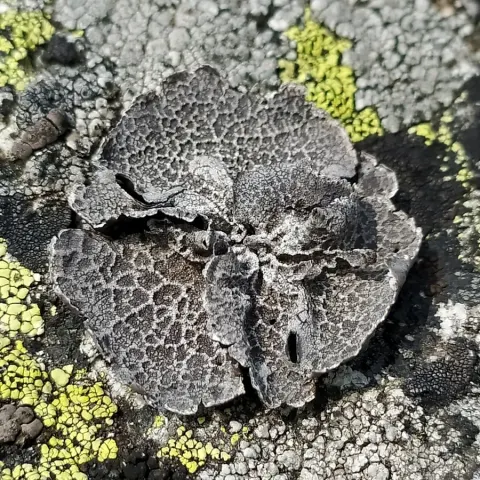
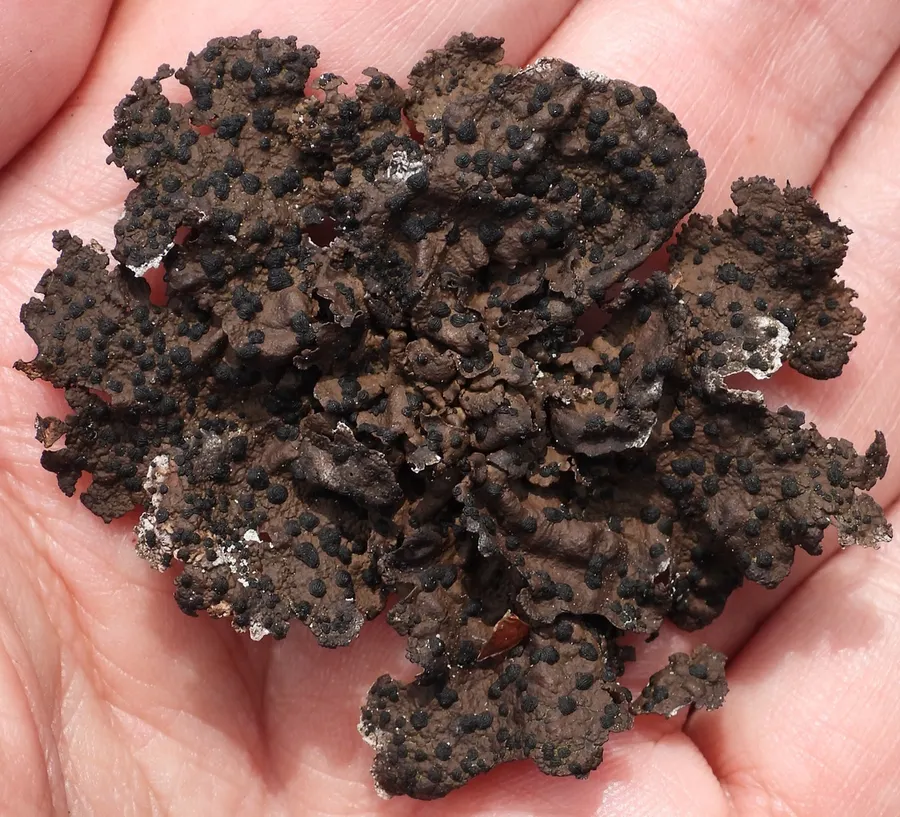
Umbilicaria torrefacta is a lichen with a thallus that ranges from 2 to 6 cm in diameter and consists of a single . The thalli are typically —connected to the at a single point of attachment called an . The thallus is often crumpled, with the edges finely dissected and perforated by small holes, giving it a lace-like appearance. These perforations may occasionally appear towards the centre. The upper surface colour ranges from brown to dark brown, and can be either smooth or have a cracked, wart-like texture. McCune and Geiser liken the surface cracks to "sutures in a skull" and treat them as characteristic. The lower surface varies from pale brown to black and features irregular, thin, somewhat flattened layers resembling plates (trabeculae) that are often torn or perforated. Although rhizines (root-like structures) are absent in this species, torn fringes of trabeculae may be mistaken for rhizines. Nineteenth-century authors noted a tea-like odour on rewetting. Apothecia (fruiting bodies) are common and measure 0.5 to 2 mm in diameter. They are slightly immersed in depressions on the thallus and have a twisted, appearance with black . The paraphyses (sterile filaments among the spores) are unbranched with brown tips. The (spores produced in the fruiting bodies) are colourless, hyaline (translucent), ellipsoid in shape, and not divided by septa (internal partitions). Different spore measurements have been reported in the literature: 7 to 16.5 μm long by 5 to 10 μm wide from a European source, and 8 to 12 μm long by 4 to 6 μm wide from a North American source. (asexual reproductive spores) are absent.
Habitat dan peran ekologis
Umbilicaria torrefacta is occurs in rocky, alpine environments within the Holarctic region, covering both the Palearctic and Nearctic biogeographical areas. It grows on rock outcrops, both open and sheltered. According to Llano's 1950 monograph on Umbilicaria, in North America, it has not been recorded south of the White Mountains of California and has not been found in South America. It grows in the splash zone of coastal ecosystems, particularly along the White Sea in Russia. This lichen species prefers a range of coastal habitats, growing on vertical rock faces and in boulder fields. It is occasionally exposed to sea spray, although it tends to favour more sheltered, less frequently wetted environments compared to its relative Umbilicaria deusta. In the Nuuk region of southern Greenland, U. torrefacta is typically found on somewhat moist siliceous rocks, and often in the company of a community of lichens that includes Aspicilia berntii, Bellemerea subsorediza, Lecidea lapicida, Miriquidica atrofulva, Miriquidica leucophaea, Miriquidica nigroleprosa, Montanelia disjuncta, Orphniospora moriopsis, and Pseudephebe minuscula.
- Habitat atau konteks temuan
- Informasi belum tersedia pada sumber rilis ini.
- Substrat
- Informasi belum tersedia pada sumber rilis ini.
- Peran atau konteks
- Pembentuk liken
Reproduksi
Apothecia (fruiting bodies) are common and measure 0.5 to 2 mm in diameter. They are slightly immersed in depressions on the thallus and have a twisted, appearance with black . The paraphyses (sterile filaments among the spores) are unbranched with brown tips. The (spores produced in the fruiting bodies) are colourless, hyaline (translucent), ellipsoid in shape, and not divided by septa (internal partitions). Different spore measurements have been reported in the literature: 7 to 16.5 μm long by 5 to 10 μm wide from a European source, and 8 to 12 μm long by 4 to 6 μm wide from a North American source. (asexual reproductive spores) are absent.
Catatan identitas dan cakupan
- Nama diterima mengikuti Catalogue of Life Base2026-09-11; uraian mempertahankan konsep dan nama sumber aslinya.
- Original geographic, specimen and life-cycle scope retained; source import awaits individual editorial review.
- Impor dan terjemahan otomatis belum diperiksa editorial per profil. Struktur reproduktif yang disebutkan tidak membuktikan seluruh siklus hidup diketahui.
- Pengukuran pada uraian mengikuti spesimen, kultur, dan metode sumber; angka tidak diperluas ke semua populasi.
Catatan distribusi dalam narasi mengikuti sumbernya. Dokumentasi spesimen atau foto mengikuti catatan sumber. Bukti wilayah Indonesia dan penilaian konservasi tidak disimpulkan dari gambar.
Melihat dengan konteks
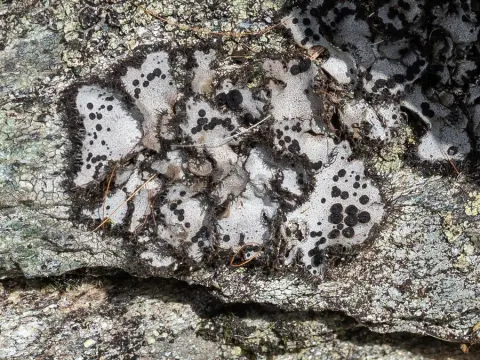
Dokumentasi Umbilicaria torrefacta menurut asosiasi foto pada record takson iNaturalist. Kredit: Vesa Oikonen. Identitas mengikuti sumber; bukan penentuan spesimen independen.
- Jenis
- Fotografi
- Kredit
- no rights reserved, uploaded by Vesa Oikonen
- Lisensi
- CC0 1.0
- Sumber media
- Buka entri sumber
Dokumentasi tambahan
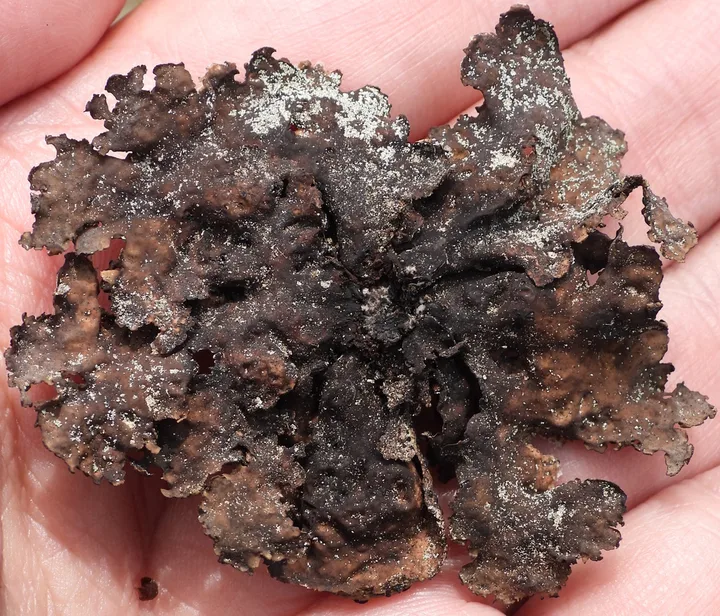
Foto yang diasosiasikan dengan Umbilicaria torrefacta pada iNaturalist. Identifikasi mengikuti sumber; bukan penentuan spesimen independen.
Kredit dan penggunaan
no rights reserved, uploaded by Vesa Oikonen
Ukuran dan format gambar disesuaikan tanpa pemotongan, retus, atau penambahan skala. Lisensi sumber dipertahankan.
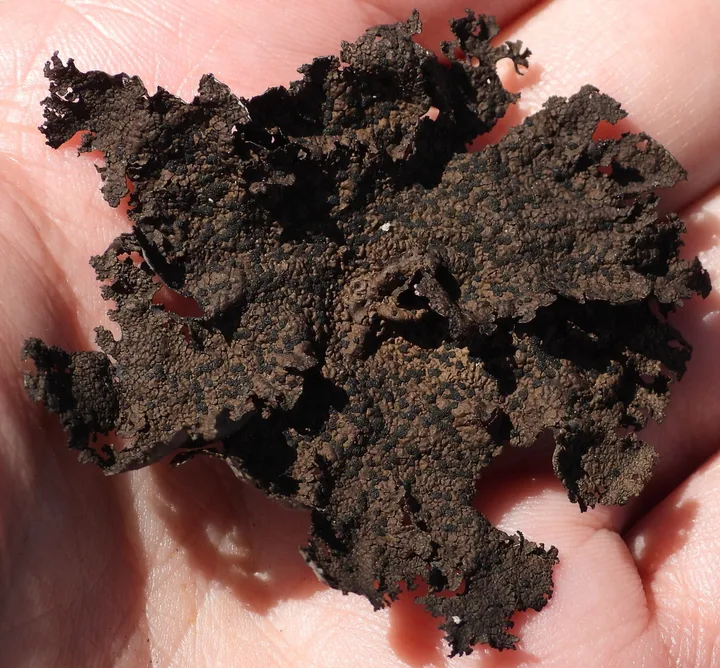
Foto yang diasosiasikan dengan Umbilicaria torrefacta pada iNaturalist. Identifikasi mengikuti sumber; bukan penentuan spesimen independen.
Kredit dan penggunaan
no rights reserved, uploaded by Vesa Oikonen
Ukuran dan format gambar disesuaikan tanpa pemotongan, retus, atau penambahan skala. Lisensi sumber dipertahankan.
Sumber profil
- [1] Umbilicaria torrefacta — Wikipedia (en)
- [2] Catalogue of Life Base2026-09-11 — Umbilicaria torrefacta
- [3] Dokumentasi visual — Umbilicaria torrefacta
- [4] Dokumentasi visual — Umbilicaria torrefacta
- [5] Dokumentasi visual — Umbilicaria torrefacta
Rujukan halaman ini
Fungi. Umbilicaria torrefacta. Rilis data fungi-2026-10-12-expansion-2. https://fungi-atlas.mgadib.chatgpt.site/jamur/umbilicaria-torrefacta/.
Status: impor sumber; pemeriksaan editorial per profil belum selesai. Untuk klaim biologis, gunakan rujukan pada bagian terkait dan periksa konteks sumber aslinya.