01 / Morfologi

Ciri dan struktur

Similar to V. robusta by the inflated branches and to V. polymorpha by the relatively short length of branches; differs by the honeycomb-like cortex or by the contorted lobes. Thallus 1–1.5 (-2.5) cm high and 0.5–1 cm broad; basal branches 1–5 or rarely more, short cylindrical, teretiform or prismatic, 1–3 mm diam., loosely united at brownish base, ± erect, inflated, irregularly shriveled and contorted when dry, transversely segmented and ruptured when wet at ± regular intervals, terminally divided into short lobes with or without apothecia; terminal lobes often many and close together or fewer and spreading, 4–6 mm long, 2–4 mm diam. Cortex two-layered, 35–50 μm thick, outer thicker, melanized, externally pale olive green, with irregular reticulate cortical ridges, recessed-concave within ridges (honeycomb-like surface), occasionally plicate on inflated lobes. Medulla subfistulose, hyphae flexuous when wet, intertwining in a net arrangement, ± periclinal, frequently uniting into minute knots; Photobiont in small yellow green to green round colonies ± continuous around the perimeter of the medulla. Apothecia many, aggregate terminally on a primary branch, each subtended by a short stalk-like lobe partly deflated and constricted to junction with branch lobe, bowl-shaped when young, to 4 mm diam., lenticular with age; thalline margin thickened, incurved, entire or crenulate or incised, disc pale orange, concave; asci 8-spored; spores opaque, 1-septate, short ellipsoid, 6–7 × 4–5 μm. Pycnidia black, common on the upper half of branches in shallow concave depressions within cortical ridges, ostiole flush with cortical surface, immersed below; conidia not observed.

Sebagian uraian ditampilkan dalam bahasa sumber; terjemahannya belum tersedia atau belum lolos pemeriksaan.

Rujukan: [1]

Pengukuran mengikuti objek, spesimen atau kultur, dan metode yang disebutkan sumber. Baca uraian asli untuk konteks lengkap.

02 / Kehidupan

Habitat dan peran ekologis

Mexico, Baja California, North Vizcaíno Desert, between Punta Santa Rosalillita and Punta Negra. Only known from that locality. On rock ledges of north-facing cliffs bordering estuary inland from the sea, occurring with species of Niebla, Vermilacinia cedrosensis and V. paleoderma, within a semicircular arc of volcanic coastal hills with steep ravines and narrow ridges trending in various directions, 200–400 m in altitude, extending approx. 20 km along the coast and to 7 km inland at midpoint near the Punta Negra Road (Google Earth 2019). Fog often lingers amongst the higher ridges and peaks during the day (Spjut 1996). A diversity of saxicolous Vermilacinia occurs here: V. breviloba, V. cedrosensis, V. ligulata, V. paleoderma, V. pustulata, V. reptilioderma and V. rigida. Vegetation on hills near type locality consists of spiny shrubs and succulents of Pachycormus discolor, Stenocereus thurberi, Cylindropuntia spp., Fouquieria diguetii and Agave shawii. The subshrub Xylonagra arborea was observed on rocks amongst the lichens and salt-scrub of Atriplex julacea and Frankenia palmeri bordered a salt marsh of aquatic species not studied.

Sebagian uraian ditampilkan dalam bahasa sumber; terjemahannya belum tersedia atau belum lolos pemeriksaan.

Rujukan: [1]

Habitat atau konteks temuan
Informasi belum tersedia pada sumber rilis ini.
Substrat
Informasi belum tersedia pada sumber rilis ini.
Peran atau konteks
Pembentuk liken
Temukan hubungan serupa
03 / Siklus hidup

Reproduksi

Thallus 1–1.5 (-2.5) cm high and 0.5–1 cm broad; basal branches 1–5 or rarely more, short cylindrical, teretiform or prismatic, 1–3 mm diam., loosely united at brownish base, ± erect, inflated, irregularly shriveled and contorted when dry, transversely segmented and ruptured when wet at ± regular intervals, terminally divided into short lobes with or without apothecia; terminal lobes often many and close together or fewer and spreading, 4–6 mm long, 2–4 mm diam. Cortex two-layered, 35–50 μm thick, outer thicker, melanized, externally pale olive green, with irregular reticulate cortical ridges, recessed-concave within ridges (honeycomb-like surface), occasionally plicate on inflated lobes. Medulla subfistulose, hyphae flexuous when wet, intertwining in a net arrangement, ± periclinal, frequently uniting into minute knots; Photobiont in small yellow green to green round colonies ± continuous around the perimeter of the medulla.

Sebagian uraian ditampilkan dalam bahasa sumber; terjemahannya belum tersedia atau belum lolos pemeriksaan.

Rujukan: [1]

04 / Batas informasi

Catatan identitas dan cakupan

  • Nama diterima mengikuti Catalogue of Life Base2026-09-11; uraian mempertahankan konsep dan nama sumber aslinya.
  • Preserve original treatment localities, hosts and substrate scope. Materials examined describe documented specimens, not the full global range.
  • Impor dan terjemahan otomatis belum diperiksa editorial per profil. Struktur reproduktif yang disebutkan tidak membuktikan seluruh siklus hidup diketahui.
  • Pengukuran pada uraian mengikuti spesimen, kultur, dan metode sumber; angka tidak diperluas ke semua populasi.

Catatan distribusi dalam narasi mengikuti sumbernya. Dokumentasi spesimen atau foto mengikuti catatan sumber. Bukti wilayah Indonesia dan penilaian konservasi tidak disimpulkan dari gambar.

05 / Dokumentasi

Melihat dengan konteks

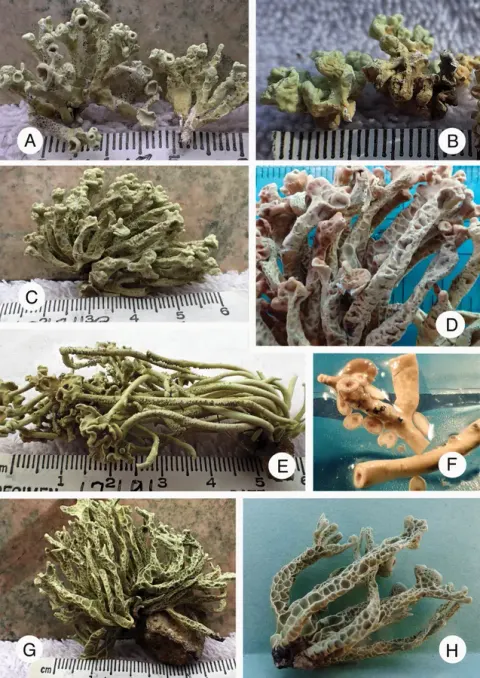
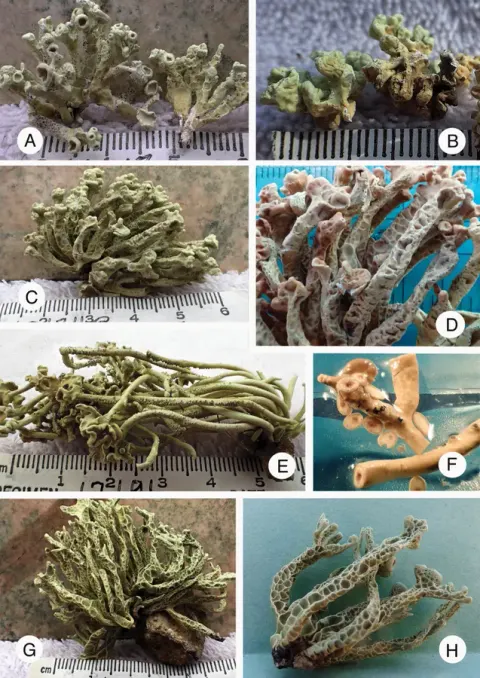
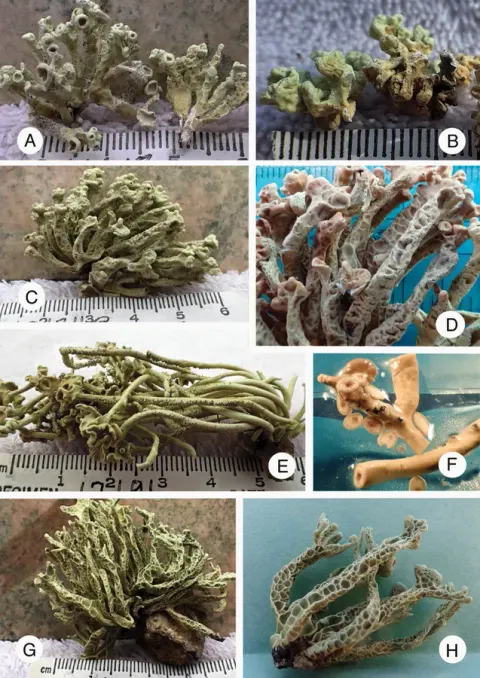
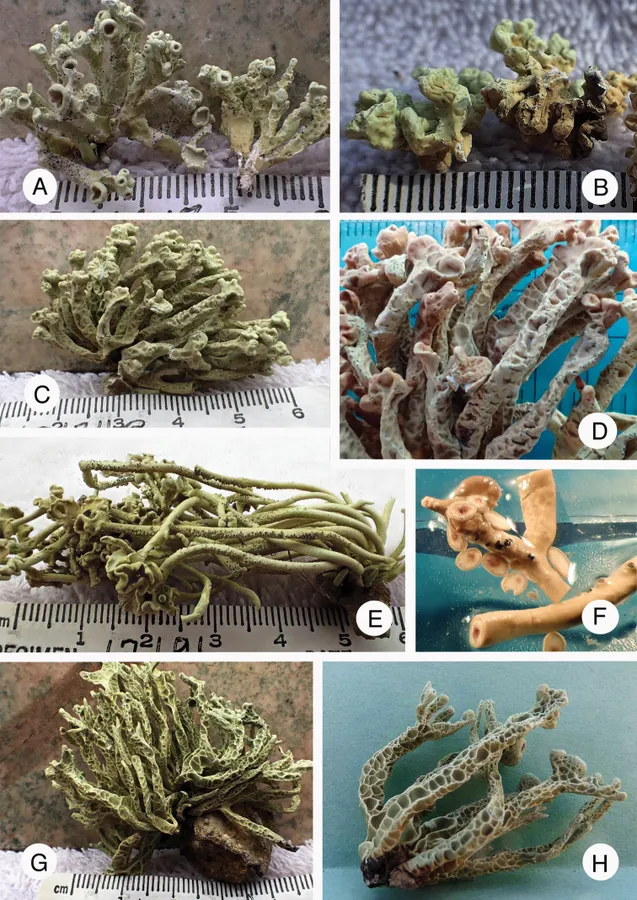
New species of saxicolous Vermilacinia A, B V. breviloba (holotype) C, D V. lacunosa (holotype) E, F V. pustulata (holotype) G, H V. reticulata (holotype). Scale: 1 mm (A, C). Photographs by R. Spjut.

Jenis
Pelat ilmiah
Kredit
Richard Spjut, Antoine Simon, Martin Guissard, Nicolas Magain, Emmanuël Sérusiaux
Lisensi
CC BY 4.0
Sumber media
Buka entri sumber

Gambar menunjukkan objek menurut identifikasi sumber, bukan verifikasi independen spesimen oleh Fungi. Tidak ada skala baru yang ditambahkan.

06 / Rujukan

Sumber profil

  1. [1] The fruticose genera in the Ramalinaceae (Ascomycota, Lecanoromycetes): their diversity and evolutionary history — Vermilacinia brevilobaBagian sumber: PMC7501315_section_64
    Tanggal penghimpunan sumber: 2026-10-12
    Teks sumber: CC BY 4.0 · Spjut R, Simon A, Guissard M, Magain N, Sérusiaux E.
  2. [2] Catalogue of Life Base2026-09-11 — Vermilacinia brevilobaBagian sumber: ColDP NameUsage.tsv ID 9ZH6N; accepted species; source 2073
    Tanggal penghimpunan sumber: 2026-10-12
  3. [3] Dokumentasi visual — Vermilacinia brevilobaBagian sumber: Individual media record; identification follows the source, not independent determination
    Tanggal penghimpunan sumber: 2026-10-12
    Media sumber: CC BY 4.0 · Richard Spjut, Antoine Simon, Martin Guissard, Nicolas Magain, Emmanuël Sérusiaux

Adaptasi teks: CC BY 4.0. Spjut R, Simon A, Guissard M, Magain N, Sérusiaux E. — The fruticose genera in the Ramalinaceae (Ascomycota, Lecanoromycetes): their diversity and evolutionary history — Vermilacinia breviloba

Uraian asli dan riwayat sumber

Riwayat atau halaman sumber

Ringkasan sumber

Similar to V. robusta by the inflated branches and to V. polymorpha by the relatively short length of branches; differs by the honeycomb-like cortex or by the contorted lobes. Thallus 1–1.5 (-2.5) cm high and 0.5–1 cm broad; basal branches 1–5 or rarely more, short cylindrical, teretiform or prismatic, 1–3 mm diam., loosely united at brownish base, ± erect, inflated, irregularly shriveled and contorted when dry, transversely segmented and ruptured when wet at ± regular intervals, terminally divided into short lobes with or without apothecia; terminal lobes often many and close together or fewer and spreading, 4–6 mm long, 2–4 mm diam.

Revisi sumber

Morfologi sumber

Similar to V. robusta by the inflated branches and to V. polymorpha by the relatively short length of branches; differs by the honeycomb-like cortex or by the contorted lobes. Thallus 1–1.5 (-2.5) cm high and 0.5–1 cm broad; basal branches 1–5 or rarely more, short cylindrical, teretiform or prismatic, 1–3 mm diam., loosely united at brownish base, ± erect, inflated, irregularly shriveled and contorted when dry, transversely segmented and ruptured when wet at ± regular intervals, terminally divided into short lobes with or without apothecia; terminal lobes often many and close together or fewer and spreading, 4–6 mm long, 2–4 mm diam. Cortex two-layered, 35–50 μm thick, outer thicker, melanized, externally pale olive green, with irregular reticulate cortical ridges, recessed-concave within ridges (honeycomb-like surface), occasionally plicate on inflated lobes. Medulla subfistulose, hyphae flexuous when wet, intertwining in a net arrangement, ± periclinal, frequently uniting into minute knots; Photobiont in small yellow green to green round colonies ± continuous around the perimeter of the medulla. Apothecia many, aggregate terminally on a primary branch, each subtended by a short stalk-like lobe partly deflated and constricted to junction with branch lobe, bowl-shaped when young, to 4 mm diam., lenticular with age; thalline margin thickened, incurved, entire or crenulate or incised, disc pale orange, concave; asci 8-spored; spores opaque, 1-septate, short ellipsoid, 6–7 × 4–5 μm. Pycnidia black, common on the upper half of branches in shallow concave depressions within cortical ridges, ostiole flush with cortical surface, immersed below; conidia not observed.

Revisi sumber

Ekologi sumber

Mexico, Baja California, North Vizcaíno Desert, between Punta Santa Rosalillita and Punta Negra. Only known from that locality. On rock ledges of north-facing cliffs bordering estuary inland from the sea, occurring with species of Niebla, Vermilacinia cedrosensis and V. paleoderma, within a semicircular arc of volcanic coastal hills with steep ravines and narrow ridges trending in various directions, 200–400 m in altitude, extending approx. 20 km along the coast and to 7 km inland at midpoint near the Punta Negra Road (Google Earth 2019). Fog often lingers amongst the higher ridges and peaks during the day (Spjut 1996). A diversity of saxicolous Vermilacinia occurs here: V. breviloba, V. cedrosensis, V. ligulata, V. paleoderma, V. pustulata, V. reptilioderma and V. rigida. Vegetation on hills near type locality consists of spiny shrubs and succulents of Pachycormus discolor, Stenocereus thurberi, Cylindropuntia spp., Fouquieria diguetii and Agave shawii. The subshrub Xylonagra arborea was observed on rocks amongst the lichens and salt-scrub of Atriplex julacea and Frankenia palmeri bordered a salt marsh of aquatic species not studied.

Revisi sumber

Struktur reproduksi sumber

Thallus 1–1.5 (-2.5) cm high and 0.5–1 cm broad; basal branches 1–5 or rarely more, short cylindrical, teretiform or prismatic, 1–3 mm diam., loosely united at brownish base, ± erect, inflated, irregularly shriveled and contorted when dry, transversely segmented and ruptured when wet at ± regular intervals, terminally divided into short lobes with or without apothecia; terminal lobes often many and close together or fewer and spreading, 4–6 mm long, 2–4 mm diam. Cortex two-layered, 35–50 μm thick, outer thicker, melanized, externally pale olive green, with irregular reticulate cortical ridges, recessed-concave within ridges (honeycomb-like surface), occasionally plicate on inflated lobes. Medulla subfistulose, hyphae flexuous when wet, intertwining in a net arrangement, ± periclinal, frequently uniting into minute knots; Photobiont in small yellow green to green round colonies ± continuous around the perimeter of the medulla.

Revisi sumber

Rujukan halaman ini

Fungi. Vermilacinia breviloba. Rilis data fungi-2026-10-12-expansion-2. https://fungi-atlas.mgadib.chatgpt.site/jamur/vermilacinia-breviloba/.

Status: impor sumber; pemeriksaan editorial per profil belum selesai. Untuk klaim biologis, gunakan rujukan pada bagian terkait dan periksa konteks sumber aslinya.