Ciri dan struktur
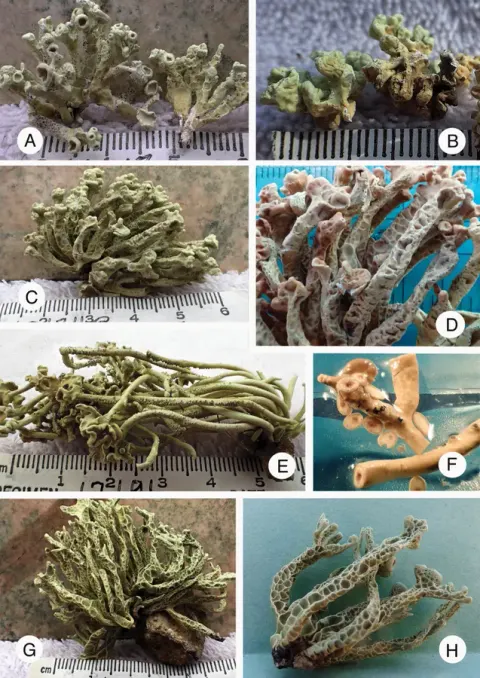
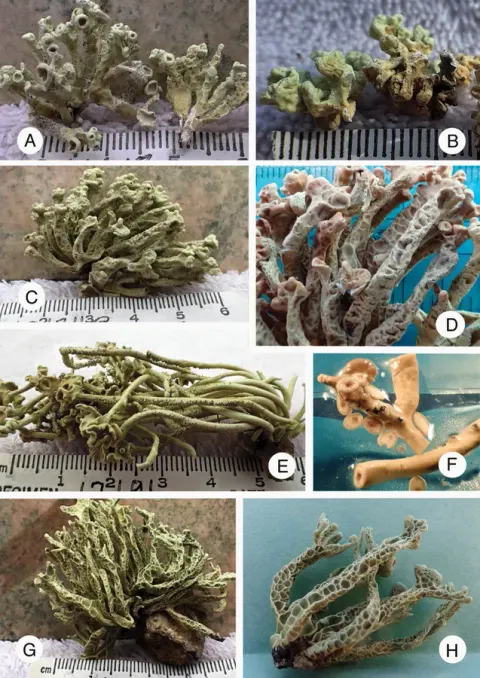
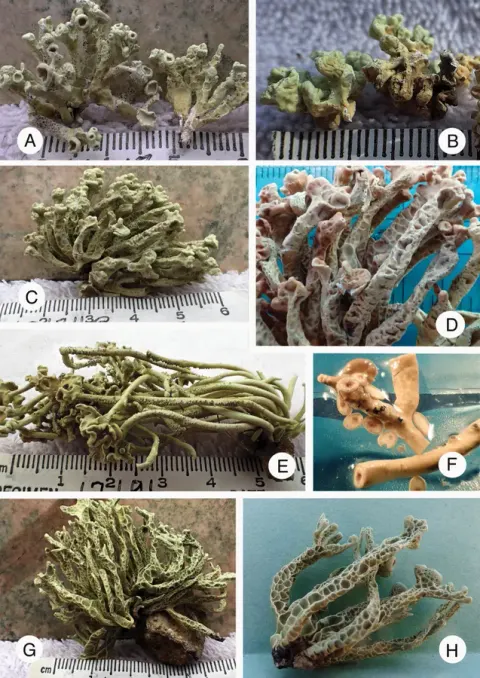
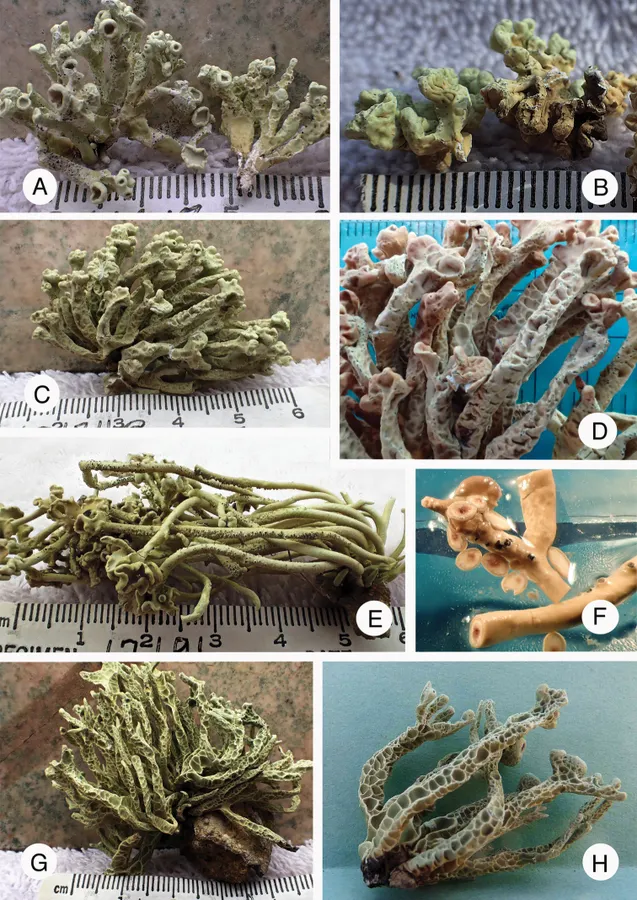
Similar to V. reptilioderma morphologically by the cylindrical-prismatic branches and chemically by the triterpenes T1 and T2, but differing in chemistry by the additional lichen substance, methyl 3,5-dichlorolecanorate (tumidulin). Thallus divided into many subcylindrical branches from a basal reddish-brown to blackish holdfast, to 2.5 cm high and broad. Primary branches ascending to erect, ± ellipsoid-arcuate in x- section, simple or once dichotomously divided near mid region, terminating in aggregate of up to 8, commonly 5, apothecia or with single apothecium, or apothecia not fully developed on most branches, occasional branches without apothecia tapering to obtusely rounded apex; surface of branches commonly lacunose, deeply recessed within reticulate or circular cortical ridges when dry. Cortex pale yellow green, 50–125 μm thick, each of two layers equal in thickness, outer melanized, inner pale. Medulla hyphae flexuous when wet, intertwining in a net arrangement, ± periclinal, frequently uniting into short knots; photobiont in small yellow green clusters irregularly discontinuous around perimeter. Apothecia subsessile, differentiated from branch by constriction or very short stalk-like lobe, bowl-shaped, to 2 mm diam. Alternatively, wider with shallower disc in age, thalline margin not differentiated by thicker cortex, incurved, entire or crenulate with age, disc pale yellow green or yellowish with age, concave; asci 8-spored; spores not observed outside asci. Pycnidia black, common on upper branches and on apothecia, mostly along cortical ridges, immersed except for ostiole flush with surface, conidia straight, short, needle-like.
Habitat dan peran ekologis
Mexico, Baja California Sur, Vizcaíno Peninsula. Known only from a single collection on calcareous rocks on the north slope facing towards a wide arroyo just inland from the sea on the far western Vizcaíno Peninsula, occurring with Vermilacinia paleoderma and vascular plants Fouquieria diguetii, Pachycormus discolor, Eriogonum pondii and Gossypium sp. This region lies within the El Vizcaíno Biosphere Reserve, the largest reserve in Mexico. Additional details on the vegetation of the Vizcaíno Peninsula can be found in Peinado et al. (2005).
- Habitat atau konteks temuan
- Informasi belum tersedia pada sumber rilis ini.
- Substrat
- Informasi belum tersedia pada sumber rilis ini.
- Peran atau konteks
- Pembentuk liken
Reproduksi
Thallus divided into many subcylindrical branches from a basal reddish-brown to blackish holdfast, to 2.5 cm high and broad. Primary branches ascending to erect, ± ellipsoid-arcuate in x- section, simple or once dichotomously divided near mid region, terminating in aggregate of up to 8, commonly 5, apothecia or with single apothecium, or apothecia not fully developed on most branches, occasional branches without apothecia tapering to obtusely rounded apex; surface of branches commonly lacunose, deeply recessed within reticulate or circular cortical ridges when dry. Cortex pale yellow green, 50–125 μm thick, each of two layers equal in thickness, outer melanized, inner pale. Medulla hyphae flexuous when wet, intertwining in a net arrangement, ± periclinal, frequently uniting into short knots; photobiont in small yellow green clusters irregularly discontinuous around perimeter.
Catatan identitas dan cakupan
- Nama diterima mengikuti Catalogue of Life Base2026-09-11; uraian mempertahankan konsep dan nama sumber aslinya.
- Preserve original treatment localities, hosts and substrate scope. Materials examined describe documented specimens, not the full global range.
- Impor dan terjemahan otomatis belum diperiksa editorial per profil. Struktur reproduktif yang disebutkan tidak membuktikan seluruh siklus hidup diketahui.
- Pengukuran pada uraian mengikuti spesimen, kultur, dan metode sumber; angka tidak diperluas ke semua populasi.
Catatan distribusi dalam narasi mengikuti sumbernya. Dokumentasi spesimen atau foto mengikuti catatan sumber. Bukti wilayah Indonesia dan penilaian konservasi tidak disimpulkan dari gambar.
Melihat dengan konteks
New species of saxicolous Vermilacinia A, B V. breviloba (holotype) C, D V. lacunosa (holotype) E, F V. pustulata (holotype) G, H V. reticulata (holotype). Scale: 1 mm (A, C). Photographs by R. Spjut.
- Jenis
- Pelat ilmiah
- Kredit
- Richard Spjut, Antoine Simon, Martin Guissard, Nicolas Magain, Emmanuël Sérusiaux
- Lisensi
- CC BY 4.0
- Sumber media
- Buka entri sumber
Sumber profil
- [1] The fruticose genera in the Ramalinaceae (Ascomycota, Lecanoromycetes): their diversity and evolutionary history — Vermilacinia lacunosa
- [2] Catalogue of Life Base2026-09-11 — Vermilacinia lacunosa
- [3] Dokumentasi visual — Vermilacinia lacunosa
Rujukan halaman ini
Fungi. Vermilacinia lacunosa. Rilis data fungi-2026-10-12-expansion-2. https://fungi-atlas.mgadib.chatgpt.site/jamur/vermilacinia-lacunosa/.
Status: impor sumber; pemeriksaan editorial per profil belum selesai. Untuk klaim biologis, gunakan rujukan pada bagian terkait dan periksa konteks sumber aslinya.