Ciri dan struktur
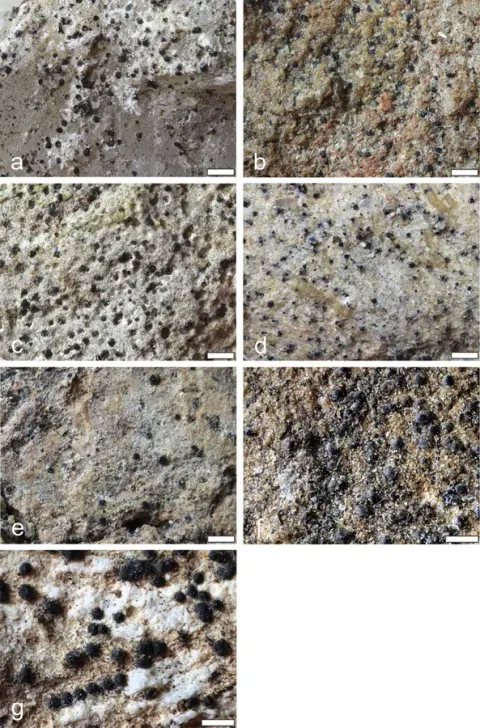
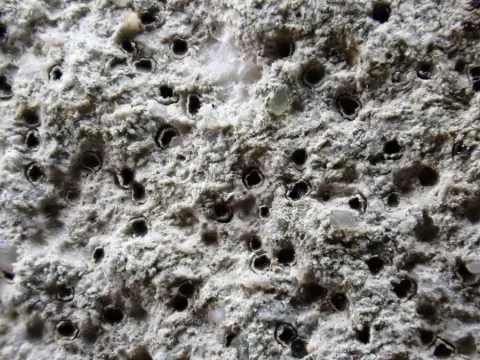
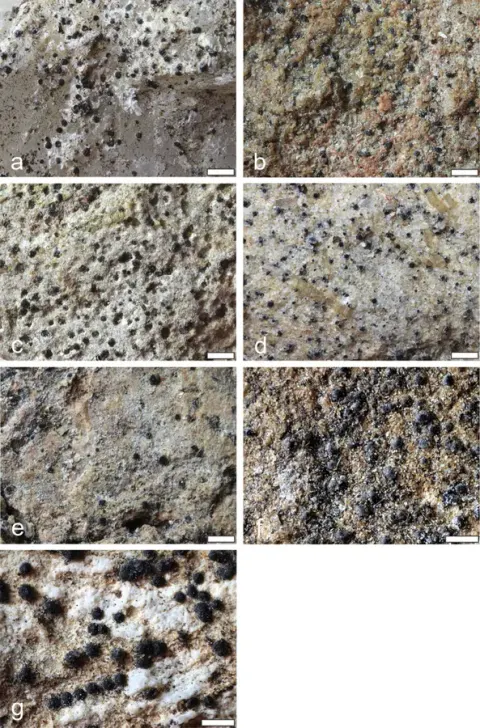
Verrucaria funckii has a light grey-green to grey-brown, somewhat gelatinous thallus that typically measures between 80–160 μm thick, though it can range from 20–240 μm. The surface of the thallus is generally smooth and uncracked, though rare specimens may display a few cracks. The cells within the thallus are arranged in distinctive vertical columns. At the edge of some specimens, a whitish (initial growth layer) may be visible, though it lacks a fringed () appearance and is sometimes absent entirely. In specimens where erosion has occurred, the exposed black basal layer along the thallus margins might be mistaken for a black prothallus. The reproductive structures (perithecia) of V. funckii are typically embedded within the thallus rather than prominently projecting from it. They form shallow, conical projections measuring 300–600 μm in diameter, though rarely these may be conical-hemispherical in shape. These structures are usually completely covered by the thallus material, with only the apex visible at the surface as a small grey dot, or occasionally exposed through abrasion as a small black disc. When examined in cross-section, the perithecia measure 180–390 μm in diameter and are colourless at the sides and base, often displaying a dilute brown colouration at the opening (ostiole). The protective outer covering of the perithecium () is well-developed, extending to the base of the thallus with distinctly conical shape. The sides of this structure are either straight or slightly concave, though sometimes they may be convex. At its base, the involucrellum often spreads widely and merges with the basal layer of the thallus when present.
Habitat dan peran ekologis
Verrucaria funckii occurs on inundated or submerged rocks (typically siliceous rocks) and pebbles in streams and lake shores. It is widespread in Europe, including Northern Europe and Iceland, central Europe including the Carpathian Mountains and the Alps, and southern Europe. It is also found in Asia and North America. In the British Isles, it is particularly common in northern and western regions on permanently or largely submerged siliceous rocks. Typical habitats include granite and slate stream beds, river systems, and lake shores.
- Habitat atau konteks temuan
- Informasi belum tersedia pada sumber rilis ini.
- Substrat
- Informasi belum tersedia pada sumber rilis ini.
- Peran atau konteks
- Pembentuk liken
Reproduksi
The reproductive structures (perithecia) of V. funckii are typically embedded within the thallus rather than prominently projecting from it. They form shallow, conical projections measuring 300–600 μm in diameter, though rarely these may be conical-hemispherical in shape. These structures are usually completely covered by the thallus material, with only the apex visible at the surface as a small grey dot, or occasionally exposed through abrasion as a small black disc. When examined in cross-section, the perithecia measure 180–390 μm in diameter and are colourless at the sides and base, often displaying a dilute brown colouration at the opening (ostiole). The spore-containing sacs (asci) within the perithecia produce ellipsoidal to narrowly ellipsoidal spores () measuring about 22.5–25.5 by 9–11 μm, though they can range from 19.5–28.5 by 8–13 μm.
Catatan identitas dan cakupan
- Nama diterima mengikuti Catalogue of Life Base2026-09-11; uraian mempertahankan konsep dan nama sumber aslinya.
- Original geographic, specimen and life-cycle scope retained; source import awaits individual editorial review.
- Impor dan terjemahan otomatis belum diperiksa editorial per profil. Struktur reproduktif yang disebutkan tidak membuktikan seluruh siklus hidup diketahui.
- Pengukuran pada uraian mengikuti spesimen, kultur, dan metode sumber; angka tidak diperluas ke semua populasi.
Catatan distribusi dalam narasi mengikuti sumbernya. Dokumentasi spesimen atau foto mengikuti catatan sumber. Bukti wilayah Indonesia dan penilaian konservasi tidak disimpulkan dari gambar.
Melihat dengan konteks
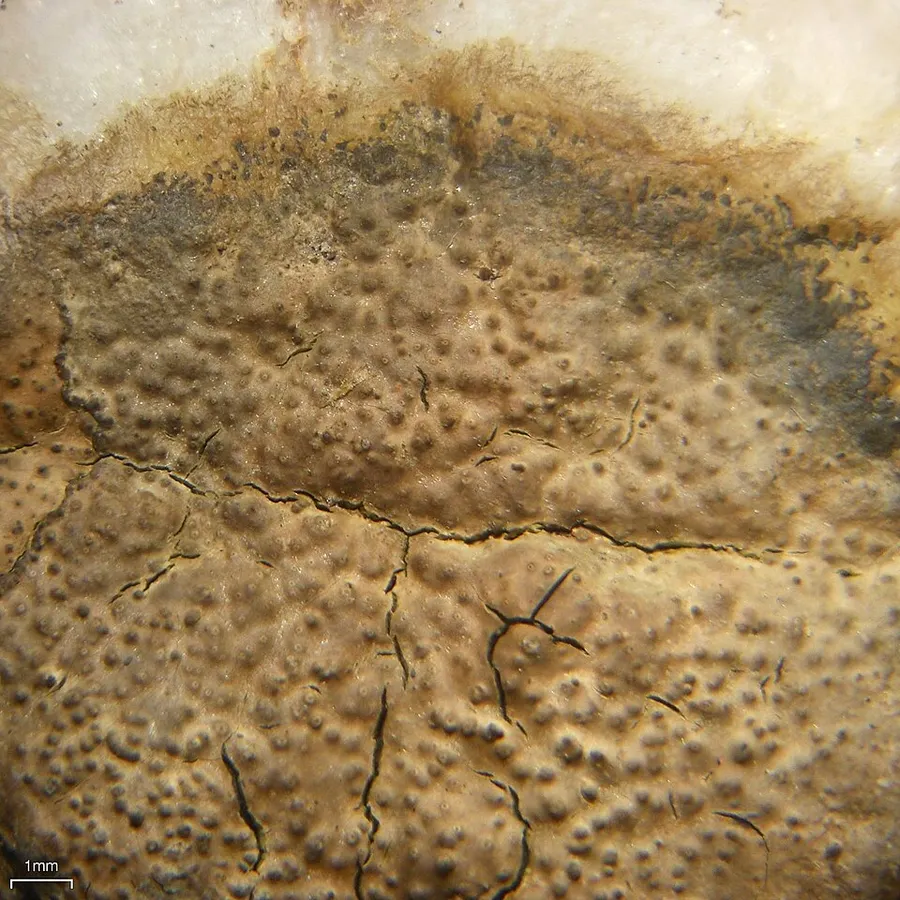
Dokumentasi Verrucaria funckii dari Wikimedia Commons. The crustose, semi-aquatic rock-dwelling lichen Verrucaria funckii on submerged quartzite. Collected from Meadow Lake, Lemhi Mountains, Salmon-Challis National Forest, Lemhi Co., Idaho, USA, at an elevation of 2810 m. See Mushroom Observer page for more extensive collection notes. Identifikasi mengikuti record berkas sumber.
- Jenis
- Fotografi
- Kredit
- Jason Hollinger
- Lisensi
- CC BY-SA 3.0
- Sumber media
- Buka entri sumber
Sumber profil
- [1] Verrucaria funckii — Wikipedia (en)
- [2] Catalogue of Life Base2026-09-11 — Verrucaria funckii
- [3] Dokumentasi visual — Verrucaria funckii
Rujukan halaman ini
Fungi. Verrucaria funckii. Rilis data fungi-2026-10-12-expansion-2. https://fungi-atlas.mgadib.chatgpt.site/jamur/verrucaria-funckii/.
Status: impor sumber; pemeriksaan editorial per profil belum selesai. Untuk klaim biologis, gunakan rujukan pada bagian terkait dan periksa konteks sumber aslinya.