01 / Morfologi

Ciri dan struktur

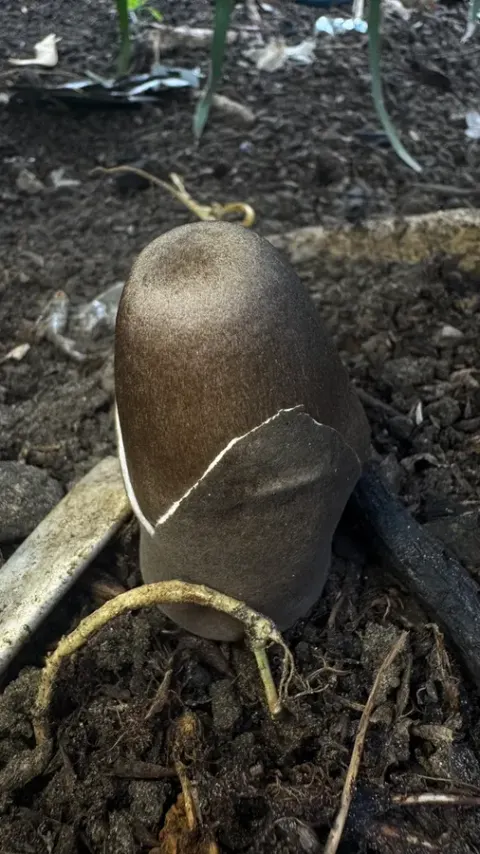
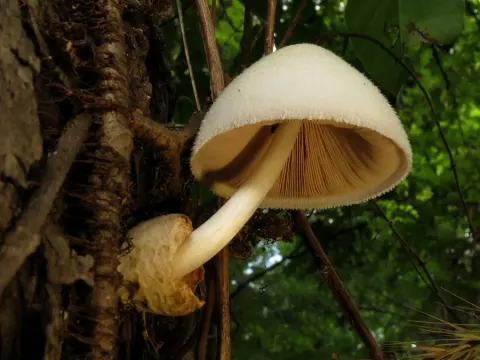
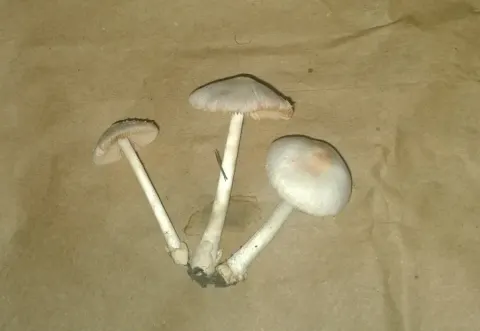
The fruit bodies of V. surrecta have caps that are initially ovoid (egg-shaped. Later they become bell-shaped or convex before flattening; reaching diameters of 2.5 - 8 cm. The cap sometimes has a shallow umbo, although the presence of this character is not consistent. The cap surface is dry and covered with long, silky hairs; the color is white to light gray, with a yellowish or brownish center. The gills are free from attachment to the stipe and are packed close together. They are initially white, later becoming pink. There are many lamellulae (short gills that do not extend fully from cap margin to the stipe) interspersed between the gills. The stipe is 4 - 9 cm long by 4 - 12 mm thick, and roughly equal in width throughout the length or somewhat thicker at the base. Its color is white to light gray, and the stipe surface is appressed-fibrillose, with a pruinose coating near the apex. The white volva measures 1.3 - 2.5 cm high and 0.6 - 1.3 cm broad, and has a lobed margin. The mushroom is not edible. The color of the spore print is brownish-pink. The spores are egg-shaped to oval, measuring 5.4–7.6 by 3.4–4.9 μm. The basidia (spore-bearing cells) are club-shaped, four-spored, and measure 20–31 by 5–10 μm. The pleurocystidia (cystidia on the gill face) are fusoid-ventricose (distinctly enlarged in the middle and tapered toward both ends), sometimes with an elongated neck. The cheilocystidia (cystidia on the gill edge) are also fusoid-ventricose with a neck that is sometimes short and bulbous; they measure 25–50 by 6–20 μm. The hyphae do not have clamp connections.

Sebagian uraian ditampilkan dalam bahasa sumber; terjemahannya belum tersedia atau belum lolos pemeriksaan.

Rujukan: [1]

Pengukuran mengikuti objek, spesimen atau kultur, dan metode yang disebutkan sumber. Baca uraian asli untuk konteks lengkap.

02 / Kehidupan

Habitat dan peran ekologis

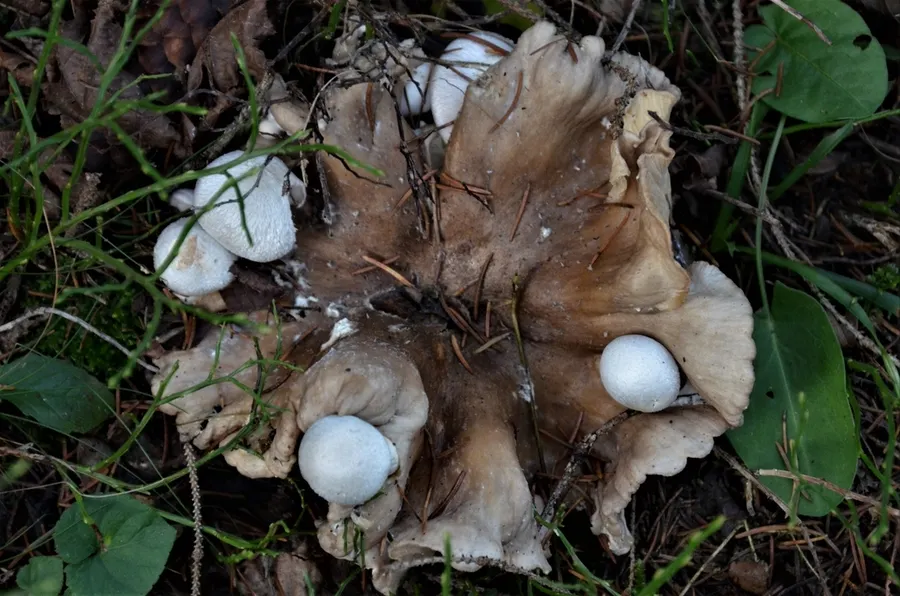
Volvariella surrecta grows parasitically on the fruit bodies of Clitocybe species, usually C. nebularis, although it has been reported growing on Tricholoma species, as well as Melanoleuca brevipes. The mushrooms grow in clusters, and fruit in the summer and autumn. The host mushroom is sometimes malformed and assumes an irregular appearance. In an early publication, Charles Bagge Plowright commented "Berkeley's figure ... is rather misleading. So is that given by Knapp under the name Agaricus surrectus ..., inasmuchas they show the Agaric (A. nebularis), upon which it is parasitic, in a very robust condition. In my specimen the host (A. nebularis) was quite sodden and collapsed so as to be practically unrecognisable unless one had known what species to expect." Volvariella surrecta is a rare species, even though its major host is quite common; the conditions required for the parasite to produce fruit bodies are not well known. Some authors have suggested that it may grow equally well as a parasite or a saprobe. V. surrecta has been found on its host in several different habitat types, including birch woodlands, pine plantations, scrub, thickets of small trees or shrubs beside roads, and under brambles.

Sebagian uraian ditampilkan dalam bahasa sumber; terjemahannya belum tersedia atau belum lolos pemeriksaan.

Rujukan: [1]

Habitat atau konteks temuan
Informasi belum tersedia pada sumber rilis ini.
Substrat
Informasi belum tersedia pada sumber rilis ini.
Peran atau konteks
Belum dikategorikan pada rilis ini.
Temukan hubungan serupa
03 / Siklus hidup

Reproduksi

The color of the spore print is brownish-pink. The spores are egg-shaped to oval, measuring 5.4–7.6 by 3.4–4.9 μm. The basidia (spore-bearing cells) are club-shaped, four-spored, and measure 20–31 by 5–10 μm. The pleurocystidia (cystidia on the gill face) are fusoid-ventricose (distinctly enlarged in the middle and tapered toward both ends), sometimes with an elongated neck. The cheilocystidia (cystidia on the gill edge) are also fusoid-ventricose with a neck that is sometimes short and bulbous; they measure 25–50 by 6–20 μm. The hyphae do not have clamp connections.

Sebagian uraian ditampilkan dalam bahasa sumber; terjemahannya belum tersedia atau belum lolos pemeriksaan.

Rujukan: [1]

Sinonim menurut acuan taksonomi rilis: Agaricus loveianus; Agaricus surrectus; Volvaria hypopithys subsp. loveiana; Volvaria loveiana; Volvaria surrecta; Volvariella loveiana; Volvariopsis loveiana
04 / Batas informasi

Catatan identitas dan cakupan

  • Nama diterima mengikuti Catalogue of Life Base2026-09-11; uraian mempertahankan konsep dan nama sumber aslinya.
  • Original geographic, specimen and life-cycle scope retained; source import awaits individual editorial review.
  • Impor dan terjemahan otomatis belum diperiksa editorial per profil. Struktur reproduktif yang disebutkan tidak membuktikan seluruh siklus hidup diketahui.
  • Pengukuran pada uraian mengikuti spesimen, kultur, dan metode sumber; angka tidak diperluas ke semua populasi.

Catatan distribusi dalam narasi mengikuti sumbernya. Dokumentasi spesimen atau foto mengikuti catatan sumber. Bukti wilayah Indonesia dan penilaian konservasi tidak disimpulkan dari gambar.

05 / Dokumentasi

Melihat dengan konteks

Dokumentasi Volvariella surrecta menurut asosiasi foto pada record takson iNaturalist. Kredit: E. A.. Identitas mengikuti sumber; bukan penentuan spesimen independen.

Jenis
Fotografi
Kredit
(c) E. A., some rights reserved (CC BY), uploaded by E. A.
Lisensi
CC BY 4.0
Sumber media
Buka entri sumber

Gambar menunjukkan objek menurut identifikasi sumber, bukan verifikasi independen spesimen oleh Fungi. Tidak ada skala baru yang ditambahkan.

06 / Rujukan

Sumber profil

  1. [1] Volvariella surrecta — Wikipedia (en)Bagian sumber: Frozen revision 1338335240
    Tanggal penghimpunan sumber: 2026-10-12
    Teks sumber: CC BY-SA4.0 · Wikipedia contributors
  2. [2] Catalogue of Life Base2026-09-11 — Volvariella surrectaBagian sumber: ColDP NameUsage.tsv ID 5BQBR; accepted species; source 2073
    Tanggal penghimpunan sumber: 2026-10-12
  3. [3] Dokumentasi visual — Volvariella surrectaBagian sumber: Individual media record; identification follows the source, not independent determination
    Tanggal penghimpunan sumber: 2026-10-12
    Media sumber: CC BY 4.0 · (c) E. A., some rights reserved (CC BY), uploaded by E. A.

Adaptasi teks: CC BY-SA 4.0. Wikipedia contributors — Volvariella surrecta — Wikipedia (en)

Uraian asli dan riwayat sumber

Riwayat atau halaman sumber

Ringkasan sumber

Volvariella surrecta, commonly known as the piggyback rosegill, is an agaric fungus in the family Pluteaceae. V. surrecta mushrooms have white or greyish silky-hairy caps up to 8 cm in diameter, and white gills that turns pink in maturity. The stipe, also white, is up to 9 cm long, and has a sack-like volva at its base. Although rare, the species is widely distributed, having been reported from Eurasia, northern Africa, North America, and New Zealand. The fungus grows as a parasite on the fruit bodies of other gilled mushrooms, usually Clitocybe nebularis.

Revisi sumber

Morfologi sumber

The fruit bodies of V. surrecta have caps that are initially ovoid (egg-shaped. Later they become bell-shaped or convex before flattening; reaching diameters of 2.5 - 8 cm. The cap sometimes has a shallow umbo, although the presence of this character is not consistent. The cap surface is dry and covered with long, silky hairs; the color is white to light gray, with a yellowish or brownish center. The gills are free from attachment to the stipe and are packed close together. They are initially white, later becoming pink. There are many lamellulae (short gills that do not extend fully from cap margin to the stipe) interspersed between the gills. The stipe is 4 - 9 cm long by 4 - 12 mm thick, and roughly equal in width throughout the length or somewhat thicker at the base. Its color is white to light gray, and the stipe surface is appressed-fibrillose, with a pruinose coating near the apex. The white volva measures 1.3 - 2.5 cm high and 0.6 - 1.3 cm broad, and has a lobed margin. The mushroom is not edible. The color of the spore print is brownish-pink. The spores are egg-shaped to oval, measuring 5.4–7.6 by 3.4–4.9 μm. The basidia (spore-bearing cells) are club-shaped, four-spored, and measure 20–31 by 5–10 μm. The pleurocystidia (cystidia on the gill face) are fusoid-ventricose (distinctly enlarged in the middle and tapered toward both ends), sometimes with an elongated neck. The cheilocystidia (cystidia on the gill edge) are also fusoid-ventricose with a neck that is sometimes short and bulbous; they measure 25–50 by 6–20 μm. The hyphae do not have clamp connections.

Revisi sumber

Ekologi sumber

Volvariella surrecta grows parasitically on the fruit bodies of Clitocybe species, usually C. nebularis, although it has been reported growing on Tricholoma species, as well as Melanoleuca brevipes. The mushrooms grow in clusters, and fruit in the summer and autumn. The host mushroom is sometimes malformed and assumes an irregular appearance. In an early publication, Charles Bagge Plowright commented "Berkeley's figure ... is rather misleading. So is that given by Knapp under the name Agaricus surrectus ..., inasmuchas they show the Agaric (A. nebularis), upon which it is parasitic, in a very robust condition. In my specimen the host (A. nebularis) was quite sodden and collapsed so as to be practically unrecognisable unless one had known what species to expect." Volvariella surrecta is a rare species, even though its major host is quite common; the conditions required for the parasite to produce fruit bodies are not well known. Some authors have suggested that it may grow equally well as a parasite or a saprobe. V. surrecta has been found on its host in several different habitat types, including birch woodlands, pine plantations, scrub, thickets of small trees or shrubs beside roads, and under brambles.

Revisi sumber

Struktur reproduksi sumber

The color of the spore print is brownish-pink. The spores are egg-shaped to oval, measuring 5.4–7.6 by 3.4–4.9 μm. The basidia (spore-bearing cells) are club-shaped, four-spored, and measure 20–31 by 5–10 μm. The pleurocystidia (cystidia on the gill face) are fusoid-ventricose (distinctly enlarged in the middle and tapered toward both ends), sometimes with an elongated neck. The cheilocystidia (cystidia on the gill edge) are also fusoid-ventricose with a neck that is sometimes short and bulbous; they measure 25–50 by 6–20 μm. The hyphae do not have clamp connections.

Revisi sumber

Rujukan halaman ini

Fungi. Volvariella surrecta. Rilis data fungi-2026-10-12-expansion-2. https://fungi-atlas.mgadib.chatgpt.site/jamur/volvariella-surrecta/.

Status: impor sumber; pemeriksaan editorial per profil belum selesai. Untuk klaim biologis, gunakan rujukan pada bagian terkait dan periksa konteks sumber aslinya.