01 / Morfologi

Ciri dan struktur

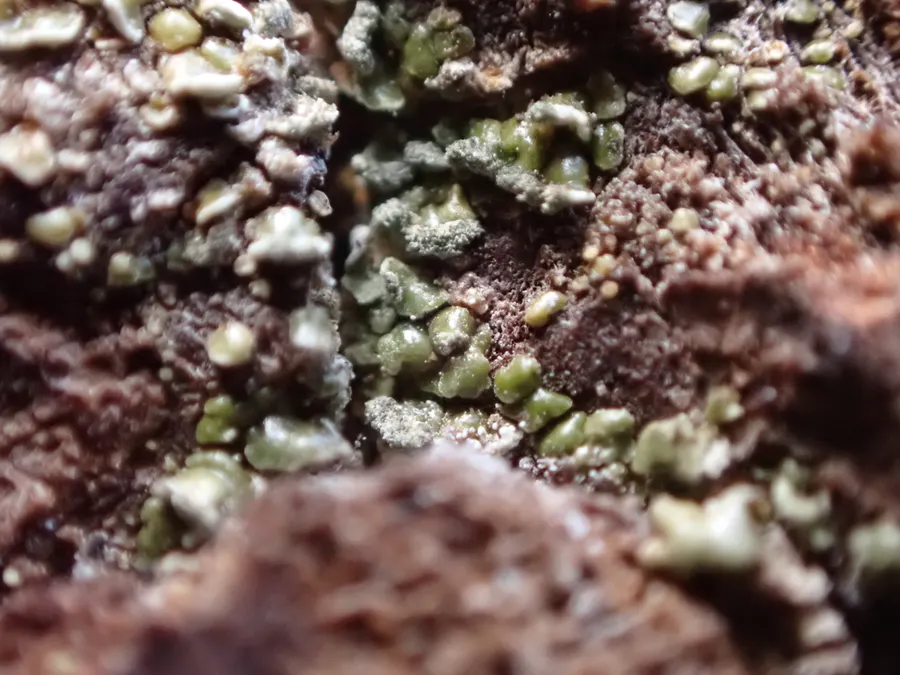
The lichen forms an irregular, (scale-like) thallus made up of small patches up to about 0.5 cm across, which can merge to form larger colonies. Each patch consists of a few convex, upward-curving less than 0.5 mm wide. The upper surface is olive-green to brown-green, sometimes glossy, and develops pale spots that become knob-like outgrowths. These eventually open into cup-shaped soralia—structures that produce powdery clusters of reproductive cells (soredia) for asexual dispersal. The lichen lacks a distinct lower , and its photobiont partner is a green alga of the Myrmecia type. Apothecia (sexual fruiting bodies) are rare, small (up to 0.5 mm across), and borne on short stalks. They are bluish gray with a pale, smooth (biatorine) margin. Inside, the spore-bearing layer (hymenium) is up to 80 μm tall. The asci (spore sacs) are cylindrical to club-shaped, each producing eight spores and possessing an amyloid (starch-reactive) apical dome. The ascospores are colorless, elongated with three internal cross-walls (3-septate), and measure 13–19 × 3–4 μm. No pycnidia have been observed, and chemical analysis by thin-layer chromatography has detected no lichen substances.

Sebagian uraian ditampilkan dalam bahasa sumber; terjemahannya belum tersedia atau belum lolos pemeriksaan.

Rujukan: [1]

Pengukuran mengikuti objek, spesimen atau kultur, dan metode yang disebutkan sumber. Baca uraian asli untuk konteks lengkap.

02 / Kehidupan

Habitat dan peran ekologis

Waynea californica is known only from a few sites in California, including the Big Sur region and the Santa Lucia Mountains. It grows on the trunks of solitary trees, especially oaks, in relatively open habitats along roadsides, occurring on both exposed and shaded trunk surfaces. The type collection was found alongside other lichens such as species of Physcia and Phaeophyscia. The species' combination of cup-shaped soralia and small, stalked apothecia makes it distinctive, although the apothecia can be difficult to see because they are pale and often mixed with the soralia. In Washington, Waynea californica has been rarely reported and is proposed for monitoring as an oak-obligate indicator species in Garry oak woodlands.

Sebagian uraian ditampilkan dalam bahasa sumber; terjemahannya belum tersedia atau belum lolos pemeriksaan.

Rujukan: [1]

Habitat atau konteks temuan
Informasi belum tersedia pada sumber rilis ini.
Substrat
Informasi belum tersedia pada sumber rilis ini.
Peran atau konteks
Pembentuk liken
Temukan hubungan serupa
03 / Siklus hidup

Reproduksi

The lichen forms an irregular, (scale-like) thallus made up of small patches up to about 0.5 cm across, which can merge to form larger colonies. Each patch consists of a few convex, upward-curving less than 0.5 mm wide. The upper surface is olive-green to brown-green, sometimes glossy, and develops pale spots that become knob-like outgrowths. These eventually open into cup-shaped soralia—structures that produce powdery clusters of reproductive cells (soredia) for asexual dispersal. The lichen lacks a distinct lower , and its photobiont partner is a green alga of the Myrmecia type. Apothecia (sexual fruiting bodies) are rare, small (up to 0.5 mm across), and borne on short stalks. They are bluish gray with a pale, smooth (biatorine) margin.

Sebagian uraian ditampilkan dalam bahasa sumber; terjemahannya belum tersedia atau belum lolos pemeriksaan.

Rujukan: [1]

04 / Batas informasi

Catatan identitas dan cakupan

  • Nama diterima mengikuti Catalogue of Life Base2026-09-11; uraian mempertahankan konsep dan nama sumber aslinya.
  • Original geographic, specimen and life-cycle scope retained; source import awaits individual editorial review.
  • Impor dan terjemahan otomatis belum diperiksa editorial per profil. Struktur reproduktif yang disebutkan tidak membuktikan seluruh siklus hidup diketahui.
  • Pengukuran pada uraian mengikuti spesimen, kultur, dan metode sumber; angka tidak diperluas ke semua populasi.

Catatan distribusi dalam narasi mengikuti sumbernya. Dokumentasi spesimen atau foto mengikuti catatan sumber. Bukti wilayah Indonesia dan penilaian konservasi tidak disimpulkan dari gambar.

05 / Dokumentasi

Melihat dengan konteks

Dokumentasi Waynea californica menurut asosiasi foto pada record takson iNaturalist. Kredit: Fotografer tidak dicantumkan. Sumber observasi iNaturalist; pengunggah: Randal. Identitas mengikuti sumber; bukan penentuan spesimen independen.

Jenis
Fotografi
Kredit
Fotografer tidak dicantumkan. Sumber observasi iNaturalist; pengunggah: Randal
Lisensi
CC0 1.0
Sumber media
Buka entri sumber

Gambar menunjukkan objek menurut identifikasi sumber, bukan verifikasi independen spesimen oleh Fungi. Tidak ada skala baru yang ditambahkan.

06 / Rujukan

Sumber profil

  1. [1] Waynea californica — Wikipedia (en)Bagian sumber: Frozen revision 1321748798
    Tanggal penghimpunan sumber: 2026-10-12
    Teks sumber: CC BY-SA4.0 · Wikipedia contributors
  2. [2] Catalogue of Life Base2026-09-11 — Waynea californicaBagian sumber: ColDP NameUsage.tsv ID 5BVGZ; accepted species; source 2073
    Tanggal penghimpunan sumber: 2026-10-12
  3. [3] Dokumentasi visual — Waynea californicaBagian sumber: Individual media record; identification follows the source, not independent determination
    Tanggal penghimpunan sumber: 2026-10-12
    Media sumber: CC0 1.0 · Fotografer tidak dicantumkan. Sumber observasi iNaturalist; pengunggah: Randal

Adaptasi teks: CC BY-SA 4.0. Wikipedia contributors — Waynea californica — Wikipedia (en)

Uraian asli dan riwayat sumber

Riwayat atau halaman sumber

Ringkasan sumber

Waynea californica is a species of lichen in the family Ramalinaceae. This rare lichen forms small, scale-like patches on oak tree trunks, with an olive-green to brownish-green surface that develops distinctive cup-shaped structures filled with powdery reproductive material. It is known primarily from California, particularly around Big Sur and the Santa Lucia Mountains, with rare reports also from Washington State, where it grows on solitary oak trees in relatively open areas.

Revisi sumber

Morfologi sumber

The lichen forms an irregular, (scale-like) thallus made up of small patches up to about 0.5 cm across, which can merge to form larger colonies. Each patch consists of a few convex, upward-curving less than 0.5 mm wide. The upper surface is olive-green to brown-green, sometimes glossy, and develops pale spots that become knob-like outgrowths. These eventually open into cup-shaped soralia—structures that produce powdery clusters of reproductive cells (soredia) for asexual dispersal. The lichen lacks a distinct lower , and its photobiont partner is a green alga of the Myrmecia type. Apothecia (sexual fruiting bodies) are rare, small (up to 0.5 mm across), and borne on short stalks. They are bluish gray with a pale, smooth (biatorine) margin. Inside, the spore-bearing layer (hymenium) is up to 80 μm tall. The asci (spore sacs) are cylindrical to club-shaped, each producing eight spores and possessing an amyloid (starch-reactive) apical dome. The ascospores are colorless, elongated with three internal cross-walls (3-septate), and measure 13–19 × 3–4 μm. No pycnidia have been observed, and chemical analysis by thin-layer chromatography has detected no lichen substances.

Revisi sumber

Ekologi sumber

Waynea californica is known only from a few sites in California, including the Big Sur region and the Santa Lucia Mountains. It grows on the trunks of solitary trees, especially oaks, in relatively open habitats along roadsides, occurring on both exposed and shaded trunk surfaces. The type collection was found alongside other lichens such as species of Physcia and Phaeophyscia. The species' combination of cup-shaped soralia and small, stalked apothecia makes it distinctive, although the apothecia can be difficult to see because they are pale and often mixed with the soralia. In Washington, Waynea californica has been rarely reported and is proposed for monitoring as an oak-obligate indicator species in Garry oak woodlands.

Revisi sumber

Struktur reproduksi sumber

The lichen forms an irregular, (scale-like) thallus made up of small patches up to about 0.5 cm across, which can merge to form larger colonies. Each patch consists of a few convex, upward-curving less than 0.5 mm wide. The upper surface is olive-green to brown-green, sometimes glossy, and develops pale spots that become knob-like outgrowths. These eventually open into cup-shaped soralia—structures that produce powdery clusters of reproductive cells (soredia) for asexual dispersal. The lichen lacks a distinct lower , and its photobiont partner is a green alga of the Myrmecia type. Apothecia (sexual fruiting bodies) are rare, small (up to 0.5 mm across), and borne on short stalks. They are bluish gray with a pale, smooth (biatorine) margin.

Revisi sumber

Rujukan halaman ini

Fungi. Waynea californica. Rilis data fungi-2026-10-12-expansion-2. https://fungi-atlas.mgadib.chatgpt.site/jamur/waynea-californica/.

Status: impor sumber; pemeriksaan editorial per profil belum selesai. Untuk klaim biologis, gunakan rujukan pada bagian terkait dan periksa konteks sumber aslinya.