Ciri dan struktur
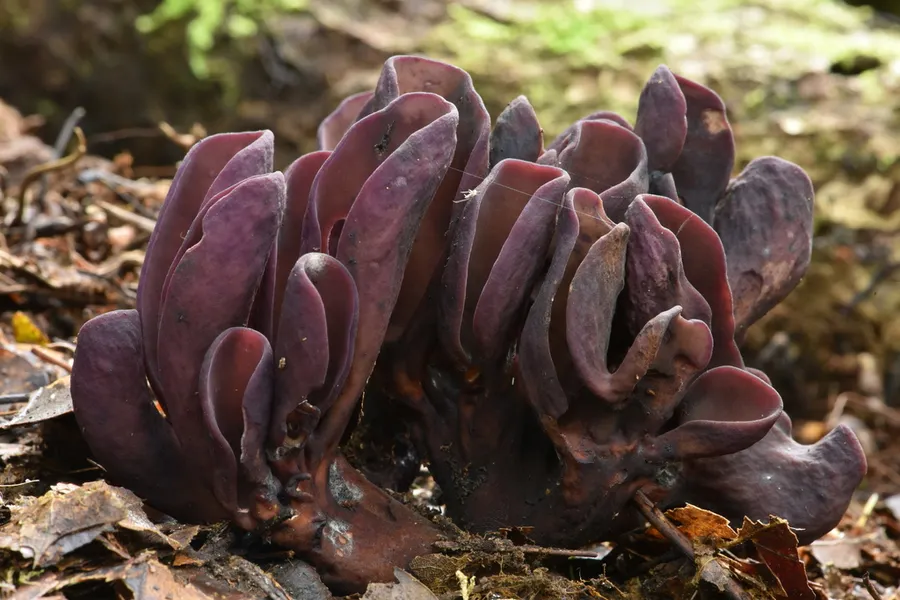
The fruit bodies (technically called apothecia) of W. americana are erect and spoon- or ear-shaped, and may reach up to 13 cm tall by 6 cm wide with the edges usually rolled inward. The outside surface is dark brown–purplish, while the inner surface—the spore-bearing hymenium—is pinkish orange to dull purplish red or brown at maturity. The outer surface may develop wrinkles in maturity. The apothecia, which occur singly or in groups of up to about 25, arise from a short stalk. The stalk is variable in length and solid, dark outside, white within. The stalks originate from a sclerotium, a compact mass of hardened mycelium. The sclerotium has an almost gelatinous consistency with irregularly shaped lobes and internal chambers, and may reach a diameter of 4 to 6 cm. The sclerotium's function is thought to supply moisture and nutrients, or to serve as a resistant structure capable of sustaining the fungus through times of stress. W. macrotis is the only other species in the genus to bear a sclerotium. Wynnea americana has no discernible odor, and its taste is unknown. It has been described as inedible due to its toughness. Clusters of fruit bodies are connected by large underground masses of compacted mycelia known as sclerotia. Armillaria mycelium is commonly found in the underground tissue, though it is unclear if there is a parasitic relationship. With many cup fungi, microscopic analysis of the anatomy and structure of the apothecium is necessary for accurate identification of species, or to help distinguish between related species that have a similar external appearance. In W. americana, the ectal excipulum (the outer layer of tissue comprising the apothecia) is 125 μm thick, and composed of dark angular to roughly spherical cells that are 40–70 μm in diameter.
Habitat dan peran ekologis
Di Amerika Utara, W. americana telah dikumpulkan dari beberapa lokasi, termasuk Tennessee, New York, Virginia Barat, Carolina Utara, Ohio, dan Pennsylvania. Ia juga telah dikumpulkan di Meksiko, Kosta Rika, India, dan Jepang. The fruit bodies grow solitarily or in clusters on the ground in deciduous forests, and prefer moist, organic soils. In both Asia and North America, fruit bodies are most often produced during August and September. Central American collection, dari Kosta Rika, dibuat pada awal November.
- Habitat atau konteks temuan
- hutan
- Substrat
- tanah
- Peran atau konteks
- Belum dikategorikan pada rilis ini.
Reproduksi
The fruit bodies (technically called apothecia) of W. americana are erect and spoon- or ear-shaped, and may reach up to 13 cm tall by 6 cm wide with the edges usually rolled inward. The outside surface is dark brown–purplish, while the inner surface—the spore-bearing hymenium—is pinkish orange to dull purplish red or brown at maturity. The outer surface may develop wrinkles in maturity. The apothecia, which occur singly or in groups of up to about 25, arise from a short stalk. The stalk is variable in length and solid, dark outside, white within. The stalks originate from a sclerotium, a compact mass of hardened mycelium. The sclerotium has an almost gelatinous consistency with irregularly shaped lobes and internal chambers, and may reach a diameter of 4 to 6 cm.
Catatan identitas dan cakupan
- Nama diterima mengikuti Catalogue of Life Base2026-09-11; uraian mempertahankan konsep dan nama sumber aslinya.
- Original geographic, specimen and life-cycle scope retained; source import awaits individual editorial review.
- Impor dan terjemahan otomatis belum diperiksa editorial per profil. Struktur reproduktif yang disebutkan tidak membuktikan seluruh siklus hidup diketahui.
- Pengukuran pada uraian mengikuti spesimen, kultur, dan metode sumber; angka tidak diperluas ke semua populasi.
Catatan distribusi dalam narasi mengikuti sumbernya. Dokumentasi spesimen atau foto mengikuti catatan sumber. Bukti wilayah Indonesia dan penilaian konservasi tidak disimpulkan dari gambar.
Melihat dengan konteks
Dokumentasi Wynnea americana menurut asosiasi foto pada record takson iNaturalist. Kredit: Alan Rockefeller. Identitas mengikuti sumber; bukan penentuan spesimen independen.
- Jenis
- Fotografi
- Kredit
- (c) Alan Rockefeller, some rights reserved (CC BY), uploaded by Alan Rockefeller
- Lisensi
- CC BY 4.0
- Sumber media
- Buka entri sumber
Sumber profil
- [1] Wynnea americana — Wikipedia (en)
- [2] Catalogue of Life Base2026-09-11 — Wynnea americana
- [3] Dokumentasi visual — Wynnea americana
Rujukan halaman ini
Fungi. Wynnea americana. Rilis data fungi-2026-10-12-expansion-2. https://fungi-atlas.mgadib.chatgpt.site/jamur/wynnea-americana/.
Status: impor sumber; pemeriksaan editorial per profil belum selesai. Untuk klaim biologis, gunakan rujukan pada bagian terkait dan periksa konteks sumber aslinya.