01 / Morfologi

Ciri dan struktur

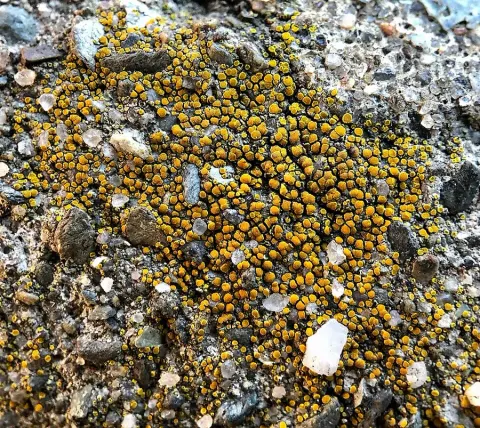
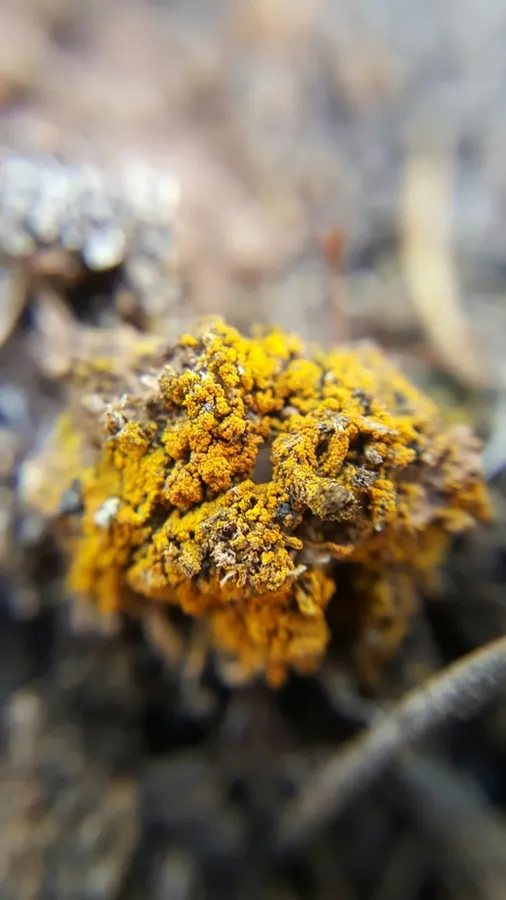
Xanthocarpia tominii is a crustose lichen with a thallus that is usually egg-yellow to orange-yellow, but may also appear brownish, light yellow, or greenish-orange. It is made up of small, rounded s that may be scattered or fused into a larger crust. These areoles are usually convex and only slightly lobed. The larger ones, before they become , can be somewhat shield-shaped, while the smaller ones are attached directly by hyphae. Lobes are usually absent, although older specimens may develop small marginal lobes. There is no distinct . The thallus produces abundant soredia, usually along the raised margins of the areoles and sometimes across their upper surface as well, giving older parts a more powdery appearance. Apothecia (fruiting bodies), when present, are very rare, small, and flat, with a dull orange to reddish-brown that may darken with age, and a thick margin that is often also sorediate. The internal tissues include a thin , a continuous , and a dense medulla. The thallus gives a red reaction with potassium hydroxide solution (K).

Sebagian uraian ditampilkan dalam bahasa sumber; terjemahannya belum tersedia atau belum lolos pemeriksaan.

Rujukan: [1]

Pengukuran mengikuti objek, spesimen atau kultur, dan metode yang disebutkan sumber. Baca uraian asli untuk konteks lengkap.

02 / Kehidupan

Habitat dan peran ekologis

In North America, Xanthocarpia tominii grows on soil rather than rock, occurring on both calcareous and non-calcareous substrates in dry, open habitats. It is found chiefly in western North America and Arctic localities including Greenland, and has been recorded in southwestern Yukon on loess deposits in open Artemisia steppe. The species is adapted to dry, exposed, base-rich sites in regions with a strongly continental climate, which helps explain its occurrence in semi-desert habitats. Its usual growth on soil helps distinguish it from the more rock-inhabiting Flavoplaca citrina.

Sebagian uraian ditampilkan dalam bahasa sumber; terjemahannya belum tersedia atau belum lolos pemeriksaan.

Rujukan: [1]

Habitat atau konteks temuan
Informasi belum tersedia pada sumber rilis ini.
Substrat
tanah
Peran atau konteks
Pembentuk liken
Temukan hubungan serupa
03 / Siklus hidup

Reproduksi

The thallus produces abundant soredia, usually along the raised margins of the areoles and sometimes across their upper surface as well, giving older parts a more powdery appearance. Apothecia (fruiting bodies), when present, are very rare, small, and flat, with a dull orange to reddish-brown that may darken with age, and a thick margin that is often also sorediate. The internal tissues include a thin , a continuous , and a dense medulla. The thallus gives a red reaction with potassium hydroxide solution (K).

Sebagian uraian ditampilkan dalam bahasa sumber; terjemahannya belum tersedia atau belum lolos pemeriksaan.

Rujukan: [1]

Sinonim menurut acuan taksonomi rilis: Callopisma tominii; Caloplaca tominii; Gasparrinia tominii
04 / Batas informasi

Catatan identitas dan cakupan

  • Nama diterima mengikuti Catalogue of Life Base2026-09-11; uraian mempertahankan konsep dan nama sumber aslinya.
  • Original geographic, specimen and life-cycle scope retained; source import awaits individual editorial review.
  • Impor dan terjemahan otomatis belum diperiksa editorial per profil. Struktur reproduktif yang disebutkan tidak membuktikan seluruh siklus hidup diketahui.
  • Pengukuran pada uraian mengikuti spesimen, kultur, dan metode sumber; angka tidak diperluas ke semua populasi.

Catatan distribusi dalam narasi mengikuti sumbernya. Dokumentasi spesimen atau foto mengikuti catatan sumber. Bukti wilayah Indonesia dan penilaian konservasi tidak disimpulkan dari gambar.

05 / Dokumentasi

Melihat dengan konteks

Dokumentasi Xanthocarpia tominii menurut asosiasi foto pada record takson iNaturalist. Kredit: Toby. Identitas mengikuti sumber; bukan penentuan spesimen independen.

Jenis
Fotografi
Kredit
(c) Toby, some rights reserved (CC BY), uploaded by Toby
Lisensi
CC BY 4.0
Sumber media
Buka entri sumber

Gambar menunjukkan objek menurut identifikasi sumber, bukan verifikasi independen spesimen oleh Fungi. Tidak ada skala baru yang ditambahkan.

06 / Rujukan

Sumber profil

  1. [1] Xanthocarpia tominii — Wikipedia (en)Bagian sumber: Frozen revision 1348700043
    Tanggal penghimpunan sumber: 2026-10-12
    Teks sumber: CC BY-SA4.0 · Wikipedia contributors
  2. [2] Catalogue of Life Base2026-09-11 — Xanthocarpia tominiiBagian sumber: ColDP NameUsage.tsv ID 5C58X; accepted species; source 2073
    Tanggal penghimpunan sumber: 2026-10-12
  3. [3] Dokumentasi visual — Xanthocarpia tominiiBagian sumber: Individual media record; identification follows the source, not independent determination
    Tanggal penghimpunan sumber: 2026-10-12
    Media sumber: CC BY 4.0 · (c) Toby, some rights reserved (CC BY), uploaded by Toby

Adaptasi teks: CC BY-SA 4.0. Wikipedia contributors — Xanthocarpia tominii — Wikipedia (en)

Uraian asli dan riwayat sumber

Riwayat atau halaman sumber

Ringkasan sumber

Xanthocarpia tominii is a species of lichen-forming fungus in the family Teloschistaceae. It is a crustose lichen with an orange to greenish-orange thallus that produces soredia, and is unusual in its group for growing on soil rather than rock. It occurs mainly in semi-desert and Arctic habitats in Russia, western North America, and Greenland.

Revisi sumber

Morfologi sumber

Xanthocarpia tominii is a crustose lichen with a thallus that is usually egg-yellow to orange-yellow, but may also appear brownish, light yellow, or greenish-orange. It is made up of small, rounded s that may be scattered or fused into a larger crust. These areoles are usually convex and only slightly lobed. The larger ones, before they become , can be somewhat shield-shaped, while the smaller ones are attached directly by hyphae. Lobes are usually absent, although older specimens may develop small marginal lobes. There is no distinct . The thallus produces abundant soredia, usually along the raised margins of the areoles and sometimes across their upper surface as well, giving older parts a more powdery appearance. Apothecia (fruiting bodies), when present, are very rare, small, and flat, with a dull orange to reddish-brown that may darken with age, and a thick margin that is often also sorediate. The internal tissues include a thin , a continuous , and a dense medulla. The thallus gives a red reaction with potassium hydroxide solution (K).

Revisi sumber

Ekologi sumber

In North America, Xanthocarpia tominii grows on soil rather than rock, occurring on both calcareous and non-calcareous substrates in dry, open habitats. It is found chiefly in western North America and Arctic localities including Greenland, and has been recorded in southwestern Yukon on loess deposits in open Artemisia steppe. The species is adapted to dry, exposed, base-rich sites in regions with a strongly continental climate, which helps explain its occurrence in semi-desert habitats. Its usual growth on soil helps distinguish it from the more rock-inhabiting Flavoplaca citrina.

Revisi sumber

Struktur reproduksi sumber

The thallus produces abundant soredia, usually along the raised margins of the areoles and sometimes across their upper surface as well, giving older parts a more powdery appearance. Apothecia (fruiting bodies), when present, are very rare, small, and flat, with a dull orange to reddish-brown that may darken with age, and a thick margin that is often also sorediate. The internal tissues include a thin , a continuous , and a dense medulla. The thallus gives a red reaction with potassium hydroxide solution (K).

Revisi sumber

Rujukan halaman ini

Fungi. Xanthocarpia tominii. Rilis data fungi-2026-10-12-expansion-2. https://fungi-atlas.mgadib.chatgpt.site/jamur/xanthocarpia-tominii/.

Status: impor sumber; pemeriksaan editorial per profil belum selesai. Untuk klaim biologis, gunakan rujukan pada bagian terkait dan periksa konteks sumber aslinya.