Ciri dan struktur
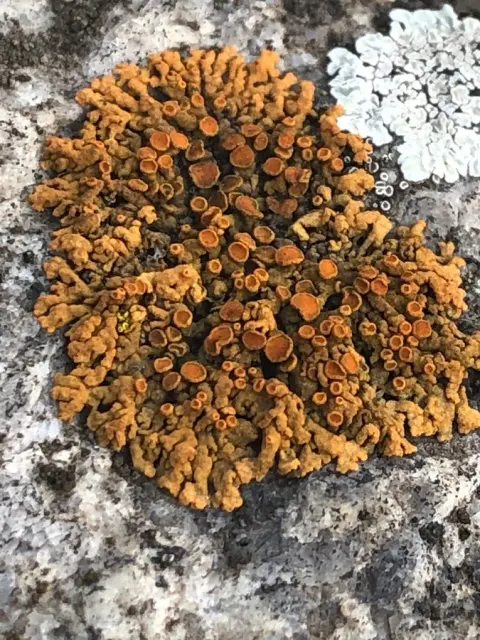
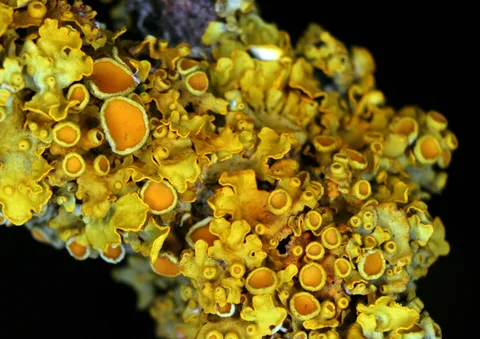
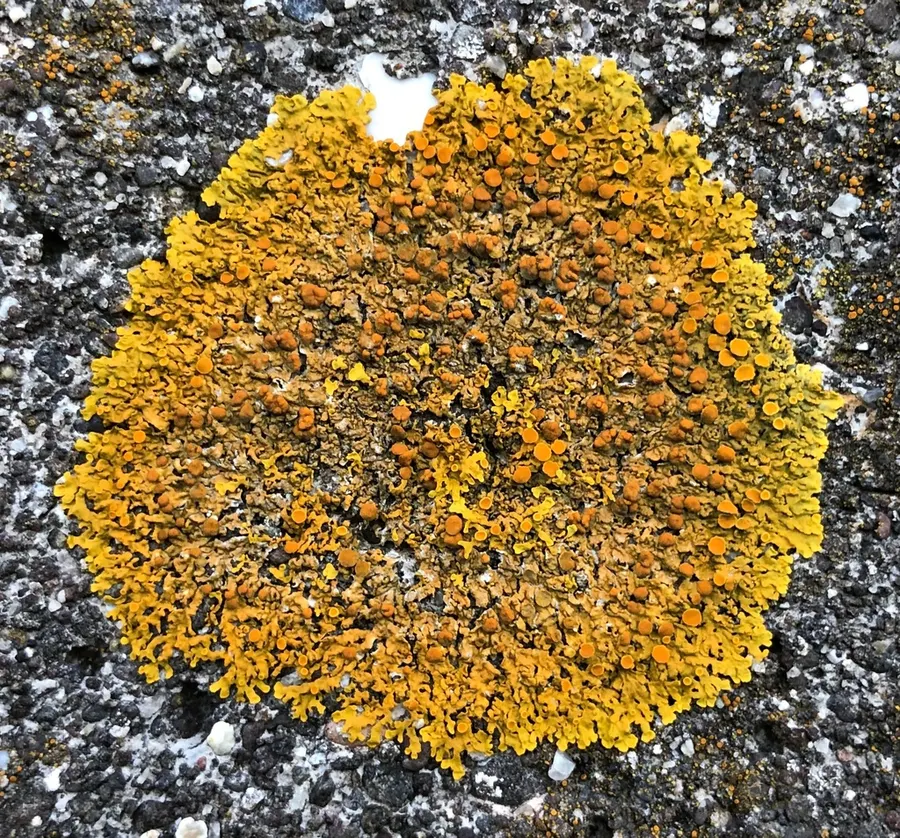
The thallus of X. aureola is bright yellow, orange, or orange-red with a foliose morphology. Mutatoxanthin, a carotenoid important in the protection of the photosynthetic component against harsh sunlight, represents 94.4% of the total carotenoid content in X. aureola. Of all Xanthoria species, X. aureola contains the most mutatoxanthin. X. aureola is often confused with closely related species X. parietina and X. calcicola. In comparison, X. aureola has a brighter thallus color as well as a considerably thicker medulla (187 mm compared to 114–120 mm). Additionally, the rough upper surface of X. aureola contains few apothecia and does not contain soredia or isidia; laminar structures are lobules. Last, substrate is important: X. aureola is restricted to seashore rocks, while X. calcicola and X. parietinia can be found on almost any rock or wall.
Habitat dan peran ekologis
Xanthoria aureola grows on exposed maritime rocks in sunny areas. It generally grows on nutrient-rich, siliceous rocks, as well as limestone and lignum. It is found on European coasts 0–150 meters above sea level. Some countries in which X. aureola is commonly found include Spain, Portugal, France, Ireland, Denmark, Sweden, Norway, Italy, and the UK. It usually grows next to X. parietina, but in greater abundance and on exposed rock. The algal symbiont in X. aureola is Trebouxia. Trebouxia fixes 14C mainly into ribitol during photosynthesis; approximately 80% is ribitol, 5% is sucrose, 4% is organic acids, and 9% is baseline CH. Therefore, ribitol is the main way in which carbohydrates are transferred among symbionts in the thallus. Environmental stress (i.e., increased UV light) enhances the creation of reactive oxygen species (ROS), including superoxide and hydrogen peroxide. Membrane integrity was measured via conductivity and potential photosystem II (PSII) efficiency (Fv/Fm), with the former being a more accurate measure. High UV, salt, and heavy metal concentrations increased membrane dissolution and electrolyte leakage. X. aureola was more resistant to salt than other lichenized species Lobaria pulmonaria and Parmelia sulcata.
- Habitat atau konteks temuan
- Informasi belum tersedia pada sumber rilis ini.
- Substrat
- Informasi belum tersedia pada sumber rilis ini.
- Peran atau konteks
- Pembentuk liken
Reproduksi
X. aureola is often confused with closely related species X. parietina and X. calcicola. In comparison, X. aureola has a brighter thallus color as well as a considerably thicker medulla (187 mm compared to 114–120 mm). Additionally, the rough upper surface of X. aureola contains few apothecia and does not contain soredia or isidia; laminar structures are lobules. Last, substrate is important: X. aureola is restricted to seashore rocks, while X. calcicola and X. parietinia can be found on almost any rock or wall.
Catatan identitas dan cakupan
- Nama diterima mengikuti Catalogue of Life Base2026-09-11; uraian mempertahankan konsep dan nama sumber aslinya.
- Original geographic, specimen and life-cycle scope retained; source import awaits individual editorial review.
- Impor dan terjemahan otomatis belum diperiksa editorial per profil. Struktur reproduktif yang disebutkan tidak membuktikan seluruh siklus hidup diketahui.
- Pengukuran pada uraian mengikuti spesimen, kultur, dan metode sumber; angka tidak diperluas ke semua populasi.
Catatan distribusi dalam narasi mengikuti sumbernya. Dokumentasi spesimen atau foto mengikuti catatan sumber. Bukti wilayah Indonesia dan penilaian konservasi tidak disimpulkan dari gambar.
Melihat dengan konteks
Dokumentasi Xanthoria aureola menurut asosiasi foto pada record takson iNaturalist. Kredit: Nova Patch. Identitas mengikuti sumber; bukan penentuan spesimen independen.
- Jenis
- Fotografi
- Kredit
- (c) Nova Patch, some rights reserved (CC BY-SA), uploaded by Nova Patch
- Lisensi
- CC BY-SA 4.0
- Sumber media
- Buka entri sumber
Sumber profil
- [1] Xanthoria aureola — Wikipedia (en)
- [2] Catalogue of Life Base2026-09-11 — Xanthoria aureola
- [3] Dokumentasi visual — Xanthoria aureola
Rujukan halaman ini
Fungi. Xanthoria aureola. Rilis data fungi-2026-10-12-expansion-2. https://fungi-atlas.mgadib.chatgpt.site/jamur/xanthoria-aureola/.
Status: impor sumber; pemeriksaan editorial per profil belum selesai. Untuk klaim biologis, gunakan rujukan pada bagian terkait dan periksa konteks sumber aslinya.