Ciri dan struktur
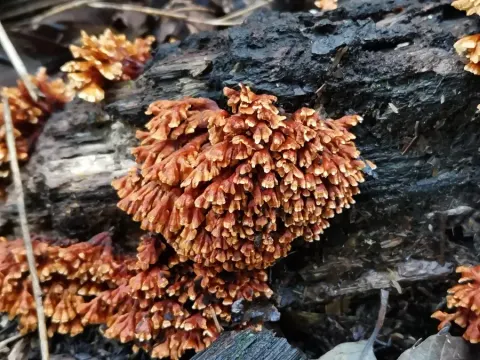
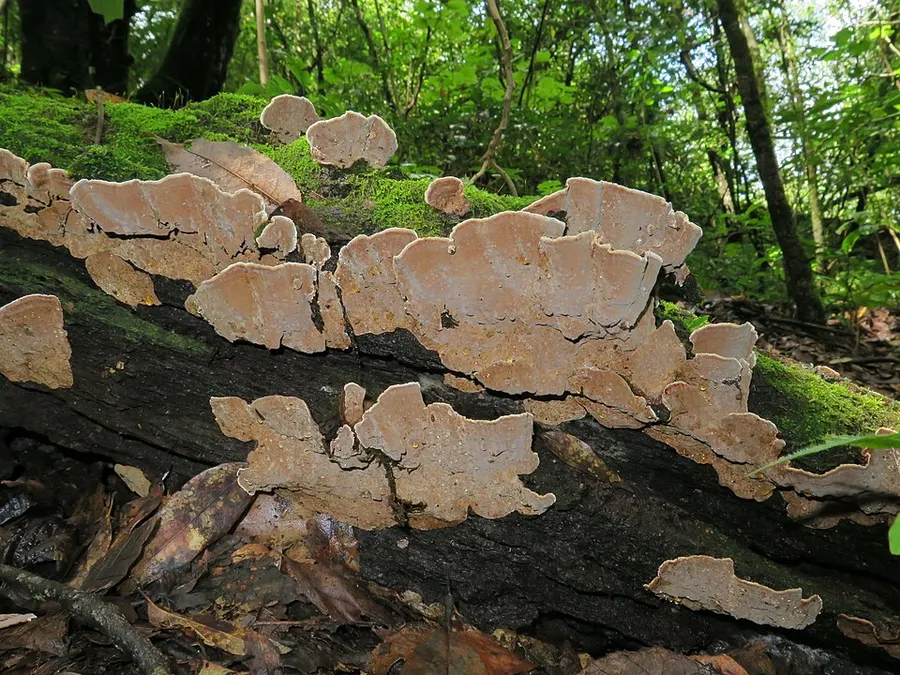
The caps are somewhat flat to wavy, with a dark zonate top and light underside. They are 2–20 cm wide and 1–3.5 cm deep. The wood-inhabiting stereoid fruit bodies form tough, crust-like basidiomes that adhere closely to the substrate, typically developing as effused patches or with reflexed margins on fallen oak logs. Basidiomes often occur adjacent to a characteristic honeycomb-like decay pattern—resulting from selective lignin degradation that leaves medullary ray parenchyma and early-wood vessels intact between pockets of degraded material.
Habitat dan peran ekologis
Xylobolus subpileatus is a saproxylic wood-decay fungus that colonises fallen oakwood, producing its characteristic honeycomb-like decay patterns by selectively degrading lignin. Fruiting bodies appear only on logs of Quercus species, with the likelihood of basidiome formation rising as the wood advances through decay; in old-growth oak forests in Corsica, for example, fruiting probability increases steadily from around 7 years after treefall to peak at roughly 40 years within natural canopy gaps, where deep shade and stable microclimates prevail. Geographically, X. subpileatus has been recorded from at least 14 countries across North America, Europe, Asia and South America, although it is absent from Africa and Antarctica. In eastern North America it is known from mature deciduous forests on fallen oak logs, while in Europe its populations are often scarce and highly localised; several countries list it as endangered (e.g. Austria, Hungary) or critically endangered (Czech Republic). In the Mediterranean basin, occurrences are confined to old-growth Quercus ilex stands on Corsica, where fruiting is restricted to logs in advanced stages of decay within dated canopy gaps.
- Habitat atau konteks temuan
- hutan
- Substrat
- kayu
- Peran atau konteks
- Pengurai
Reproduksi
The caps are somewhat flat to wavy, with a dark zonate top and light underside. They are 2–20 cm wide and 1–3.5 cm deep. The wood-inhabiting stereoid fruit bodies form tough, crust-like basidiomes that adhere closely to the substrate, typically developing as effused patches or with reflexed margins on fallen oak logs. Basidiomes often occur adjacent to a characteristic honeycomb-like decay pattern—resulting from selective lignin degradation that leaves medullary ray parenchyma and early-wood vessels intact between pockets of degraded material.
Catatan identitas dan cakupan
- Nama diterima mengikuti Catalogue of Life Base2026-09-11; uraian mempertahankan konsep dan nama sumber aslinya.
- Original geographic, specimen and life-cycle scope retained; source import awaits individual editorial review.
- Impor dan terjemahan otomatis belum diperiksa editorial per profil. Struktur reproduktif yang disebutkan tidak membuktikan seluruh siklus hidup diketahui.
- Pengukuran pada uraian mengikuti spesimen, kultur, dan metode sumber; angka tidak diperluas ke semua populasi.
Catatan distribusi dalam narasi mengikuti sumbernya. Dokumentasi spesimen atau foto mengikuti catatan sumber. Bukti wilayah Indonesia dan penilaian konservasi tidak disimpulkan dari gambar.
Melihat dengan konteks
Dokumentasi Xylobolus subpileatus dari Wikimedia Commons. Fruit bodies of the crust fungus Xylobolus subpileatus . Specimen photographed in Tonatico, Sierra Gorda, Querétaro, Mexico. Identifikasi mengikuti record berkas sumber.
- Jenis
- Fotografi
- Kredit
- Alan Rockefeller
- Lisensi
- CC BY-SA 3.0
- Sumber media
- Buka entri sumber
Sumber profil
- [1] Xylobolus subpileatus — Wikipedia (en)
- [2] Catalogue of Life Base2026-09-11 — Xylobolus subpileatus
- [3] Dokumentasi visual — Xylobolus subpileatus
Rujukan halaman ini
Fungi. Xylobolus subpileatus. Rilis data fungi-2026-10-12-expansion-2. https://fungi-atlas.mgadib.chatgpt.site/jamur/xylobolus-subpileatus/.
Status: impor sumber; pemeriksaan editorial per profil belum selesai. Untuk klaim biologis, gunakan rujukan pada bagian terkait dan periksa konteks sumber aslinya.