01 / Morfologi

Ciri dan struktur

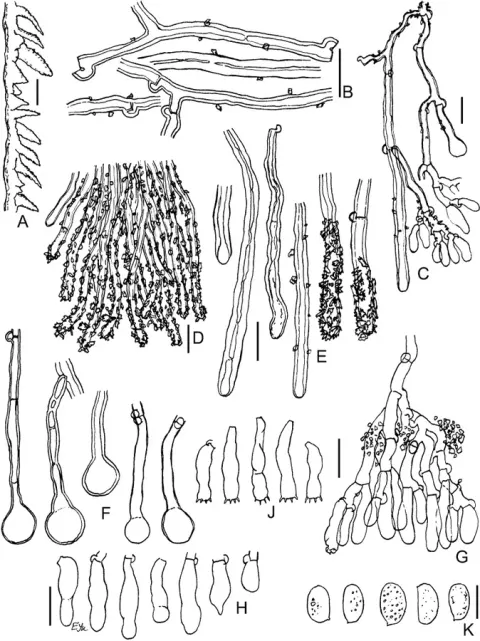
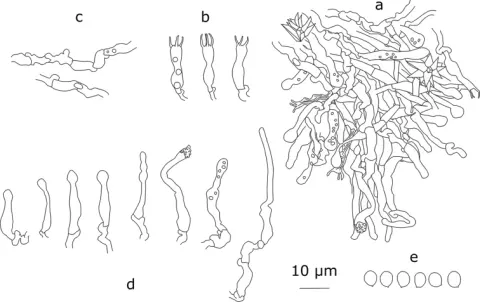
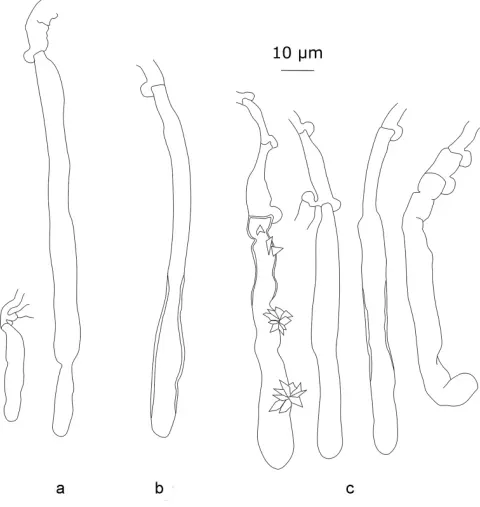
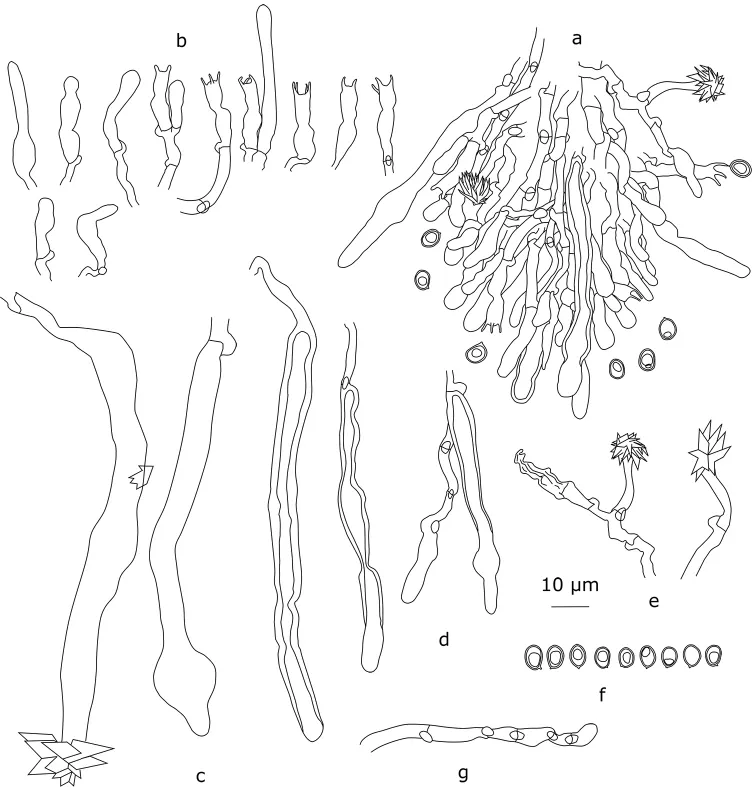
Basidiocarps effused, up to 10 cm in longest dimension. Sterile margin white to pale ochraceous, floccose, up to 1 mm wide. Hymenial surface pale ochraceous, grandinioid to odontoid; projections rather regularly arranged, from 100 µm to 250 μm high, 90–110 μm broad at base, 6–8(–9) per mm. Hyphal structure monomitic, hyphae clamped, faintly cyanophilous, thin-walled. Subicular hyphae interwoven, (3.0–)3.4–6.2 μm in diam. (n=30/3). Tramal hyphae subparallel, subhymenial hyphae short-celled, 1.9–3.9 μm in diam. (n=30/3). Large rhomboid or stellate crystals rarely present in trama and subiculum, 10–19 μm in diam. Cystidia of three types: a) large, thin- or fairly thick-walled (wall up to 2.8 μm thick) cystidia of subicular, tramal or subhymenial origin, cylindrical, spathuliform, almost capitate or with one intercalary inflation at the upper part, (64.0–)71.0–188.9(–220.0)×(5.0–)5.7–9.4(–11.9) μm (n=30/3), often apically encrusted by large rhomboid crystals, b) astrocystidia of subhymenial origin, bearing a stellate crystalline cap 15–17×4.5–4.8 μm, sometimes rare, c) cystidia of subhymenial origin, thin-walled, varying from fusoid to cylindrical or submoniliform, rarely forked, 40.0–84.0(–92.0)×5.0–9.0(–11.4) μm (n=30/3). Basidia suburniform, 4-spored, 14.7–22.8(–24.0)×3.4–4.9 μm (n=30/3), thin-walled. Basidiospores clearly thick-walled, ellipsoid to broadly ellipsoid, usually with an oil-drop, (4.8–)5.1–6.0×3.8–4.6 μm (n=92/3), L=5.48, W=4.21, Q=1.30, cyanophilous.

Sebagian uraian ditampilkan dalam bahasa sumber; terjemahannya belum tersedia atau belum lolos pemeriksaan.

Rujukan: [1]

Pengukuran mengikuti objek, spesimen atau kultur, dan metode yang disebutkan sumber. Baca uraian asli untuk konteks lengkap.

02 / Kehidupan

Habitat dan peran ekologis

East Asia (Russian Far East – Primorie), on decayed angiosperm wood; seemingly not rare in secondary oak-dominated forest.

Sebagian uraian ditampilkan dalam bahasa sumber; terjemahannya belum tersedia atau belum lolos pemeriksaan.

Rujukan: [1]

Habitat atau konteks temuan
Informasi belum tersedia pada sumber rilis ini.
Substrat
Informasi belum tersedia pada sumber rilis ini.
Peran atau konteks
Belum dikategorikan pada rilis ini.
Temukan hubungan serupa
03 / Siklus hidup

Reproduksi

Basidiocarps effused, up to 10 cm in longest dimension. Sterile margin white to pale ochraceous, floccose, up to 1 mm wide. Hymenial surface pale ochraceous, grandinioid to odontoid; projections rather regularly arranged, from 100 µm to 250 μm high, 90–110 μm broad at base, 6–8(–9) per mm. Hyphal structure monomitic, hyphae clamped, faintly cyanophilous, thin-walled. Subicular hyphae interwoven, (3.0–)3.4–6.2 μm in diam. (n=30/3). Tramal hyphae subparallel, subhymenial hyphae short-celled, 1.9–3.9 μm in diam. (n=30/3). Large rhomboid or stellate crystals rarely present in trama and subiculum, 10–19 μm in diam. Cystidia of three types: a) large, thin- or fairly thick-walled (wall up to 2.8 μm thick) cystidia of subicular, tramal or subhymenial origin, cylindrical, spathuliform, almost capitate or with one intercalary inflation at the upper part, (64.0–)71.0–188.9(–220.0)×(5.0–)5.7–9.4(–11.9) μm (n=30/3), often apically encrusted by large rhomboid crystals, b) astrocystidia of subhymenial origin, bearing a stellate crystalline cap 15–17×4.5–4.8 μm, sometimes rare, c) cystidia of subhymenial origin, thin-walled, varying from fusoid to cylindrical or submoniliform, rarely forked, 40.0–84.0(–92.0)×5.0–9.0(–11.4) μm (n=30/3).

Sebagian uraian ditampilkan dalam bahasa sumber; terjemahannya belum tersedia atau belum lolos pemeriksaan.

Rujukan: [1]

04 / Batas informasi

Catatan identitas dan cakupan

  • Nama diterima mengikuti Catalogue of Life Base2026-09-11; uraian mempertahankan konsep dan nama sumber aslinya.
  • Preserve original treatment localities, hosts and substrate scope. Materials examined describe documented specimens, not the full global range.
  • Impor dan terjemahan otomatis belum diperiksa editorial per profil. Struktur reproduktif yang disebutkan tidak membuktikan seluruh siklus hidup diketahui.
  • Pengukuran pada uraian mengikuti spesimen, kultur, dan metode sumber; angka tidak diperluas ke semua populasi.

Catatan distribusi dalam narasi mengikuti sumbernya. Dokumentasi spesimen atau foto mengikuti catatan sumber. Bukti wilayah Indonesia dan penilaian konservasi tidak disimpulkan dari gambar.

05 / Dokumentasi

Melihat dengan konteks

Xylodon ussuriensis (holotype): a section through an aculeus b basidia, basidioles and hymenial cystidia c thick- and thin-wall tramal cystidia d thick- and thin-wall subhymenial cystidia e astrocystidia f basidiospores h short-celled hyphae from aculei.

Jenis
Pelat ilmiah
Kredit
Ilya Viner, Viacheslav Spirin, Lucie Zíbarová, Karl-Henrik Larsson
Lisensi
CC BY 4.0
Sumber media
Buka entri sumber

Gambar menunjukkan objek menurut identifikasi sumber, bukan verifikasi independen spesimen oleh Fungi. Tidak ada skala baru yang ditambahkan.

06 / Rujukan

Sumber profil

  1. [1] Additions to the taxonomy of Lagarobasidium and Xylodon (Hymenochaetales, Basidiomycota) — Xylodon ussuriensisBagian sumber: PMC6207632_section_42
    Tanggal penghimpunan sumber: 2026-10-12
    Teks sumber: CC BY 4.0 · Viner I, Spirin V, Zíbarová L, Larsson KH.
  2. [2] Catalogue of Life Base2026-09-11 — Xylodon ussuriensisBagian sumber: ColDP NameUsage.tsv ID 7FYM8; accepted species; source 2073
    Tanggal penghimpunan sumber: 2026-10-12
  3. [3] Dokumentasi visual — Xylodon ussuriensisBagian sumber: Individual media record; identification follows the source, not independent determination
    Tanggal penghimpunan sumber: 2026-10-12
    Media sumber: CC BY 4.0 · Ilya Viner, Viacheslav Spirin, Lucie Zíbarová, Karl-Henrik Larsson

Adaptasi teks: CC BY 4.0. Viner I, Spirin V, Zíbarová L, Larsson KH. — Additions to the taxonomy of Lagarobasidium and Xylodon (Hymenochaetales, Basidiomycota) — Xylodon ussuriensis

Uraian asli dan riwayat sumber

Riwayat atau halaman sumber

Ringkasan sumber

Basidiocarps effused, up to 10 cm in longest dimension. Sterile margin white to pale ochraceous, floccose, up to 1 mm wide. Hymenial surface pale ochraceous, grandinioid to odontoid; projections rather regularly arranged, from 100 µm to 250 μm high, 90–110 μm broad at base, 6–8(–9) per mm. Hyphal structure monomitic, hyphae clamped, faintly cyanophilous, thin-walled. Subicular hyphae interwoven, (3.0–)3.4–6.2 μm in diam. (n=30/3). Tramal hyphae subparallel, subhymenial hyphae short-celled, 1.9–3.9 μm in diam. (n=30/3).

Revisi sumber

Morfologi sumber

Basidiocarps effused, up to 10 cm in longest dimension. Sterile margin white to pale ochraceous, floccose, up to 1 mm wide. Hymenial surface pale ochraceous, grandinioid to odontoid; projections rather regularly arranged, from 100 µm to 250 μm high, 90–110 μm broad at base, 6–8(–9) per mm. Hyphal structure monomitic, hyphae clamped, faintly cyanophilous, thin-walled. Subicular hyphae interwoven, (3.0–)3.4–6.2 μm in diam. (n=30/3). Tramal hyphae subparallel, subhymenial hyphae short-celled, 1.9–3.9 μm in diam. (n=30/3). Large rhomboid or stellate crystals rarely present in trama and subiculum, 10–19 μm in diam. Cystidia of three types: a) large, thin- or fairly thick-walled (wall up to 2.8 μm thick) cystidia of subicular, tramal or subhymenial origin, cylindrical, spathuliform, almost capitate or with one intercalary inflation at the upper part, (64.0–)71.0–188.9(–220.0)×(5.0–)5.7–9.4(–11.9) μm (n=30/3), often apically encrusted by large rhomboid crystals, b) astrocystidia of subhymenial origin, bearing a stellate crystalline cap 15–17×4.5–4.8 μm, sometimes rare, c) cystidia of subhymenial origin, thin-walled, varying from fusoid to cylindrical or submoniliform, rarely forked, 40.0–84.0(–92.0)×5.0–9.0(–11.4) μm (n=30/3). Basidia suburniform, 4-spored, 14.7–22.8(–24.0)×3.4–4.9 μm (n=30/3), thin-walled. Basidiospores clearly thick-walled, ellipsoid to broadly ellipsoid, usually with an oil-drop, (4.8–)5.1–6.0×3.8–4.6 μm (n=92/3), L=5.48, W=4.21, Q=1.30, cyanophilous.

Revisi sumber

Ekologi sumber

East Asia (Russian Far East – Primorie), on decayed angiosperm wood; seemingly not rare in secondary oak-dominated forest.

Revisi sumber

Struktur reproduksi sumber

Basidiocarps effused, up to 10 cm in longest dimension. Sterile margin white to pale ochraceous, floccose, up to 1 mm wide. Hymenial surface pale ochraceous, grandinioid to odontoid; projections rather regularly arranged, from 100 µm to 250 μm high, 90–110 μm broad at base, 6–8(–9) per mm. Hyphal structure monomitic, hyphae clamped, faintly cyanophilous, thin-walled. Subicular hyphae interwoven, (3.0–)3.4–6.2 μm in diam. (n=30/3). Tramal hyphae subparallel, subhymenial hyphae short-celled, 1.9–3.9 μm in diam. (n=30/3). Large rhomboid or stellate crystals rarely present in trama and subiculum, 10–19 μm in diam. Cystidia of three types: a) large, thin- or fairly thick-walled (wall up to 2.8 μm thick) cystidia of subicular, tramal or subhymenial origin, cylindrical, spathuliform, almost capitate or with one intercalary inflation at the upper part, (64.0–)71.0–188.9(–220.0)×(5.0–)5.7–9.4(–11.9) μm (n=30/3), often apically encrusted by large rhomboid crystals, b) astrocystidia of subhymenial origin, bearing a stellate crystalline cap 15–17×4.5–4.8 μm, sometimes rare, c) cystidia of subhymenial origin, thin-walled, varying from fusoid to cylindrical or submoniliform, rarely forked, 40.0–84.0(–92.0)×5.0–9.0(–11.4) μm (n=30/3).

Revisi sumber

Rujukan halaman ini

Fungi. Xylodon ussuriensis. Rilis data fungi-2026-10-12-expansion-2. https://fungi-atlas.mgadib.chatgpt.site/jamur/xylodon-ussuriensis/.

Status: impor sumber; pemeriksaan editorial per profil belum selesai. Untuk klaim biologis, gunakan rujukan pada bagian terkait dan periksa konteks sumber aslinya.