Ciri dan struktur
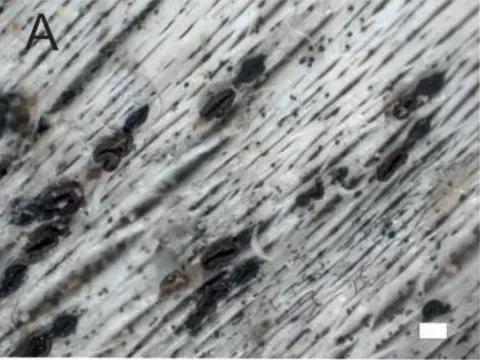
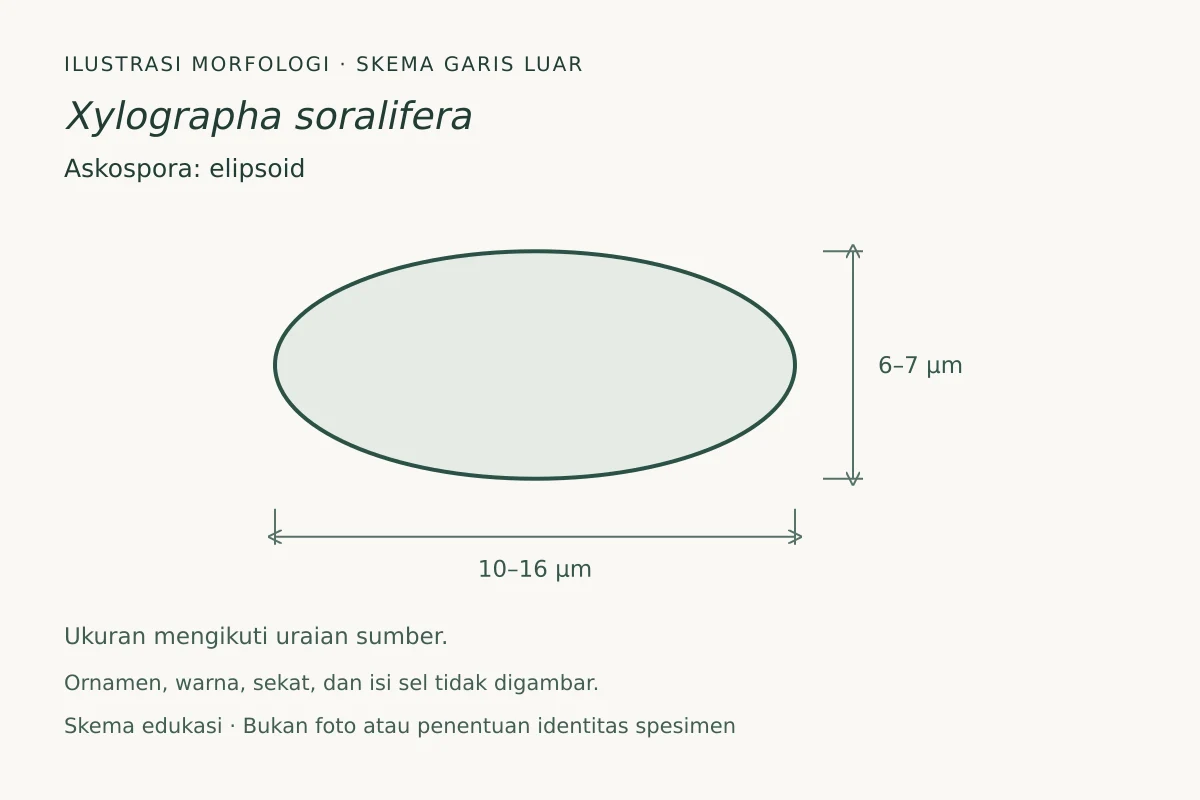
The thallus (the lichen body) of Xylographa soralifera is crustose and occurs within to on the surface of the wood (endosubstratal to episubstratal). It is usually distinctly (broken into small "tiles"), and sorediate—producing powdery propagules. Soralia (the patches that release soredia) are whitish to greenish, mostly convex, often with a thin pale rim, and about 0.3–0.6 mm across; they may coalesce. Soredia are comparatively coarse (mostly 14–26, less commonly up to 31) μm). The thallus is C−, K− and PD− in spot tests, while the soralia are PD+ (red); fumarprotocetraric acid is confirmed by thin-layer chromatography. Fruiting bodies (apothecia) may be present or absent; when present they are round to narrowly elliptic, solitary or clustered, with a pale brown to flesh-colored that is flat to strongly concave. Typical dimensions are about 0.1–0.3 × 0.2–0.8 mm. Asci are cylindrical to more or less club shaped () (about 80–96 × 11–15 μm) with eight hyaline, simple (non-septate) ellipsoid to ovoid ascospores (about 10–16 × 6–7 μm). The is a green coccoid alga (8–15 μm). Separation from similar taxa: compared with X. vitiligo, X. soralifera usually shows clearly convex areoles and soralia (X. vitiligo has indistinct areoles and sunken soralia), and the two differ chemically as noted above. Other sorediate, wood-associated species with overlapping chemistry can occur in similar habitats—e.g., Mycoblastus fucatus (bluish-gray thallus; soralia flat to excavate; contains atranorin), Ramboldia cinnabarina (often yellowish-white to gray-green soralia; atranorin present), and Pertusaria pupillaris (continuous, mostly endosubstratal thallus with larger, flat, pure-white soralia)—but these differ in thallus color, soralia form, and chemistry.
Habitat dan peran ekologis
Xylographa soralifera grows on wood, most frequently on slowly decomposing, decorticated (bark-free) logs and stumps in relatively open forest. In Norway it is most often on spruce (Picea abies) and Scots pine (Pinus sylvestris), and more rarely on wood of downy birch (Betula pubescens), common juniper (Juniperus communis) and goat willow (Salix caprea). In North America it occurs on wood—and only rarely on bark—of several conifers including western larch (Larix occidentalis), pine (Pinus spp.), Douglas fir (Pseudotsuga menziesii), western redcedar (Thuja plicata) and western hemlock (Tsuga heterophylla). The species has a northern and/or alpine tendency. In Europe it is known from Norway (Hordaland north to Finnmark, descending to sea level in the north), Sweden, and the Italian Alps. In North America it is recorded from the Pacific Northwest and interior mountains—Washington and Montana in the United States, British Columbia in Canada—and farther south at higher elevations in Arizona. Documented sites span roughly 600 – 2900 m in elevation. The authors also note that Pacific coast driftwood in Washington and southwestern British Columbia commonly bears X. vitiligo, whereas X. soralifera has yet to be found there.
- Habitat atau konteks temuan
- hutan
- Substrat
- kayu; kulit kayu
- Peran atau konteks
- Pembentuk liken
Reproduksi
The thallus (the lichen body) of Xylographa soralifera is crustose and occurs within to on the surface of the wood (endosubstratal to episubstratal). It is usually distinctly (broken into small "tiles"), and sorediate—producing powdery propagules. Soralia (the patches that release soredia) are whitish to greenish, mostly convex, often with a thin pale rim, and about 0.3–0.6 mm across; they may coalesce. Soredia are comparatively coarse (mostly 14–26, less commonly up to 31) μm). The thallus is C−, K− and PD− in spot tests, while the soralia are PD+ (red); fumarprotocetraric acid is confirmed by thin-layer chromatography. Fruiting bodies (apothecia) may be present or absent; when present they are round to narrowly elliptic, solitary or clustered, with a pale brown to flesh-colored that is flat to strongly concave.
Catatan identitas dan cakupan
- Nama diterima mengikuti Catalogue of Life Base2026-09-11; uraian mempertahankan konsep dan nama sumber aslinya.
- Original geographic, specimen and life-cycle scope retained; source import awaits individual editorial review.
- Impor dan terjemahan otomatis belum diperiksa editorial per profil. Struktur reproduktif yang disebutkan tidak membuktikan seluruh siklus hidup diketahui.
- Pengukuran pada uraian mengikuti spesimen, kultur, dan metode sumber; angka tidak diperluas ke semua populasi.
Catatan distribusi dalam narasi mengikuti sumbernya. Dokumentasi spesimen atau foto mengikuti catatan sumber. Bukti wilayah Indonesia dan penilaian konservasi tidak disimpulkan dari gambar.
Melihat dengan konteks
Ilustrasi skematis garis luar askospora Xylographa soralifera, berdasarkan uraian sumber; ukuran yang dilaporkan 10–16 × 6–7 µm. Proporsi disederhanakan, bukan salinan satu spesimen. Ornamen permukaan, warna, sekat, dan isi sel tidak direkonstruksi. Skema memilih askospora elipsoid dari bentuk elipsoid hingga telur, sekitar 10–16 × 6–7 µm. Tidak mencampurkan ukuran askus atau sel alga.
- Jenis
- Ilustrasi skematis
- Kredit
- Fungi, ilustrasi orisinal (2026); fakta morfologi berdasarkan Wikipedia contributors
- Lisensi
- CC BY-SA 4.0
- Sumber media
- Buka entri sumber
Sumber profil
- [1] Xylographa soralifera — Wikipedia (en)
- [2] Catalogue of Life Base2026-09-11 — Xylographa soralifera
Rujukan halaman ini
Fungi. Xylographa soralifera. Rilis data fungi-2026-10-12-expansion-2. https://fungi-atlas.mgadib.chatgpt.site/jamur/xylographa-soralifera/.
Status: impor sumber; pemeriksaan editorial per profil belum selesai. Untuk klaim biologis, gunakan rujukan pada bagian terkait dan periksa konteks sumber aslinya.