01 / Morfologi

Ciri dan struktur

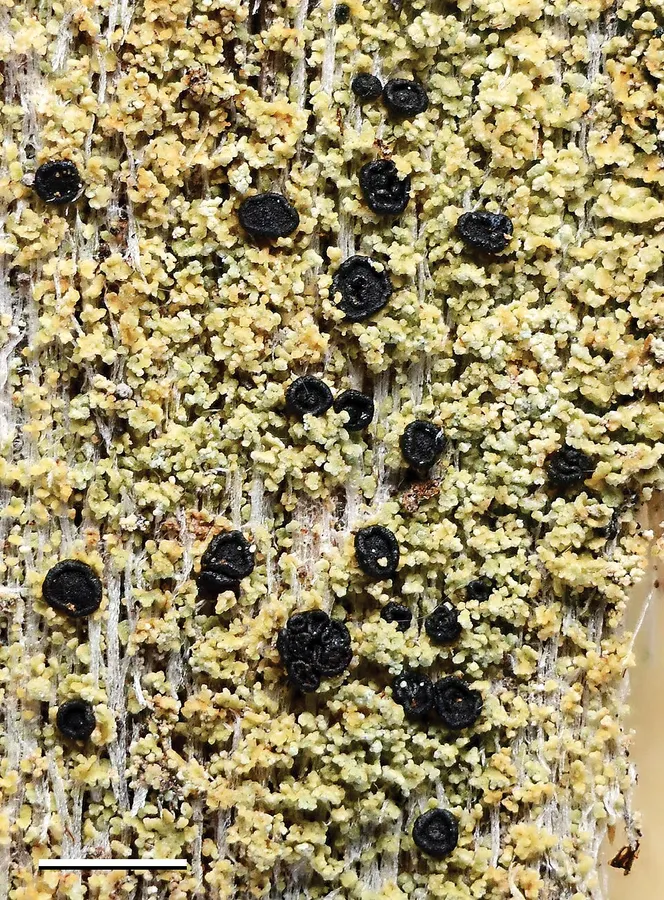
The species differs from X. caradocensis and X. friesii mainly in forming more minute, coralloid and sometimes, sorediate squamules and sometimes (the holotype) in containing thamnolic acid in addition to friesiic acid; it also differs from the former in having shorter, non-septate ascospores. Thallus crustose to squamulose; individual squamules up to 0.5 mm diam. but often soon breaking up into a coralloid crust, adnate when young, later ascending and more or less geotropically imbricate; soralia occurring patchily, labriform, bluish; upper surface greyish-green to medium brown, dull; margin crenulate or incised, concolorous with upper surface. Upper cortex up to 15 μm thick but mostly poorly defined. Apothecia common, up to 0.6 mm diam., plane, black, epruinose, egyrose; margin remaining prominent, entire or flexuose; proper exciple composed of closely conglutinated hyphae, olivaceous brown in inner part, brownish black in the rim, not containing crystals, K–, N–; hymenium ca. 50 µm high, pale olivaceous brown; hypothecium pale olivaceous brown; epihymenium dark reddish brown, not containing crystals, K–, N–; paraphyses ca. 2 µm thick, simple, without swelling or pigment cap in apical cell; ascus clavate, ca. 30 µm tall, with a thin, evenly amyloid tholus and covered by an amyloid cap, with orange pigment in the cytoplasm when young. Ascospores ellipsoid, simple, hyaline, with orange pigment in the cytoplasm when young, 4–7 × 2.5–4.5 μm (n = 20, from holotype). Pycnidia not seen.

Sebagian uraian ditampilkan dalam bahasa sumber; terjemahannya belum tersedia atau belum lolos pemeriksaan.

Rujukan: [1]

Pengukuran mengikuti objek, spesimen atau kultur, dan metode yang disebutkan sumber. Baca uraian asli untuk konteks lengkap.

02 / Kehidupan

Habitat dan peran ekologis

Specimens were collected from central coastal California in Big Basin Redwoods State Park (37.1°N, 11 km from the Pacific Ocean) and Armstrong Redwoods State Natural Reserve (38.3°N, 18 km from the Pacific Ocean). Xylopsora canopeorum was observed on coarse, fibrous bark and occasionally on charred bark between 5 and 75 m above ground level along the trunks of large coast redwood trees in old-growth redwood forests. The species commonly co-occurred with Carbonicola anthracophila, Fulgidea oligospora, F. sierrae, Hertelidea botryosa and Hypocenomyce scalaris, which together covered substantial portions of the trunk surface. Xylopsora canopeorum appeared to have an affinity for old and stable bark surfaces on the main trunks of large redwood trees.

Sebagian uraian ditampilkan dalam bahasa sumber; terjemahannya belum tersedia atau belum lolos pemeriksaan.

Rujukan: [1]

Habitat atau konteks temuan
hutan
Substrat
Informasi belum tersedia pada sumber rilis ini.
Peran atau konteks
Pembentuk liken
Temukan hubungan serupa
03 / Siklus hidup

Reproduksi

The species differs from X. caradocensis and X. friesii mainly in forming more minute, coralloid and sometimes, sorediate squamules and sometimes (the holotype) in containing thamnolic acid in addition to friesiic acid; it also differs from the former in having shorter, non-septate ascospores. Thallus crustose to squamulose; individual squamules up to 0.5 mm diam. but often soon breaking up into a coralloid crust, adnate when young, later ascending and more or less geotropically imbricate; soralia occurring patchily, labriform, bluish; upper surface greyish-green to medium brown, dull; margin crenulate or incised, concolorous with upper surface. Upper cortex up to 15 μm thick but mostly poorly defined.

Sebagian uraian ditampilkan dalam bahasa sumber; terjemahannya belum tersedia atau belum lolos pemeriksaan.

Rujukan: [1]

04 / Batas informasi

Catatan identitas dan cakupan

  • Nama diterima mengikuti Catalogue of Life Base2026-09-11; uraian mempertahankan konsep dan nama sumber aslinya.
  • Preserve original treatment localities, hosts and substrate scope. Materials examined describe documented specimens, not the full global range.
  • Impor dan terjemahan otomatis belum diperiksa editorial per profil. Struktur reproduktif yang disebutkan tidak membuktikan seluruh siklus hidup diketahui.
  • Pengukuran pada uraian mengikuti spesimen, kultur, dan metode sumber; angka tidak diperluas ke semua populasi.

Catatan distribusi dalam narasi mengikuti sumbernya. Dokumentasi spesimen atau foto mengikuti catatan sumber. Bukti wilayah Indonesia dan penilaian konservasi tidak disimpulkan dari gambar.

05 / Dokumentasi

Melihat dengan konteks

Dokumentasi Xylopsora canopeorum dari Wikimedia Commons. Figure 2 ; Xylopsora canopeorum , holotype . Scale bar: 1 mm. Identifikasi mengikuti record berkas sumber.

Jenis
Fotografi
Kredit
Bendiksby M, Reese Næsborg R, Timdal E (2018) Xylopsora canopeorum (Umbilicariaceae), a new lichen species from the canopy of Sequoia sempervirens. MycoKeys 30: 1-15. https://doi.org/10.3897/mycokeys.30.22271
Lisensi
CC BY 4.0
Sumber media
Buka entri sumber

Gambar menunjukkan objek menurut identifikasi sumber, bukan verifikasi independen spesimen oleh Fungi. Tidak ada skala baru yang ditambahkan.

06 / Rujukan

Sumber profil

  1. [1] Xylopsora canopeorum (Umbilicariaceae), a new lichen species from the canopy of Sequoia sempervirens — Xylopsora canopeorumBagian sumber: PMC5804297_section_11
    Tanggal penghimpunan sumber: 2026-10-12
    Teks sumber: CC BY 4.0 · Bendiksby, Mika & Naesborg, Rikke Reese & Timdal, Einar
  2. [2] Catalogue of Life Base2026-09-11 — Xylopsora canopeorumBagian sumber: ColDP NameUsage.tsv ID 5CMBL; accepted species; source 2073
    Tanggal penghimpunan sumber: 2026-10-12
  3. [3] Dokumentasi visual — Xylopsora canopeorumBagian sumber: Individual media record; identification follows the source, not independent determination
    Tanggal penghimpunan sumber: 2026-10-12
    Media sumber: CC BY 4.0 · Bendiksby M, Reese Næsborg R, Timdal E (2018) Xylopsora canopeorum (Umbilicariaceae), a new lichen species from the canopy of Sequoia sempervirens. MycoKeys 30: 1-15. https://doi.org/10.3897/mycokeys.30.22271

Adaptasi teks: CC BY 4.0. Bendiksby, Mika & Naesborg, Rikke Reese & Timdal, Einar — Xylopsora canopeorum (Umbilicariaceae), a new lichen species from the canopy of Sequoia sempervirens — Xylopsora canopeorum

Uraian asli dan riwayat sumber

Riwayat atau halaman sumber

Ringkasan sumber

The species differs from X. caradocensis and X. friesii mainly in forming more minute, coralloid and sometimes, sorediate squamules and sometimes (the holotype) in containing thamnolic acid in addition to friesiic acid; it also differs from the former in having shorter, non-septate ascospores. Thallus crustose to squamulose; individual squamules up to 0.5 mm diam. but often soon breaking up into a coralloid crust, adnate when young, later ascending and more or less geotropically imbricate; soralia occurring patchily, labriform, bluish; upper surface greyish-green to medium brown, dull; margin crenulate or incised, concolorous with upper surface.

Revisi sumber

Morfologi sumber

The species differs from X. caradocensis and X. friesii mainly in forming more minute, coralloid and sometimes, sorediate squamules and sometimes (the holotype) in containing thamnolic acid in addition to friesiic acid; it also differs from the former in having shorter, non-septate ascospores. Thallus crustose to squamulose; individual squamules up to 0.5 mm diam. but often soon breaking up into a coralloid crust, adnate when young, later ascending and more or less geotropically imbricate; soralia occurring patchily, labriform, bluish; upper surface greyish-green to medium brown, dull; margin crenulate or incised, concolorous with upper surface. Upper cortex up to 15 μm thick but mostly poorly defined. Apothecia common, up to 0.6 mm diam., plane, black, epruinose, egyrose; margin remaining prominent, entire or flexuose; proper exciple composed of closely conglutinated hyphae, olivaceous brown in inner part, brownish black in the rim, not containing crystals, K–, N–; hymenium ca. 50 µm high, pale olivaceous brown; hypothecium pale olivaceous brown; epihymenium dark reddish brown, not containing crystals, K–, N–; paraphyses ca. 2 µm thick, simple, without swelling or pigment cap in apical cell; ascus clavate, ca. 30 µm tall, with a thin, evenly amyloid tholus and covered by an amyloid cap, with orange pigment in the cytoplasm when young. Ascospores ellipsoid, simple, hyaline, with orange pigment in the cytoplasm when young, 4–7 × 2.5–4.5 μm (n = 20, from holotype). Pycnidia not seen.

Revisi sumber

Ekologi sumber

Specimens were collected from central coastal California in Big Basin Redwoods State Park (37.1°N, 11 km from the Pacific Ocean) and Armstrong Redwoods State Natural Reserve (38.3°N, 18 km from the Pacific Ocean). Xylopsora canopeorum was observed on coarse, fibrous bark and occasionally on charred bark between 5 and 75 m above ground level along the trunks of large coast redwood trees in old-growth redwood forests. The species commonly co-occurred with Carbonicola anthracophila, Fulgidea oligospora, F. sierrae, Hertelidea botryosa and Hypocenomyce scalaris, which together covered substantial portions of the trunk surface. Xylopsora canopeorum appeared to have an affinity for old and stable bark surfaces on the main trunks of large redwood trees.

Revisi sumber

Struktur reproduksi sumber

The species differs from X. caradocensis and X. friesii mainly in forming more minute, coralloid and sometimes, sorediate squamules and sometimes (the holotype) in containing thamnolic acid in addition to friesiic acid; it also differs from the former in having shorter, non-septate ascospores. Thallus crustose to squamulose; individual squamules up to 0.5 mm diam. but often soon breaking up into a coralloid crust, adnate when young, later ascending and more or less geotropically imbricate; soralia occurring patchily, labriform, bluish; upper surface greyish-green to medium brown, dull; margin crenulate or incised, concolorous with upper surface. Upper cortex up to 15 μm thick but mostly poorly defined.

Revisi sumber

Rujukan halaman ini

Fungi. Xylopsora canopeorum. Rilis data fungi-2026-10-12-expansion-2. https://fungi-atlas.mgadib.chatgpt.site/jamur/xylopsora-canopeorum/.

Status: impor sumber; pemeriksaan editorial per profil belum selesai. Untuk klaim biologis, gunakan rujukan pada bagian terkait dan periksa konteks sumber aslinya.