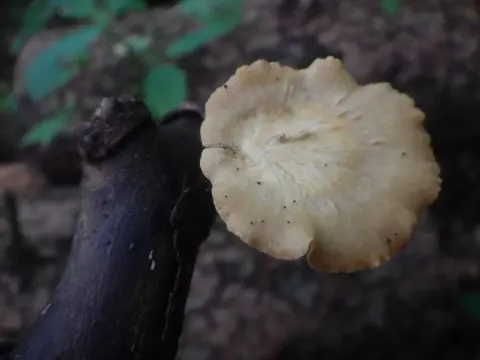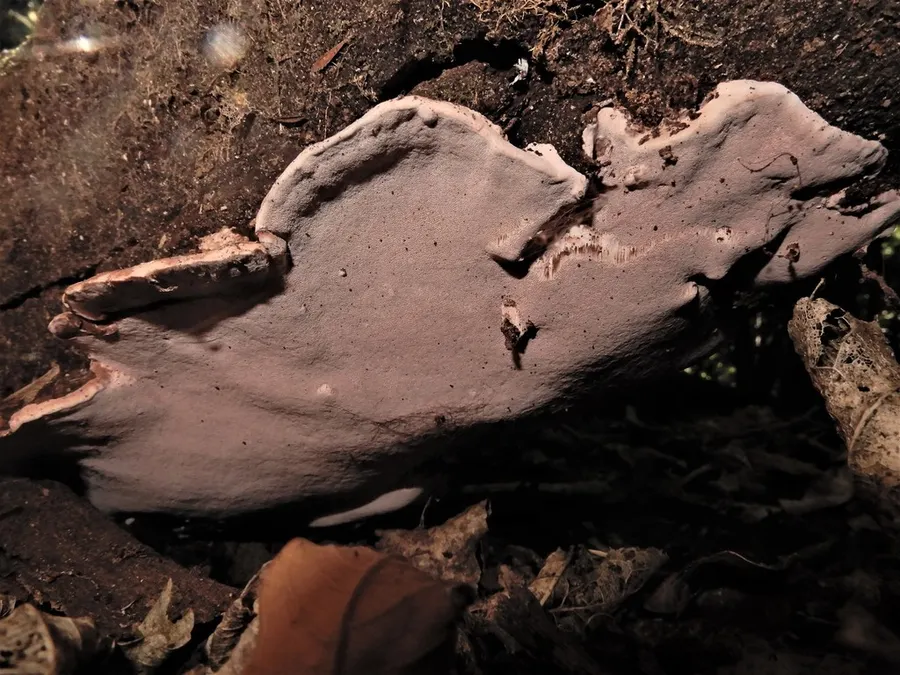
01 / Morfologi

Ciri dan struktur

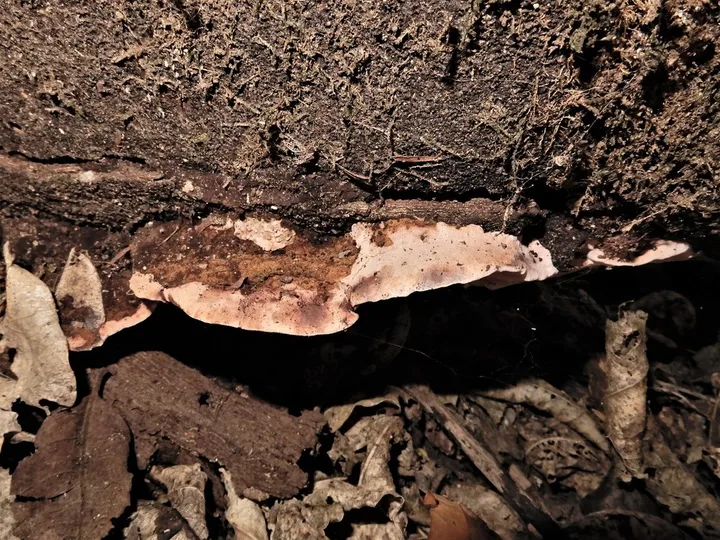
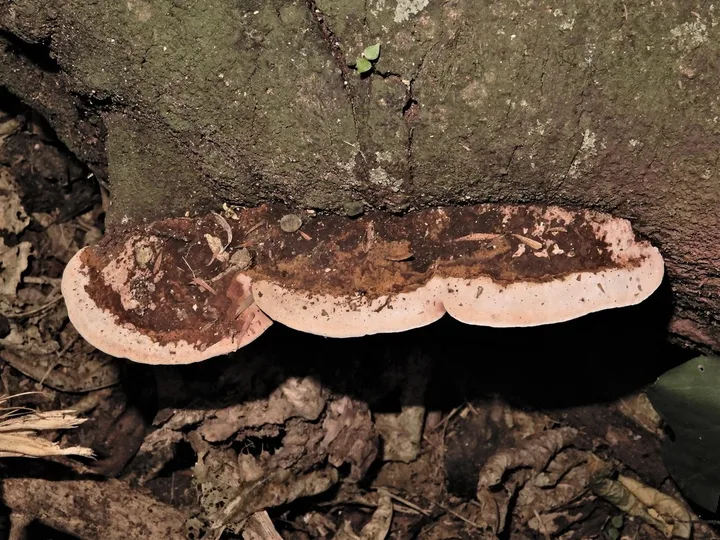
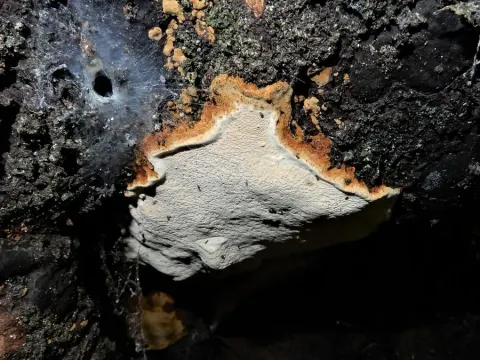
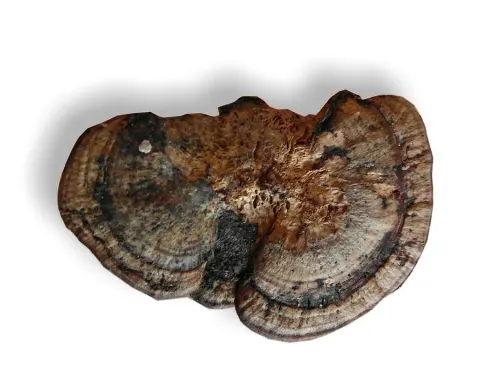
Hymenophore perennial, dimidiate, imbricate, soft but firm, light. Pileus narrowly applanate, effused-reflexed, often resupinate, with occasional orbicular outlying islands, 6-20 cm. x 2-5 cm. x 0.5-2 cm.; surface even or obscurely concentrically zoned, dull, finely pubescent or as often glabrous, bay-brown, umber, sometimes violaceous, almost black in old specimens, cuticle wanting; margin bluntly rounded, even, entire, concolorous; hymenial surface slightly glancing, even, fawn, bay-brown, rose-pink or violaceous when fresh, becoming tobacco-brown, sterile border 1-5 mm. wide, lighter in colour, dissepiments not toothed. Context fawn, bay-brown or chestnut-brown, 1-3 mm. thick, of loosely woven hyphae; skeletal hyphae 4-4.5 µ thick. lumen 2 µ, light fuscous, tapering, branched and undulate near ends, aseptate, staining; generative hyphae hyaline, thick, delicate walled, septate, branched. Pores stratose, round, 1-5 mm. deep in each layer, bay-brown, chestnut-brown or violaceous in section, 100-150 µ diameter, commonly 50µ, or 7-9 per mm.; dissepiments 50-100 µ thick, commonly 50 µ, equal or tapering slightly, apex finely velutinate. solitary or imbricate on hark or decorticated wood of fallen trunks, associated with a white rot. Basidia clavate, 8-10 x 3.5-4 µ, soon collapsing. Spores oblong with rounded ends, 3.5-5 x 2-3 µ, smooth, yellow-brown, abundant.

Sebagian uraian ditampilkan dalam bahasa sumber; terjemahannya belum tersedia atau belum lolos pemeriksaan.

Rujukan: [1]

Pengukuran mengikuti objek, spesimen atau kultur, dan metode yang disebutkan sumber. Baca uraian asli untuk konteks lengkap.

02 / Kehidupan

Habitat dan peran ekologis

HABITAT: Growing solitary or imbricate on bark or decorticated wood of fallen trunks, associated with a white rot.

Sebagian uraian ditampilkan dalam bahasa sumber; terjemahannya belum tersedia atau belum lolos pemeriksaan.

Rujukan: [1]

Habitat atau konteks temuan
Informasi belum tersedia pada sumber rilis ini.
Substrat
kulit kayu
Peran atau konteks
Belum dikategorikan pada rilis ini.
Temukan hubungan serupa
03 / Siklus hidup

Reproduksi

Hymenophore perennial, dimidiate, imbricate, soft but firm, light. Pileus narrowly applanate, effused-reflexed, often resupinate, with occasional orbicular outlying islands, 6-20 cm. x 2-5 cm. x 0.5-2 cm.; surface even or obscurely concentrically zoned, dull, finely pubescent or as often glabrous, bay-brown, umber, sometimes violaceous, almost black in old specimens, cuticle wanting; margin bluntly rounded, even, entire, concolorous; hymenial surface slightly glancing, even, fawn, bay-brown, rose-pink or violaceous when fresh, becoming tobacco-brown, sterile border 1-5 mm. wide, lighter in colour, dissepiments not toothed. Context fawn, bay-brown or chestnut-brown, 1-3 mm. thick, of loosely woven hyphae; skeletal hyphae 4-4.5 µ thick. lumen 2 µ, light fuscous, tapering, branched and undulate near ends, aseptate, staining; generative hyphae hyaline, thick, delicate walled, septate, branched.

Sebagian uraian ditampilkan dalam bahasa sumber; terjemahannya belum tersedia atau belum lolos pemeriksaan.

Rujukan: [1]

Sinonim menurut acuan taksonomi rilis: Abundisporus subflexibilis; Cerrena vibratilis; Coriolopsis copelandii; Coriolopsis vibratilis; Fomes awhitu; Fomes endapalus; Fomes exotephrus; Fomes intertextus; Fomes roseoalbus; Fomes subflexibilis; Loweporus roseoalbus; Microporus vibratilis; Nigroporus roseoalbus; Phellinus endapalus; Phellinus subflexibilis; Polyporus copelandii; Polyporus endapalus; Polyporus exotephrus; Polyporus purpureoalbus; Polyporus roseoalbus; Polyporus subflexibilis; Polyporus vibratilis; Polystictus copelandii; Polystictus purpureoalbus; Polystictus vibratilis; Poria roseoalba; Scindalma endapalum; Scindalma exotephrum; Scindalma subflexibile; Truncospora roseoalba
04 / Batas informasi

Catatan identitas dan cakupan

  • Nama diterima mengikuti Catalogue of Life Base2026-09-11; uraian mempertahankan konsep dan nama sumber aslinya.
  • Historical description as cited by BiotaNZ. Preserve explicit New Zealand/locality, host and specimen qualifiers. Distribution is the cited source scope, not a current global range.
  • Impor dan terjemahan otomatis belum diperiksa editorial per profil. Struktur reproduktif yang disebutkan tidak membuktikan seluruh siklus hidup diketahui.
  • Pengukuran pada uraian mengikuti spesimen, kultur, dan metode sumber; angka tidak diperluas ke semua populasi.

Catatan distribusi dalam narasi mengikuti sumbernya. Dokumentasi spesimen atau foto mengikuti catatan sumber. Bukti wilayah Indonesia dan penilaian konservasi tidak disimpulkan dari gambar.

05 / Dokumentasi

Melihat dengan konteks

Dokumentasi Abundisporus roseoalbus menurut asosiasi foto pada record takson iNaturalist. Kredit: Grey Smith. Identitas mengikuti sumber; bukan penentuan spesimen independen.

Jenis
Fotografi
Kredit
(c) Grey Smith, some rights reserved (CC BY), uploaded by Grey Smith
Lisensi
CC BY 4.0
Sumber media
Buka entri sumber

Gambar menunjukkan objek menurut identifikasi sumber, bukan verifikasi independen spesimen oleh Fungi. Tidak ada skala baru yang ditambahkan.

Dokumentasi tambahan

06 / Rujukan

Sumber profil

  1. [1] Cunningham, G.H. 1948: New Zealand Polyporaceae. 8. The genus Fomes. New Zealand Department of Scientific and Industrial Research, Plant Diseases Division, Bulletin. 79. — Fomes awhituBagian sumber: biota:1cb0def0-36b9-11d5-9548-00d0592d548c:1cb1b2b8-36b9-11d5-9548-00d0592d548c
    Tanggal penghimpunan sumber: 2026-10-12
    Teks sumber: CC BY 4.0 · Cunningham, G.H. 1948: New Zealand Polyporaceae. 8. The genus Fomes. New Zealand Department of Scientific and Industrial Research, Plant Diseases Division, Bulletin. 79.
  2. [2] Catalogue of Life Base2026-09-11 — Abundisporus roseoalbusBagian sumber: ColDP NameUsage.tsv ID 8MTM; accepted species; source 2073
    Tanggal penghimpunan sumber: 2026-10-12
  3. [3] Dokumentasi visual — Abundisporus roseoalbusBagian sumber: Identitas mengikuti sumber dokumentasi; bukan penentuan spesimen independen.
    Tanggal penghimpunan sumber: 2026-10-17
    Media sumber: CC BY 4.0 · (c) Grey Smith, some rights reserved (CC BY), uploaded by Grey Smith
  4. [4] Dokumentasi visual — Abundisporus roseoalbusBagian sumber: Identitas mengikuti sumber dokumentasi; bukan penentuan spesimen independen.
    Tanggal penghimpunan sumber: 2026-10-17
    Teks sumber: CC BY 4.0 · (c) Grey Smith, some rights reserved (CC BY), uploaded by Grey Smith
  5. [5] Dokumentasi visual — Abundisporus roseoalbusBagian sumber: Identitas mengikuti sumber dokumentasi; bukan penentuan spesimen independen.
    Tanggal penghimpunan sumber: 2026-10-17
    Teks sumber: CC BY 4.0 · (c) Grey Smith, some rights reserved (CC BY), uploaded by Grey Smith

Adaptasi teks: CC BY 4.0. Cunningham, G.H. 1948: New Zealand Polyporaceae. 8. The genus Fomes. New Zealand Department of Scientific and Industrial Research, Plant Diseases Division, Bulletin. 79. — Cunningham, G.H. 1948: New Zealand Polyporaceae. 8. The genus Fomes. New Zealand Department of Scientific and Industrial Research, Plant Diseases Division, Bulletin. 79. — Fomes awhitu

Uraian asli dan riwayat sumber

Riwayat atau halaman sumber

Ringkasan sumber

Hymenophore perennial, dimidiate, imbricate, soft but firm, light. Pileus narrowly applanate, effused-reflexed, often resupinate, with occasional orbicular outlying islands, 6-20 cm. x 2-5 cm. x 0.5-2 cm.; surface even or obscurely concentrically zoned, dull, finely pubescent or as often glabrous, bay-brown, umber, sometimes violaceous, almost black in old specimens, cuticle wanting; margin bluntly rounded, even, entire, concolorous; hymenial surface slightly glancing, even, fawn, bay-brown, rose-pink or violaceous when fresh, becoming tobacco-brown, sterile border 1-5 mm. wide, lighter in colour, dissepiments not toothed.

Revisi sumber

Morfologi sumber

Hymenophore perennial, dimidiate, imbricate, soft but firm, light. Pileus narrowly applanate, effused-reflexed, often resupinate, with occasional orbicular outlying islands, 6-20 cm. x 2-5 cm. x 0.5-2 cm.; surface even or obscurely concentrically zoned, dull, finely pubescent or as often glabrous, bay-brown, umber, sometimes violaceous, almost black in old specimens, cuticle wanting; margin bluntly rounded, even, entire, concolorous; hymenial surface slightly glancing, even, fawn, bay-brown, rose-pink or violaceous when fresh, becoming tobacco-brown, sterile border 1-5 mm. wide, lighter in colour, dissepiments not toothed. Context fawn, bay-brown or chestnut-brown, 1-3 mm. thick, of loosely woven hyphae; skeletal hyphae 4-4.5 µ thick. lumen 2 µ, light fuscous, tapering, branched and undulate near ends, aseptate, staining; generative hyphae hyaline, thick, delicate walled, septate, branched. Pores stratose, round, 1-5 mm. deep in each layer, bay-brown, chestnut-brown or violaceous in section, 100-150 µ diameter, commonly 50µ, or 7-9 per mm.; dissepiments 50-100 µ thick, commonly 50 µ, equal or tapering slightly, apex finely velutinate. solitary or imbricate on hark or decorticated wood of fallen trunks, associated with a white rot. Basidia clavate, 8-10 x 3.5-4 µ, soon collapsing. Spores oblong with rounded ends, 3.5-5 x 2-3 µ, smooth, yellow-brown, abundant.

Revisi sumber

Ekologi sumber

HABITAT: Growing solitary or imbricate on bark or decorticated wood of fallen trunks, associated with a white rot.

Revisi sumber

Struktur reproduksi sumber

Hymenophore perennial, dimidiate, imbricate, soft but firm, light. Pileus narrowly applanate, effused-reflexed, often resupinate, with occasional orbicular outlying islands, 6-20 cm. x 2-5 cm. x 0.5-2 cm.; surface even or obscurely concentrically zoned, dull, finely pubescent or as often glabrous, bay-brown, umber, sometimes violaceous, almost black in old specimens, cuticle wanting; margin bluntly rounded, even, entire, concolorous; hymenial surface slightly glancing, even, fawn, bay-brown, rose-pink or violaceous when fresh, becoming tobacco-brown, sterile border 1-5 mm. wide, lighter in colour, dissepiments not toothed. Context fawn, bay-brown or chestnut-brown, 1-3 mm. thick, of loosely woven hyphae; skeletal hyphae 4-4.5 µ thick. lumen 2 µ, light fuscous, tapering, branched and undulate near ends, aseptate, staining; generative hyphae hyaline, thick, delicate walled, septate, branched.

Revisi sumber

Rujukan halaman ini

Fungi. Abundisporus roseoalbus. Rilis data fungi-2026-10-12-expansion-2. https://fungi-atlas.mgadib.chatgpt.site/jamur/abundisporus-roseoalbus/.

Status: impor sumber; pemeriksaan editorial per profil belum selesai. Untuk klaim biologis, gunakan rujukan pada bagian terkait dan periksa konteks sumber aslinya.