Ciri dan struktur
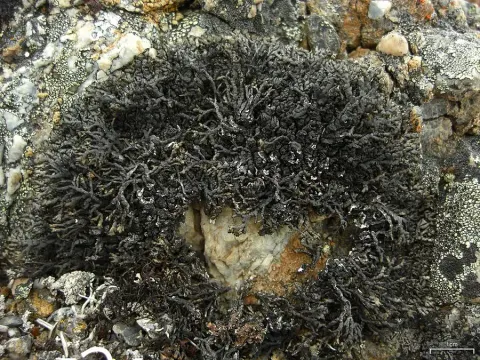
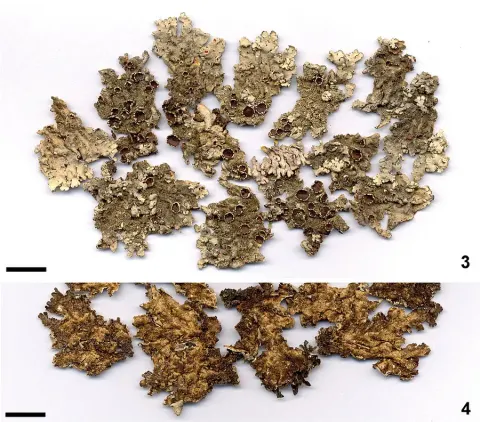
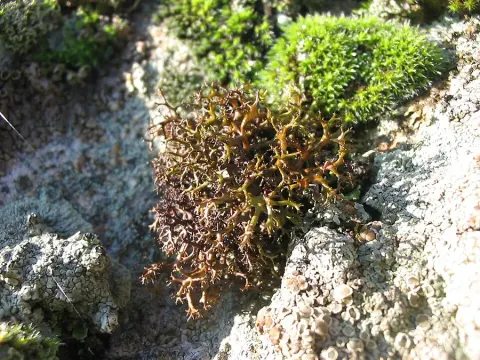
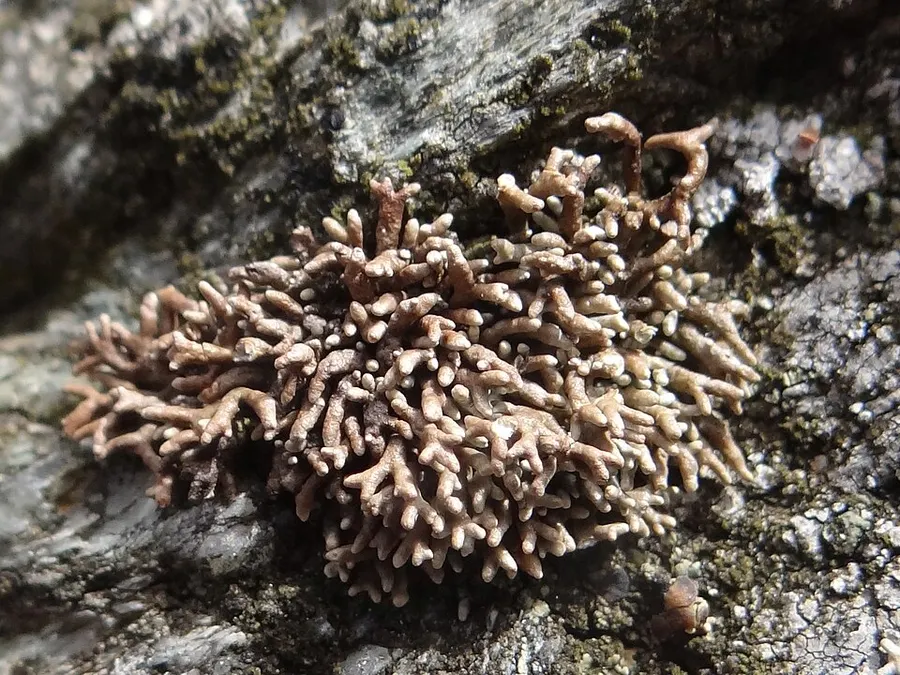
Allocetraria madreporiformis has a yellow-brown thallus composed of radially symmetric, slightly swollen branches; as a result, the lobes are more or less cylindrical rather than clearly differentiated into an upper and lower surface. An English vernacular name for the lichen, "V-fingers", refers to the repeatedly dichotomous, V-shaped branching that gives the thallus its finger-like appearance. These lobes grow to 3 cm tall and are 1–2 mm wide. Towards the centre of older thalli, the interior often becomes loose and web-like; the medulla (inner tissue) is white. The species forms pycnidia (minute asexual fruiting bodies that produce spores) that are usually sunken in the thallus surface, though they may be slightly raised. Chemically, it contains usnic acid in the (outer layer) and fatty acids of the lichesterinic–protolichesterinic type in the medulla. Chemical testing by thin-layer chromatography of ten specimens detected usnic acid and protolichesterinic acid as major compounds, with lichesterinic acid in minor amounts; two analysed specimens (one from Canada and one from Svalbard) also showed trace gyrophoric acid and other minor, unidentified lichen substances.
Habitat dan peran ekologis
Allocetraria madreporiformis is a circumarctic (around the Arctic) and alpine (high-mountain) species, recorded from North America and Asia and also from the mountains of central Europe. In Asia it has been reported from China (including provinces such as Qinghai, Xinjiang, Xizang, and Yunnan), as well as from Kyrgyzstan, Mongolia, and Russia. On Svalbard, Allocetraria madreporiformis has a highly localized distribution, known from the inner fjord districts (inlets of the sea) of Wijdefjorden (including Austfjorden) in Spitsbergen. Surveys across the fjord system recorded it at 12 of 40 surveyed sites, with occurrences concentrated in the high-arctic steppe landscapes protected in Indre Wijdefjorden National Park; it was absent from adjacent middle-arctic tundra and from the most saline steppe areas. In this region it grows directly on soil (a terricolous lichen) on dry, wind-exposed ridges of fine-textured mineral soil, where wind erosion and aeolian (wind-blown) transport of silt and sand keep the surface unstable and the cryptogamic cover (lichens, mosses, and similar organisms) sparse. Soil sampling indicated that occurrences are concentrated on moderately alkaline substrates (about pH 7.0–8.5, with the highest frequencies around pH 7.8) and that the lichen largely avoids saline crusts and other extremely alkaline surfaces.
- Habitat atau konteks temuan
- Informasi belum tersedia pada sumber rilis ini.
- Substrat
- tanah
- Peran atau konteks
- Pembentuk liken
Reproduksi
The species forms pycnidia (minute asexual fruiting bodies that produce spores) that are usually sunken in the thallus surface, though they may be slightly raised. Chemically, it contains usnic acid in the (outer layer) and fatty acids of the lichesterinic–protolichesterinic type in the medulla. Chemical testing by thin-layer chromatography of ten specimens detected usnic acid and protolichesterinic acid as major compounds, with lichesterinic acid in minor amounts; two analysed specimens (one from Canada and one from Svalbard) also showed trace gyrophoric acid and other minor, unidentified lichen substances.
Catatan identitas dan cakupan
- Nama diterima mengikuti Catalogue of Life Base2026-09-11; uraian mempertahankan konsep dan nama sumber aslinya.
- Original geographic, specimen and life-cycle scope retained; source import awaits individual editorial review.
- Impor dan terjemahan otomatis belum diperiksa editorial per profil. Struktur reproduktif yang disebutkan tidak membuktikan seluruh siklus hidup diketahui.
- Pengukuran pada uraian mengikuti spesimen, kultur, dan metode sumber; angka tidak diperluas ke semua populasi.
Catatan distribusi dalam narasi mengikuti sumbernya. Dokumentasi spesimen atau foto mengikuti catatan sumber. Bukti wilayah Indonesia dan penilaian konservasi tidak disimpulkan dari gambar.
Melihat dengan konteks
Dokumentasi Allocetraria madreporiformis dari Wikimedia Commons. Allocetraria madreporiformis (location: Slovakia, Nízke Tatry, Kráľova hoľa Identifikasi mengikuti record berkas sumber.
- Jenis
- Fotografi
- Kredit
- Jerzy Opioła
- Lisensi
- CC BY-SA 4.0
- Sumber media
- Buka entri sumber
Sumber profil
- [1] Allocetraria madreporiformis — Wikipedia (en)
- [2] Catalogue of Life Base2026-09-11 — Allocetraria madreporiformis
- [3] Dokumentasi visual — Allocetraria madreporiformis
Rujukan halaman ini
Fungi. Allocetraria madreporiformis. Rilis data fungi-2026-10-12-expansion-2. https://fungi-atlas.mgadib.chatgpt.site/jamur/allocetraria-madreporiformis/.
Status: impor sumber; pemeriksaan editorial per profil belum selesai. Untuk klaim biologis, gunakan rujukan pada bagian terkait dan periksa konteks sumber aslinya.