Ciri dan struktur
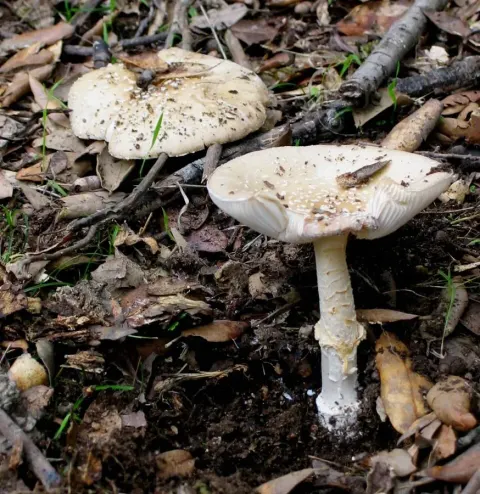
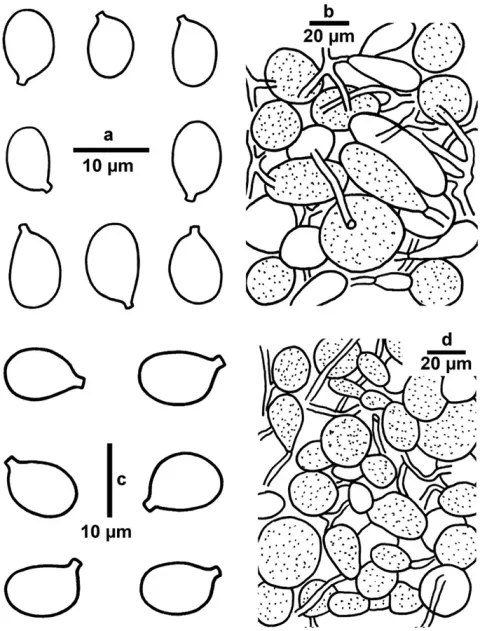
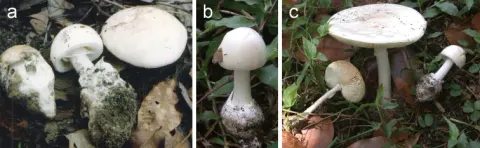
The fruit bodies are colored yellow overall. The fresh cap, ranging in color from dull creamy yellow to golden yellow to buff, is sticky when moist. White warts adorn the cap surface, but they are usually flimsy and easily washed away by rain. They are placed randomly, but tend to be more concentrated in the center. The cap is typically 2.5–12 cm in diameter, and initially convex before flattening out in maturity. The flesh is white, and shows no change when sliced. The gills are adnate to adnexed, and white; they are close together, with little intervening space. The pale yellowish stem is 4–12 cm long by 0.5–1.9 cm thick, and either roughly equal in width throughout, or slightly thicker at the base. Young mushrooms have a membranous partial veil extending from the upper stem to the cap margin; as the mushroom grows, the partial veil tears to leave a flimsy, skirt-like, easily lost ring on the stem. At the base of the stem is a white volva (a remnant of the universal veil that covered the immature mushroom) that usually forms a small, free rim. The spore print is white. There is no distinctive odour. Amanita gemmata has ellipsoid to broadly ellipsoid spores measuring 8–10 by 6.5–7.5 μm with an average Q-ratio (the fraction of length/width) of 1.35; they are not amyloid. The spores are smooth, thin-walled, and they contain one to several small oil droplets. The basidia (spore-bearing cells of the hymenium) are usually four-spored, club shaped, and measure 30–40 by 8–11 μm. The gill tissue is divergent, meaning that the cells are more or less parallel near the center of the gill, but bend outwards near the end of the gill.
Habitat dan peran ekologis
The fungus favours sandy and slightly acidic soils, and is often found in association with Norway Spruce (Picea abies). The mushroom grows either singly, scattered, or in groups in coniferousand mixed forests, especially along paths and roads. The species is distributed in areas of Asia and Europe. It is widely distributed (as a species cluster) in North America, where it has been found as far south as Ixtlán de Juárez, Mexico. The species has been reported from the Dominican Republic. In South America, it is known from Chile and Colombia. In Asia, the mushroom has been collected from Iran and China. Amanita gemmata is a mycorrhizal fungus, meaning it forms a mutually beneficial relationship with the roots of compatible host plants. Through the association, the plant provides the fungus with a carbon source, and the fungus provides the plant with several benefits such as nutrients and protection from pathogens. Largent and collaborators (1980) document mycorrhizal associations of A. gemmata with Manzanita (Arctostaphylos spp.) and Pinus contorta (lodgepole pine), and Nieto and Carbone with Pinus pinaster (maritime pine) in Spain.
- Habitat atau konteks temuan
- hutan
- Substrat
- Informasi belum tersedia pada sumber rilis ini.
- Peran atau konteks
- Mitra tumbuhan
Reproduksi
The gills are adnate to adnexed, and white; they are close together, with little intervening space. The pale yellowish stem is 4–12 cm long by 0.5–1.9 cm thick, and either roughly equal in width throughout, or slightly thicker at the base. Young mushrooms have a membranous partial veil extending from the upper stem to the cap margin; as the mushroom grows, the partial veil tears to leave a flimsy, skirt-like, easily lost ring on the stem. At the base of the stem is a white volva (a remnant of the universal veil that covered the immature mushroom) that usually forms a small, free rim. The spore print is white. There is no distinctive odour. Amanita gemmata has ellipsoid to broadly ellipsoid spores measuring 8–10 by 6.5–7.5 μm with an average Q-ratio (the fraction of length/width) of 1.35; they are not amyloid.
Catatan identitas dan cakupan
- Nama diterima mengikuti Catalogue of Life Base2026-09-11; uraian mempertahankan konsep dan nama sumber aslinya.
- Original geographic, specimen and life-cycle scope retained; source import awaits individual editorial review.
- Impor dan terjemahan otomatis belum diperiksa editorial per profil. Struktur reproduktif yang disebutkan tidak membuktikan seluruh siklus hidup diketahui.
- Pengukuran pada uraian mengikuti spesimen, kultur, dan metode sumber; angka tidak diperluas ke semua populasi.
Catatan distribusi dalam narasi mengikuti sumbernya. Dokumentasi spesimen atau foto mengikuti catatan sumber. Bukti wilayah Indonesia dan penilaian konservasi tidak disimpulkan dari gambar.
Melihat dengan konteks
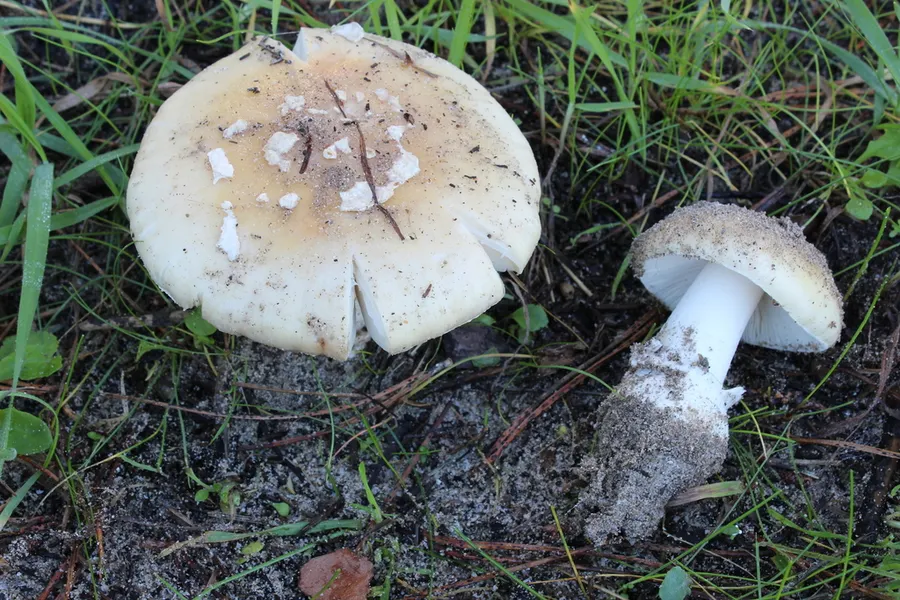
Dokumentasi Amanita junquillea menurut asosiasi foto pada record takson iNaturalist. Kredit: Davide Puddu. Identitas mengikuti sumber; bukan penentuan spesimen independen.
- Jenis
- Fotografi
- Kredit
- (c) Davide Puddu, some rights reserved (CC BY), uploaded by Davide Puddu
- Lisensi
- CC BY 4.0
- Sumber media
- Buka entri sumber
Dokumentasi tambahan
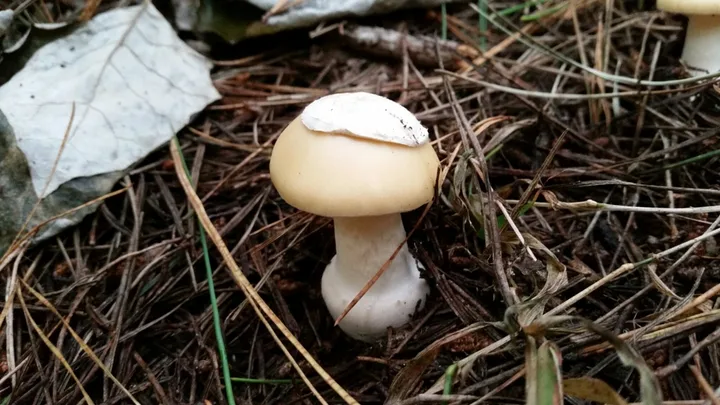
Foto yang diasosiasikan dengan Amanita gemmata pada iNaturalist. Identifikasi mengikuti sumber; bukan penentuan spesimen independen.
Kredit dan penggunaan
no rights reserved, uploaded by Ronel Ellis
Ukuran dan format gambar disesuaikan tanpa pemotongan, retus, atau penambahan skala. Lisensi sumber dipertahankan.
Sumber profil
- [1] Amanita gemmata — Wikipedia (en)
- [2] Catalogue of Life Base2026-09-11 — Amanita gemmata
- [3] Dokumentasi visual — Amanita gemmata
- [4] Dokumentasi visual — Amanita gemmata
Rujukan halaman ini
Fungi. Amanita gemmata. Rilis data fungi-2026-10-12-expansion-2. https://fungi-atlas.mgadib.chatgpt.site/jamur/amanita-gemmata/.
Status: impor sumber; pemeriksaan editorial per profil belum selesai. Untuk klaim biologis, gunakan rujukan pada bagian terkait dan periksa konteks sumber aslinya.