Ciri dan struktur
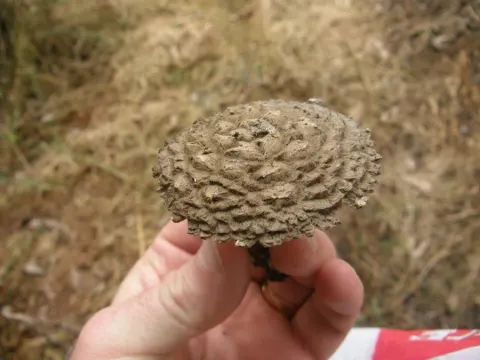
Basidiomata medium-sized to large. Pileus 60–125 mm wide, initially hemispherical then convex to plano-convex, dry, slightly viscid when moist, whitish to greyish-white (1B1) to ash grey (1B2) to grey (1D1); context 6–11 mm thick, white (1A1), thinning evenly towards margin, unchanging when cut or bruised. Universal veil on pileus as felted to subconical to verrucose, brownish-grey (1D3), greyish-brown (5F3) to dark grey (1F1), soft, up to 4 mm thick, 5–8 mm wide, irregularly distributed; margin non-striate, appendiculate; Lamellae free to narrowly adnate, crowded, white (1A1), unchanging, 6–10 mm broad; lamellulae attenuate, plentiful, of several lengths, with 7–8 lamellae per cm at margin. Stipe 45–90 × 12–21 mm (excluding bulb), narrowing upwards, solid, lower part covered by light grey (1D1) fibrillose squamules, upper part covered by white farinose squamules; context white, unchanging on cutting or bruising. Bulb 32–62 × 19–32 mm, ventricose to clavate, white, covered with grey (1D1) to dark grey (1F1), universal veil remnants. Partial veil superior, soft, cottony, white, easily collapsed. Odour indistinct, taste not observed. Spore deposit white. Basidiospores [80/4/2] (8–) 8.5–10(–11) × (5.5–)6 –6.5 (–7) µm, [ L =9.05–9.17 µm, L ' = 9.11 µm; W = 5.9–6.5 µm, W ' = 6.2 µm; Q = (1.32–)1.42–1.5(–1.69), Q = 1.51–1.54, Q ' = 1.53], ellipsoid, hyaline, thin walled, smooth, amyloid, apiculus sublateral, up to 1 µm. Basidia (34–)45–50(–53) × (9.5–)10–12(–14) µm, 2 to 4-spored, thin-walled, colourless, hyaline; sterigmata up to 4 µm long; basal clamp connections not observed in any tissue after extensive search.
Habitat dan peran ekologis
Solitary to gregarious, with plants of Fagaceae, Pinaceae and Ericaceae (Rhododendron arboretum). Currently known from China (Yang 2004, 2015) and now India.
- Habitat atau konteks temuan
- Informasi belum tersedia pada sumber rilis ini.
- Substrat
- Informasi belum tersedia pada sumber rilis ini.
- Peran atau konteks
- Belum dikategorikan pada rilis ini.
Reproduksi
Basidiomata medium-sized to large. Pileus 60–125 mm wide, initially hemispherical then convex to plano-convex, dry, slightly viscid when moist, whitish to greyish-white (1B1) to ash grey (1B2) to grey (1D1); context 6–11 mm thick, white (1A1), thinning evenly towards margin, unchanging when cut or bruised. Universal veil on pileus as felted to subconical to verrucose, brownish-grey (1D3), greyish-brown (5F3) to dark grey (1F1), soft, up to 4 mm thick, 5–8 mm wide, irregularly distributed; margin non-striate, appendiculate; Lamellae free to narrowly adnate, crowded, white (1A1), unchanging, 6–10 mm broad; lamellulae attenuate, plentiful, of several lengths, with 7–8 lamellae per cm at margin.
Catatan identitas dan cakupan
- Nama diterima mengikuti Catalogue of Life Base2026-09-11; uraian mempertahankan konsep dan nama sumber aslinya.
- Preserve original treatment localities, hosts and substrate scope. Materials examined describe documented specimens, not the full global range.
- Impor dan terjemahan otomatis belum diperiksa editorial per profil. Struktur reproduktif yang disebutkan tidak membuktikan seluruh siklus hidup diketahui.
- Pengukuran pada uraian mengikuti spesimen, kultur, dan metode sumber; angka tidak diperluas ke semua populasi.
Catatan distribusi dalam narasi mengikuti sumbernya. Dokumentasi spesimen atau foto mengikuti catatan sumber. Bukti wilayah Indonesia dan penilaian konservasi tidak disimpulkan dari gambar.
Melihat dengan konteks
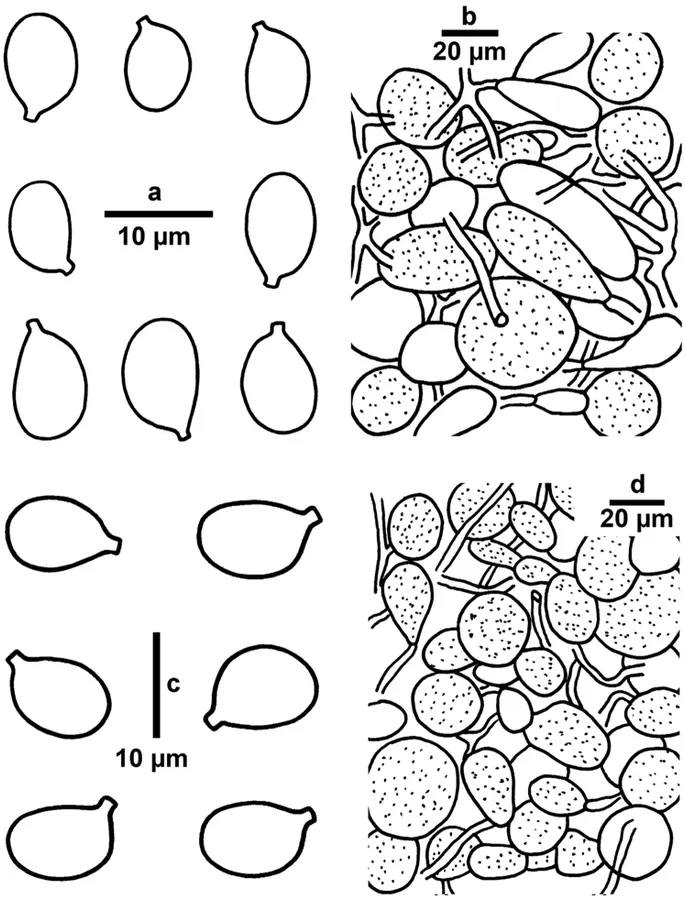
Microscopic features of Amanita species. a, b Amanita griseoverrucosa (TM 16-1247) a Basidiospores b Elements of universal veil from pileus surface c, d Amanita virgineoides (TM 14-413) c Basidiospores d Elements of universal veil from pileus surface.
- Jenis
- Pelat ilmiah
- Kredit
- Md. Iqbal Hosen, Tahir Mehmood, Kanad Das, Linas V. Kudzma, R. P. Bhatt
- Lisensi
- CC BY 4.0
- Sumber media
- Buka entri sumber
Dokumentasi tambahan
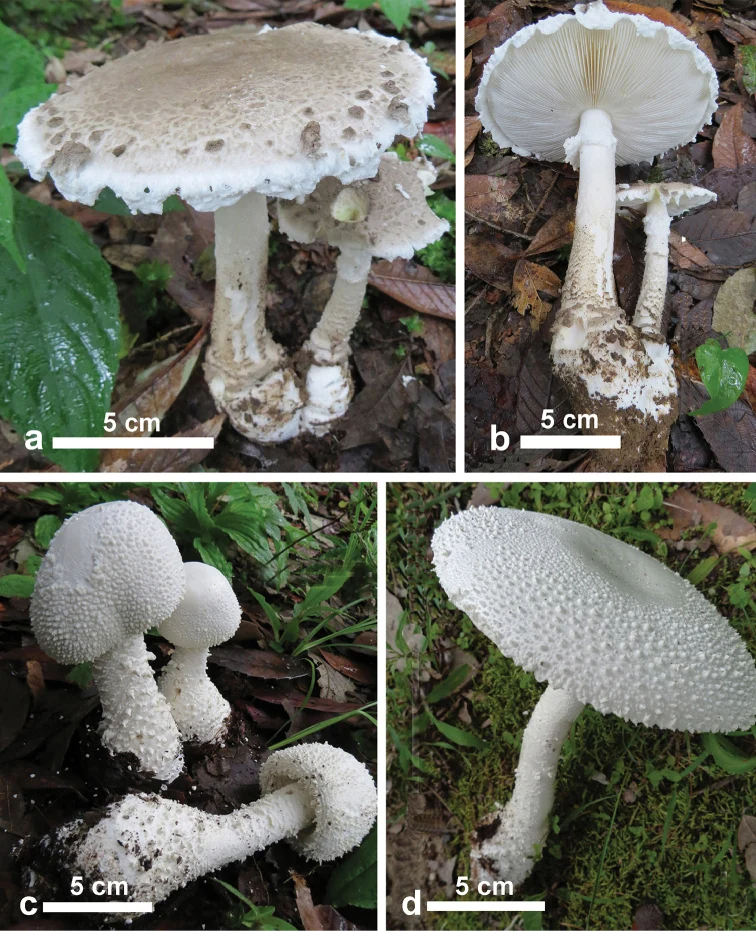
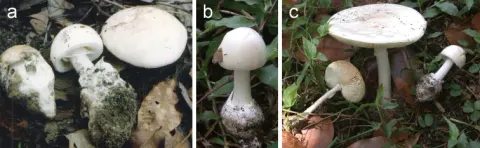
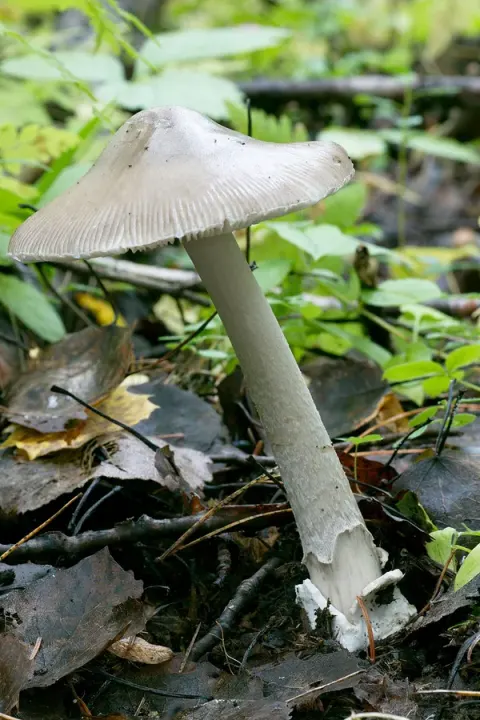
Basidioma Amanita griseoverrucosa dalam habitat alami (a–b; TM 16-1228) dan A. virgineoides (c–d; TM 14-413). Batang skala asli: 5 cm.
Kredit dan penggunaan
Md. Iqbal Hosen, Tahir Mehmood, Kanad Das, Linas V. Kudzma, R. P. Bhatt
Ukuran dan format gambar disesuaikan tanpa pemotongan, retus, atau penambahan skala. Lisensi sumber dipertahankan.
Sumber profil
- [1] Amanita tullossiana, a new species, and two new records of Amanita section Lepidella from north-western Himalaya, India — Amanita griseoverrucosa
- [2] Catalogue of Life Base2026-09-11 — Amanita griseoverrucosa
- [3] Dokumentasi visual — Amanita griseoverrucosa
- [4] Dokumentasi visual — Amanita griseoverrucosa
Rujukan halaman ini
Fungi. Amanita griseoverrucosa. Rilis data fungi-2026-10-12-expansion-2. https://fungi-atlas.mgadib.chatgpt.site/jamur/amanita-griseoverrucosa/.
Status: impor sumber; pemeriksaan editorial per profil belum selesai. Untuk klaim biologis, gunakan rujukan pada bagian terkait dan periksa konteks sumber aslinya.