01 / Morfologi

Ciri dan struktur

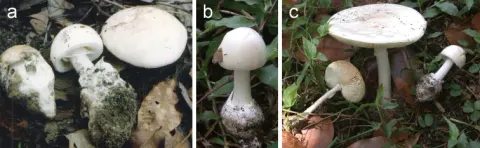
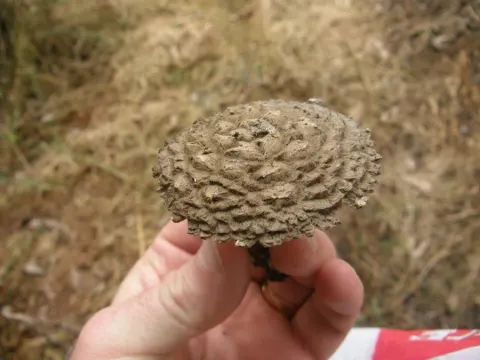
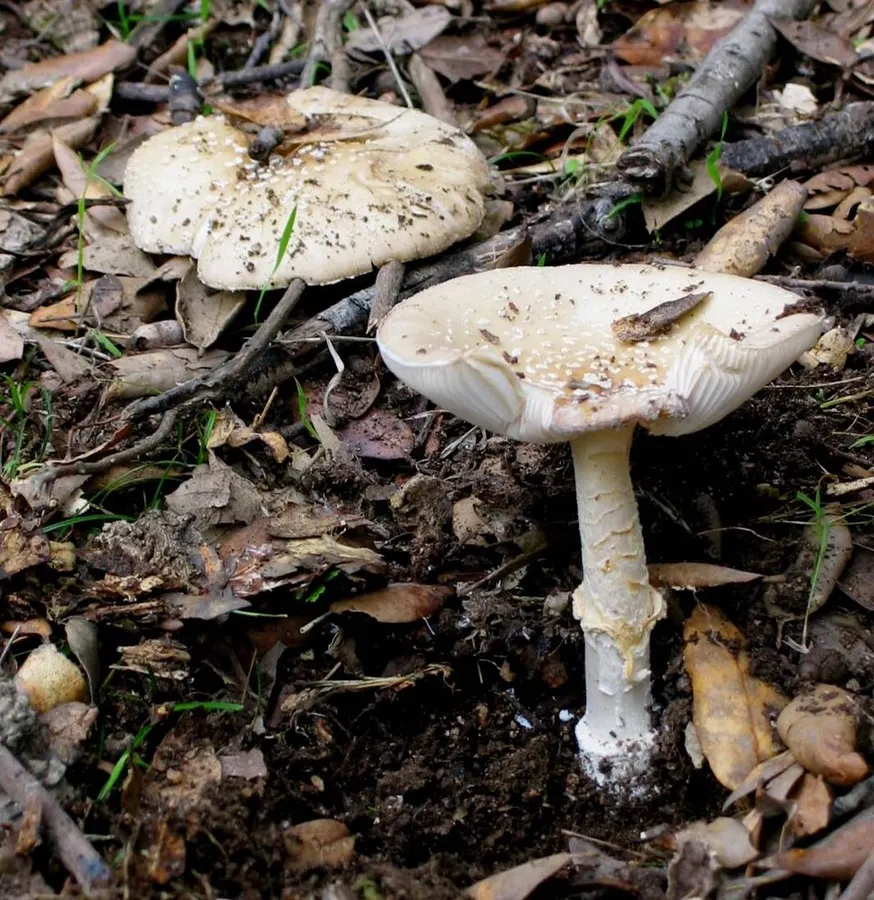
Amanita gioiosa is a medium to large mushroom-forming species in the genus Amanita. The cap (pileus) measures 4–15 cm in diameter and evolves from a hemispheric shape when young to convex and eventually flattening with maturity. The cap margin (edge) starts slightly curved but quickly flattens and turns upward as the mushroom matures, with minimal undulation and little to no striations except in very mature specimens. The cap surface is smooth, dry or slightly viscous in humid conditions, and can appear either matt or glossy. It is separable from the flesh beneath and typically cream-yellowish to cream-ochre in colour, sometimes with greyish-brown tones developing in the central area as it matures. A distinctive feature is the presence of small white, cotton-like fragments (remnants of the universal veil) on the cap surface, which appear as flattened or broadly pyramidal clumps that persist for a long time. The gills are free or slightly attached to the stipe when young, closely spaced, with partial gills (lamellulae) of varying lengths. They measure up to 9 mm in width, are white in colour, becoming pale cream with maturity, and have a somewhat frayed edge of the same colour. The stipe is 4–14 cm long and 1.3–2.7 cm thick, cylindrical, straight to curved, initially solid with firm flesh that becomes more spongy with age. It is white with striations at the top and ends in a rounded or, more commonly, turnip-shaped bulb. The ring (annulus) is fragile, ephemeral (temporary), white, and often completely adheres to the stipe surface. The volva (remnant of the universal veil at the stem base) is membranous, adherent with a free edge, white, and measures 2–4 by 2.5–3.2 cm.

Sebagian uraian ditampilkan dalam bahasa sumber; terjemahannya belum tersedia atau belum lolos pemeriksaan.

Rujukan: [1]

Pengukuran mengikuti objek, spesimen atau kultur, dan metode yang disebutkan sumber. Baca uraian asli untuk konteks lengkap.

02 / Kehidupan

Habitat dan peran ekologis

Amanita gioiosa typically grows in acidophilous habitats, favouring siliceous and particularly granitic substrates. It has been observed in association predominantly with trees of the family Fagaceae, including sweet chestnut (Castanea sativa) and various oak species (Quercus), such as cork oak (Q. suber) and Pyrenean oak (Q. pyrenaica). It can sometimes be found alongside shrubs like Cistus and strawberry tree (Arbutus unedo), and occasionally with pine (Pinus) species. The original Italian collection of this species and a collection from Cantabria, Spain, were found under eucalyptus trees, indicating some ecological plasticity regarding host associations. Nevertheless, occurrences away from eucalyptus plantations suggest it is likely native to the Iberian Peninsula rather than introduced. In terms of geographic distribution, Amanita gioiosa shows a clearly Mediterranean pattern, originally described from Italy, where it appears relatively common. The species has also been reported in France, Spain, and Morocco. Within the Iberian Peninsula, confirmed collections exist from several Spanish provinces, including Ávila, Cáceres, Girona, Toledo, and Huelva, primarily from sites with suitable acidic soil conditions at elevations ranging between about 1000 and 1100 metres.

Sebagian uraian ditampilkan dalam bahasa sumber; terjemahannya belum tersedia atau belum lolos pemeriksaan.

Rujukan: [1]

Habitat atau konteks temuan
Informasi belum tersedia pada sumber rilis ini.
Substrat
Informasi belum tersedia pada sumber rilis ini.
Peran atau konteks
Belum dikategorikan pada rilis ini.
Temukan hubungan serupa
03 / Siklus hidup

Reproduksi

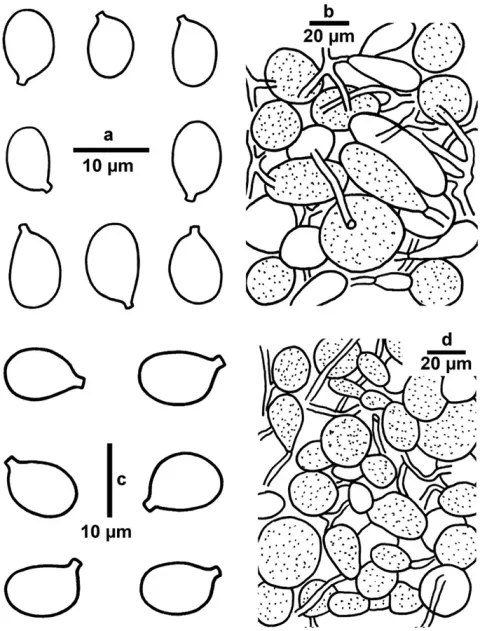
Microscopically, A. gioiosa is characterized by broadly elliptical to elliptical spores typically measuring 8–11 by 6-8.5 μm, which are smooth, hyaline (transparent), and non-amyloid (not staining with iodine). A key diagnostic feature is the presence of clamp connections throughout the mushroom's tissues, which distinguishes it from similar-looking species.

Sebagian uraian ditampilkan dalam bahasa sumber; terjemahannya belum tersedia atau belum lolos pemeriksaan.

Rujukan: [1]

Sinonim menurut acuan taksonomi rilis: Amanita pantherina var. mediterranea
04 / Batas informasi

Catatan identitas dan cakupan

  • Nama diterima mengikuti Catalogue of Life Base2026-09-11; uraian mempertahankan konsep dan nama sumber aslinya.
  • Original geographic, specimen and life-cycle scope retained; source import awaits individual editorial review.
  • Impor dan terjemahan otomatis belum diperiksa editorial per profil. Struktur reproduktif yang disebutkan tidak membuktikan seluruh siklus hidup diketahui.
  • Pengukuran pada uraian mengikuti spesimen, kultur, dan metode sumber; angka tidak diperluas ke semua populasi.

Catatan distribusi dalam narasi mengikuti sumbernya. Dokumentasi spesimen atau foto mengikuti catatan sumber. Bukti wilayah Indonesia dan penilaian konservasi tidak disimpulkan dari gambar.

05 / Dokumentasi

Melihat dengan konteks

Dokumentasi Amanita gioiosa dari Wikimedia Commons. Amanita gioiosa Identifikasi mengikuti record berkas sumber.

Jenis
Fotografi
Kredit
James Baker (cepecity) — James Baker
Sumber media
Buka entri sumber

Gambar menunjukkan objek menurut identifikasi sumber, bukan verifikasi independen spesimen oleh Fungi. Tidak ada skala baru yang ditambahkan.

06 / Rujukan

Sumber profil

  1. [1] Amanita gioiosa — Wikipedia (en)Bagian sumber: Frozen revision 1322134367
    Tanggal penghimpunan sumber: 2026-10-12
    Teks sumber: CC BY-SA4.0 · Wikipedia contributors
  2. [2] Catalogue of Life Base2026-09-11 — Amanita gioiosaBagian sumber: ColDP NameUsage.tsv ID 5TZFZ; accepted species; source 2073
    Tanggal penghimpunan sumber: 2026-10-12
  3. [3] Dokumentasi visual — Amanita gioiosaBagian sumber: Individual media record; identification follows the source, not independent determination
    Tanggal penghimpunan sumber: 2026-10-12
    Media sumber: CC BY-SA 3.0 · James Baker (cepecity) — James Baker

Adaptasi teks: CC BY-SA 4.0. Wikipedia contributors — Amanita gioiosa — Wikipedia (en)

Uraian asli dan riwayat sumber

Riwayat atau halaman sumber

Ringkasan sumber

Amanita gioiosa is a species of basidiomycete fungus in the family Amanitaceae. This distinctive Mediterranean mushroom produces medium to large cream-yellowish to ochre caps adorned with persistent white, cotton-like fragments, and grows primarily in acidic soils in association with chestnut and oak trees. This relatively rare species is found in several countries including Italy, France, Spain, and Morocco, typically fruiting in early autumn following late-summer rainfall. A member of the same genus as the deadly death cap and destroying angel mushrooms, A. gioiosa is closely related to Amanita muscaria and can be identified by its turnip-shaped stipe base, fragile white ring, and the presence of microscopic structures called clamp connections throughout its tissues.

Revisi sumber

Morfologi sumber

Amanita gioiosa is a medium to large mushroom-forming species in the genus Amanita. The cap (pileus) measures 4–15 cm in diameter and evolves from a hemispheric shape when young to convex and eventually flattening with maturity. The cap margin (edge) starts slightly curved but quickly flattens and turns upward as the mushroom matures, with minimal undulation and little to no striations except in very mature specimens. The cap surface is smooth, dry or slightly viscous in humid conditions, and can appear either matt or glossy. It is separable from the flesh beneath and typically cream-yellowish to cream-ochre in colour, sometimes with greyish-brown tones developing in the central area as it matures. A distinctive feature is the presence of small white, cotton-like fragments (remnants of the universal veil) on the cap surface, which appear as flattened or broadly pyramidal clumps that persist for a long time. The gills are free or slightly attached to the stipe when young, closely spaced, with partial gills (lamellulae) of varying lengths. They measure up to 9 mm in width, are white in colour, becoming pale cream with maturity, and have a somewhat frayed edge of the same colour. The stipe is 4–14 cm long and 1.3–2.7 cm thick, cylindrical, straight to curved, initially solid with firm flesh that becomes more spongy with age. It is white with striations at the top and ends in a rounded or, more commonly, turnip-shaped bulb. The ring (annulus) is fragile, ephemeral (temporary), white, and often completely adheres to the stipe surface. The volva (remnant of the universal veil at the stem base) is membranous, adherent with a free edge, white, and measures 2–4 by 2.5–3.2 cm.

Revisi sumber

Ekologi sumber

Amanita gioiosa typically grows in acidophilous habitats, favouring siliceous and particularly granitic substrates. It has been observed in association predominantly with trees of the family Fagaceae, including sweet chestnut (Castanea sativa) and various oak species (Quercus), such as cork oak (Q. suber) and Pyrenean oak (Q. pyrenaica). It can sometimes be found alongside shrubs like Cistus and strawberry tree (Arbutus unedo), and occasionally with pine (Pinus) species. The original Italian collection of this species and a collection from Cantabria, Spain, were found under eucalyptus trees, indicating some ecological plasticity regarding host associations. Nevertheless, occurrences away from eucalyptus plantations suggest it is likely native to the Iberian Peninsula rather than introduced. In terms of geographic distribution, Amanita gioiosa shows a clearly Mediterranean pattern, originally described from Italy, where it appears relatively common. The species has also been reported in France, Spain, and Morocco. Within the Iberian Peninsula, confirmed collections exist from several Spanish provinces, including Ávila, Cáceres, Girona, Toledo, and Huelva, primarily from sites with suitable acidic soil conditions at elevations ranging between about 1000 and 1100 metres.

Revisi sumber

Struktur reproduksi sumber

Microscopically, A. gioiosa is characterized by broadly elliptical to elliptical spores typically measuring 8–11 by 6-8.5 μm, which are smooth, hyaline (transparent), and non-amyloid (not staining with iodine). A key diagnostic feature is the presence of clamp connections throughout the mushroom's tissues, which distinguishes it from similar-looking species.

Revisi sumber

Rujukan halaman ini

Fungi. Amanita gioiosa. Rilis data fungi-2026-10-12-expansion-2. https://fungi-atlas.mgadib.chatgpt.site/jamur/amanita-gioiosa/.

Status: impor sumber; pemeriksaan editorial per profil belum selesai. Untuk klaim biologis, gunakan rujukan pada bagian terkait dan periksa konteks sumber aslinya.