01 / Morfologi

Ciri dan struktur

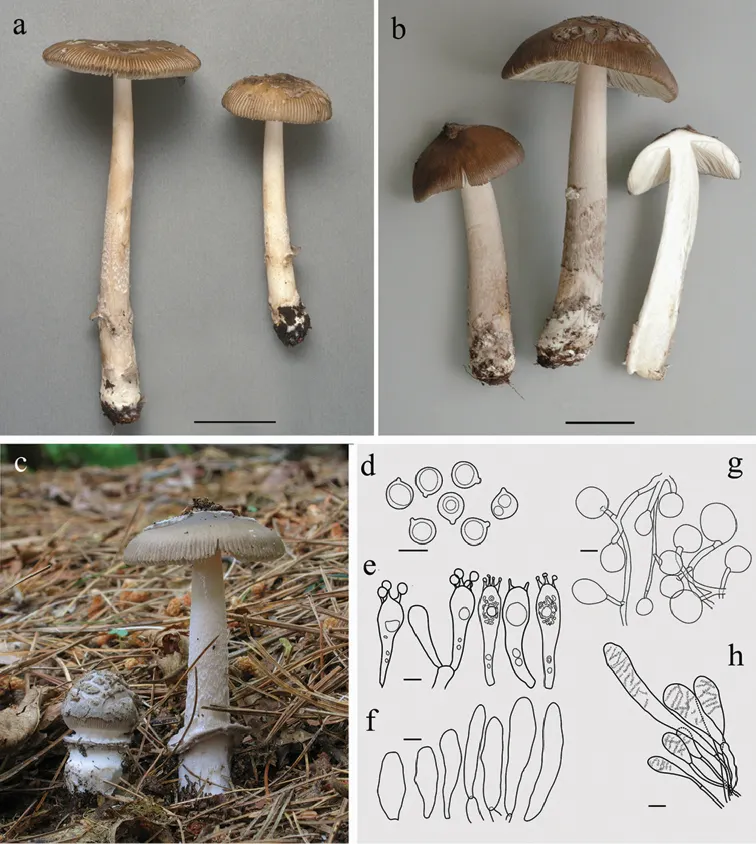
Amanita rhacopus differs from other species of Amanita section Vaginatae by its brown to dark grey-brown pileus, stipe white at times covered with grey chevrons, universal veil grey leaving small to large flakes on pileus and annulus-like remnants at the stipe base, found in stands of conifers (Abies, Picea, Pinus, Tsuga) mixed with Betula.

Sebagian uraian ditampilkan dalam bahasa sumber; terjemahannya belum tersedia atau belum lolos pemeriksaan.

Rujukan: [1]

Pengukuran mengikuti objek, spesimen atau kultur, dan metode yang disebutkan sumber. Baca uraian asli untuk konteks lengkap.

02 / Kehidupan

Habitat dan peran ekologis

Solitary or scattered in stands of conifers (Abies, Picea, Pinus) mixed with Betula, on mesic to sub-mesic soil, never seen in plantations, from July to September in Québec and, according to sequences in Genbank, in all eastern North America down to Tennessee and Texas.

Sebagian uraian ditampilkan dalam bahasa sumber; terjemahannya belum tersedia atau belum lolos pemeriksaan.

Rujukan: [1]

Habitat atau konteks temuan
Informasi belum tersedia pada sumber rilis ini.
Substrat
Informasi belum tersedia pada sumber rilis ini.
Peran atau konteks
Belum dikategorikan pada rilis ini.
Temukan hubungan serupa
03 / Siklus hidup

Reproduksi

CANADA, Québec: Mont Orford, in mountain, close to a stand of Betula papyrifera in a Abies balsamea and Tsuga canadensis forest, 45°18'43" North, 72°14'24" West, 11 July 1994, CMMF002171, ITS Genbank accession number MG734660. Description. Pileus 40-80 mm wide, ovoid to rounded conic slightly umbonate to applanate, smooth, brown to greyish-brown, with time darker in the centre and over inner ends of marginal striations, often with grey velar flakes, margin striated. Lamellae free, crowded, greyish near the pileus margin or completely greyish with age, lamellulae numerous, truncated, of very diverse lengths, unevenly distributed, edges finely powdered, white to whitish. Stipe 70–120 × 7–13 mm, cylindrical (not bulbous), flocculose and white first, then smooth to appressed fibrillose, whitish to greyish, at times with chevron-forming greyish fibrils, without annulus, with grey annulus-like remnants at the base.

Sebagian uraian ditampilkan dalam bahasa sumber; terjemahannya belum tersedia atau belum lolos pemeriksaan.

Rujukan: [1]

04 / Batas informasi

Catatan identitas dan cakupan

  • Nama diterima mengikuti Catalogue of Life Base2026-09-11; uraian mempertahankan konsep dan nama sumber aslinya.
  • Preserve original treatment localities, hosts and substrate scope. Materials examined describe documented specimens, not the full global range.
  • Impor dan terjemahan otomatis belum diperiksa editorial per profil. Struktur reproduktif yang disebutkan tidak membuktikan seluruh siklus hidup diketahui.
  • Pengukuran pada uraian mengikuti spesimen, kultur, dan metode sumber; angka tidak diperluas ke semua populasi.

Catatan distribusi dalam narasi mengikuti sumbernya. Dokumentasi spesimen atau foto mengikuti catatan sumber. Bukti wilayah Indonesia dan penilaian konservasi tidak disimpulkan dari gambar.

05 / Dokumentasi

Melihat dengan konteks

Amanita rhacopus. a–c Basidiomes a CMMF002171(holotype), photograph by Yves Lamoureux b CMMF009640, photograph by Jacqueline Labrecque c HL016, photograph by Herman Lambert d–h Drawings of typical microscopic structures by Guy Fortin d Basidiospores e Basidia f Acrophysalides g Universal veil. h. Caulocystides. Scale bar: 3 cm (a, b), 10 µm (d, e), 20 µm (f–h).

Jenis
Pelat ilmiah
Kredit
Herman Lambert, Guy Fortin, Roland Labbé, Jacqueline Labrecque, Jean A. Bérubé, Jacques Landry, Evgeny Ilyukhin, Simona Margaritescu, Jean-Marc Moncalvo, Yves Lamoureux
Lisensi
CC BY 4.0
Sumber media
Buka entri sumber

Gambar menunjukkan objek menurut identifikasi sumber, bukan verifikasi independen spesimen oleh Fungi. Tidak ada skala baru yang ditambahkan.

06 / Rujukan

Sumber profil

  1. [1] Validation of two Amanita species from eastern North America: A. rhacopus sp. nov. and A. variicolor sp. nov. — Amanita rhacopusBagian sumber: PMC6160832_section_8
    Tanggal penghimpunan sumber: 2026-10-12
    Teks sumber: CC BY 4.0 · Lambert H, Fortin G, Labbé R, Labrecque J, Bérubé JA, Landry J, Ilyukhin E, Margaritescu S, Moncalvo JM, Lamoureux Y.
  2. [2] Catalogue of Life Base2026-09-11 — Amanita rhacopusBagian sumber: ColDP NameUsage.tsv ID 65YQV; accepted species; source 2073
    Tanggal penghimpunan sumber: 2026-10-12
  3. [3] Dokumentasi visual — Amanita rhacopusBagian sumber: Individual media record; identification follows the source, not independent determination
    Tanggal penghimpunan sumber: 2026-10-12
    Media sumber: CC BY 4.0 · Herman Lambert, Guy Fortin, Roland Labbé, Jacqueline Labrecque, Jean A. Bérubé, Jacques Landry, Evgeny Ilyukhin, Simona Margaritescu, Jean-Marc Moncalvo, Yves Lamoureux

Adaptasi teks: CC BY 4.0. Lambert H, Fortin G, Labbé R, Labrecque J, Bérubé JA, Landry J, Ilyukhin E, Margaritescu S, Moncalvo JM, Lamoureux Y. — Validation of two Amanita species from eastern North America: A. rhacopus sp. nov. and A. variicolor sp. nov. — Amanita rhacopus

Uraian asli dan riwayat sumber

Riwayat atau halaman sumber

Ringkasan sumber

Amanita rhacopus differs from other species of Amanita section Vaginatae by its brown to dark grey-brown pileus, stipe white at times covered with grey chevrons, universal veil grey leaving small to large flakes on pileus and annulus-like remnants at the stipe base, found in stands of conifers (Abies, Picea, Pinus, Tsuga) mixed with Betula.

Revisi sumber

Morfologi sumber

Amanita rhacopus differs from other species of Amanita section Vaginatae by its brown to dark grey-brown pileus, stipe white at times covered with grey chevrons, universal veil grey leaving small to large flakes on pileus and annulus-like remnants at the stipe base, found in stands of conifers (Abies, Picea, Pinus, Tsuga) mixed with Betula.

Revisi sumber

Ekologi sumber

Solitary or scattered in stands of conifers (Abies, Picea, Pinus) mixed with Betula, on mesic to sub-mesic soil, never seen in plantations, from July to September in Québec and, according to sequences in Genbank, in all eastern North America down to Tennessee and Texas.

Revisi sumber

Struktur reproduksi sumber

CANADA, Québec: Mont Orford, in mountain, close to a stand of Betula papyrifera in a Abies balsamea and Tsuga canadensis forest, 45°18'43" North, 72°14'24" West, 11 July 1994, CMMF002171, ITS Genbank accession number MG734660. Description. Pileus 40-80 mm wide, ovoid to rounded conic slightly umbonate to applanate, smooth, brown to greyish-brown, with time darker in the centre and over inner ends of marginal striations, often with grey velar flakes, margin striated. Lamellae free, crowded, greyish near the pileus margin or completely greyish with age, lamellulae numerous, truncated, of very diverse lengths, unevenly distributed, edges finely powdered, white to whitish. Stipe 70–120 × 7–13 mm, cylindrical (not bulbous), flocculose and white first, then smooth to appressed fibrillose, whitish to greyish, at times with chevron-forming greyish fibrils, without annulus, with grey annulus-like remnants at the base.

Revisi sumber

Rujukan halaman ini

Fungi. Amanita rhacopus. Rilis data fungi-2026-10-12-expansion-2. https://fungi-atlas.mgadib.chatgpt.site/jamur/amanita-rhacopus/.

Status: impor sumber; pemeriksaan editorial per profil belum selesai. Untuk klaim biologis, gunakan rujukan pada bagian terkait dan periksa konteks sumber aslinya.