01 / Morfologi

Ciri dan struktur

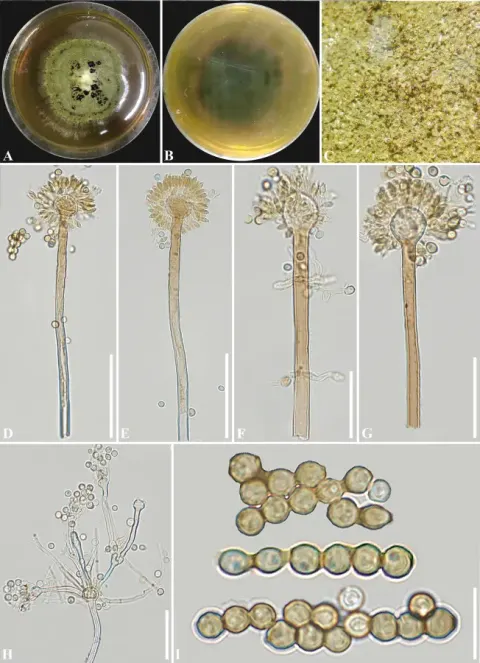
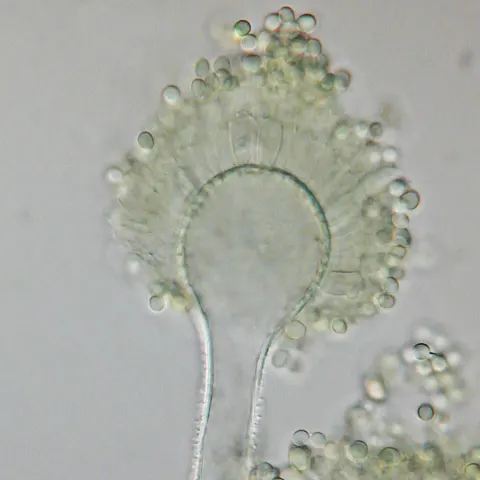
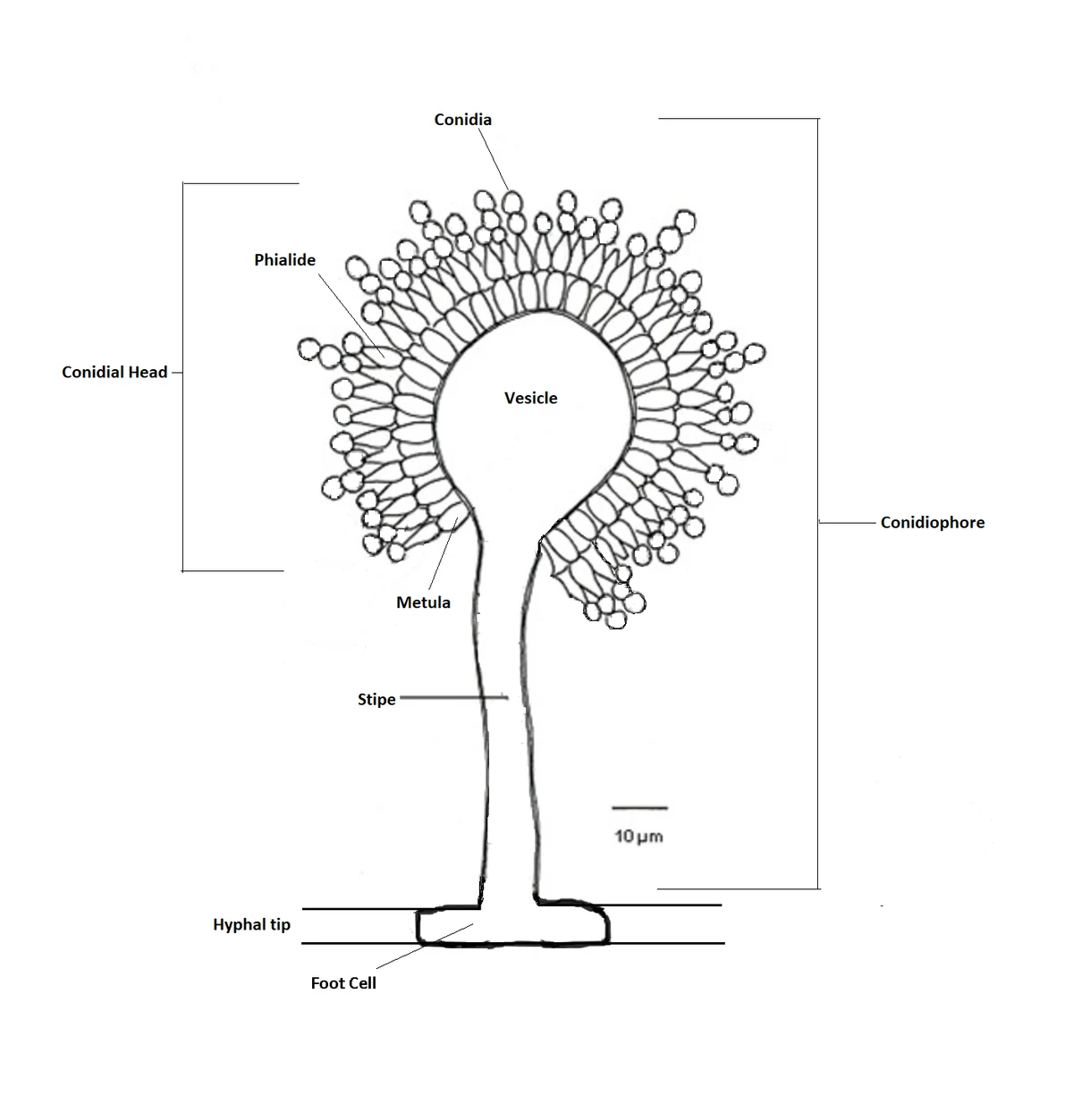
Aspergillus wentii produces single-celled, globose, conidia (singular conidium) in unbranched, filamentous chains. Young asexual conidia (also called spores) start off smooth, colourless, and ellipsoidal before maturing into rough, globose spores approximately 4.5–5 μm in diameter. Aspergillus wentii conidia can appear anywhere from darker yellow to brown in colour when mature and have a single wall, unlike related species Aspergillus tamarii whose conidia have a double wall membrane. The elongating chains of conidia are dispersed through slightly pigmented, vase-shaped structures known as phialides that are around 6–8 μm. The phialides sit on top of almond-shaped structures known as metulae that are about 10–20 μm in length and also slightly pigmented. Together, these metulae and phialides structures radiate outward from a spheroid structure known as the vesicle, layering around its entire surface area. The vesicle can grow to a diameter of 80 μm, with a completely fertile spheroid surface area. Collectively, this large globose complex made up of the vesicle at the centre with metulae and phialides radiating outward is called the conidial head. The conidial head can vary from tan-yellow to darker coffee-coloured brown and grow as big as 500–800 μm in diameter. The conidial head is affixed atop of a thick, aseptate stalk known as a stipe. Aspergillus wentii stipes are notable for being interspersed and longer than average Aspergillus stalks. The stipe and conidial head together form a translucent, rod-shaped structure collectively known as the conidiophore that in turn, extends from the hyphal tip.

Sebagian uraian ditampilkan dalam bahasa sumber; terjemahannya belum tersedia atau belum lolos pemeriksaan.

Rujukan: [1]

Pengukuran mengikuti objek, spesimen atau kultur, dan metode yang disebutkan sumber. Baca uraian asli untuk konteks lengkap.

02 / Kehidupan

Habitat dan peran ekologis

Aspergilli are collectively classified as indoor mold fungi. Aspergillus wentii is typically found as mold on various decomposing vegetable and organic material and is notorious for causing food spoilage in corns, cereals, ground nuts and peanuts. Aspergillus wentii can also be isolated from tobacco. As a common soil fungus and endosymbiont, Aspergillus wentii often lives in symbiosis with species in rhizospheres (an area of soil populated with roots and home to many microorganisms). Within these rhizospheres, Aspergillus wentii can be found amongst cottonseed, olives, barley, rice, pineapple, oats, Brazil nuts, pecans, groundnuts, wheat, fir tree leaf matter, and more. Not only limited to plant and vegetative sources, A. wentii has also been associated with bird and gerbil nests. Distributed in many different parts of the world, Aspergillus wentii has been found in countries such as China, Peru, Argentina, Japan, South Africa, France, Pakistan, Guyana, Turkey, India, Spain, Italy, Israel, the Bahamas, the United States and more. Aspergillus wentii is most commonly found in warm, subtropical areas such as South America. Aspergillus wentii has a tendency to colonize dry soils, especially in deserts and warm climates.

Sebagian uraian ditampilkan dalam bahasa sumber; terjemahannya belum tersedia atau belum lolos pemeriksaan.

Rujukan: [1]

Habitat atau konteks temuan
Informasi belum tersedia pada sumber rilis ini.
Substrat
Informasi belum tersedia pada sumber rilis ini.
Peran atau konteks
Belum dikategorikan pada rilis ini.
Temukan hubungan serupa
03 / Siklus hidup

Reproduksi

Aspergillus wentii produces single-celled, globose, conidia (singular conidium) in unbranched, filamentous chains. Young asexual conidia (also called spores) start off smooth, colourless, and ellipsoidal before maturing into rough, globose spores approximately 4.5–5 μm in diameter. Aspergillus wentii conidia can appear anywhere from darker yellow to brown in colour when mature and have a single wall, unlike related species Aspergillus tamarii whose conidia have a double wall membrane. The elongating chains of conidia are dispersed through slightly pigmented, vase-shaped structures known as phialides that are around 6–8 μm. The phialides sit on top of almond-shaped structures known as metulae that are about 10–20 μm in length and also slightly pigmented.

Sebagian uraian ditampilkan dalam bahasa sumber; terjemahannya belum tersedia atau belum lolos pemeriksaan.

Rujukan: [1]

Sinonim menurut acuan taksonomi rilis: Aspergillus wentii var. fumeus; Aspergillus wentii var. minimus
04 / Batas informasi

Catatan identitas dan cakupan

  • Nama diterima mengikuti Catalogue of Life Base2026-09-11; uraian mempertahankan konsep dan nama sumber aslinya.
  • Original geographic, specimen and life-cycle scope retained; source import awaits individual editorial review.
  • Impor dan terjemahan otomatis belum diperiksa editorial per profil. Struktur reproduktif yang disebutkan tidak membuktikan seluruh siklus hidup diketahui.
  • Pengukuran pada uraian mengikuti spesimen, kultur, dan metode sumber; angka tidak diperluas ke semua populasi.

Catatan distribusi dalam narasi mengikuti sumbernya. Dokumentasi spesimen atau foto mengikuti catatan sumber. Bukti wilayah Indonesia dan penilaian konservasi tidak disimpulkan dari gambar.

05 / Dokumentasi

Melihat dengan konteks

Ilustrasi struktur morfologi Aspergillus wentii oleh Cynthia.somai, dengan konidiofor, kepala konidia, dan sel kaki. Identitas mengikuti berkas sumber.

Jenis
Ilustrasi
Kredit
Cynthia.somai
Sumber media
Buka entri sumber

Gambar menunjukkan objek menurut identifikasi sumber, bukan verifikasi independen spesimen oleh Fungi. Tidak ada skala baru yang ditambahkan.

06 / Rujukan

Sumber profil

  1. [1] Aspergillus wentii — Wikipedia (en)Bagian sumber: Frozen revision 1346632258
    Tanggal penghimpunan sumber: 2026-10-12
    Teks sumber: CC BY-SA4.0 · Wikipedia contributors
  2. [2] Catalogue of Life Base2026-09-11 — Aspergillus wentiiBagian sumber: ColDP NameUsage.tsv ID HCFF; accepted species; source 2073
    Tanggal penghimpunan sumber: 2026-10-12
  3. [3] Dokumentasi visual — Aspergillus wentiiBagian sumber: Identitas mengikuti sumber dokumentasi; bukan penentuan spesimen independen.
    Tanggal penghimpunan sumber: 2026-10-17
    Media sumber: CC BY-SA 4.0 · Cynthia.somai

Adaptasi teks: CC BY-SA 4.0. Wikipedia contributors — Aspergillus wentii — Wikipedia (en)

Uraian asli dan riwayat sumber

Riwayat atau halaman sumber

Ringkasan sumber

Aspergillus wentii produces single-celled, globose, conidia (singular conidium) in unbranched, filamentous chains. Young asexual conidia (also called spores) start off smooth, colourless, and ellipsoidal before maturing into rough, globose spores approximately 4.5–5 μm in diameter. Aspergillus wentii conidia can appear anywhere from darker yellow to brown in colour when mature and have a single wall, unlike related species Aspergillus tamarii whose conidia have a double wall membrane. The elongating chains of conidia are dispersed through slightly pigmented, vase-shaped structures known as phialides that are around 6–8 μm.

Revisi sumber

Morfologi sumber

Aspergillus wentii produces single-celled, globose, conidia (singular conidium) in unbranched, filamentous chains. Young asexual conidia (also called spores) start off smooth, colourless, and ellipsoidal before maturing into rough, globose spores approximately 4.5–5 μm in diameter. Aspergillus wentii conidia can appear anywhere from darker yellow to brown in colour when mature and have a single wall, unlike related species Aspergillus tamarii whose conidia have a double wall membrane. The elongating chains of conidia are dispersed through slightly pigmented, vase-shaped structures known as phialides that are around 6–8 μm. The phialides sit on top of almond-shaped structures known as metulae that are about 10–20 μm in length and also slightly pigmented. Together, these metulae and phialides structures radiate outward from a spheroid structure known as the vesicle, layering around its entire surface area. The vesicle can grow to a diameter of 80 μm, with a completely fertile spheroid surface area. Collectively, this large globose complex made up of the vesicle at the centre with metulae and phialides radiating outward is called the conidial head. The conidial head can vary from tan-yellow to darker coffee-coloured brown and grow as big as 500–800 μm in diameter. The conidial head is affixed atop of a thick, aseptate stalk known as a stipe. Aspergillus wentii stipes are notable for being interspersed and longer than average Aspergillus stalks. The stipe and conidial head together form a translucent, rod-shaped structure collectively known as the conidiophore that in turn, extends from the hyphal tip.

Revisi sumber

Ekologi sumber

Aspergilli are collectively classified as indoor mold fungi. Aspergillus wentii is typically found as mold on various decomposing vegetable and organic material and is notorious for causing food spoilage in corns, cereals, ground nuts and peanuts. Aspergillus wentii can also be isolated from tobacco. As a common soil fungus and endosymbiont, Aspergillus wentii often lives in symbiosis with species in rhizospheres (an area of soil populated with roots and home to many microorganisms). Within these rhizospheres, Aspergillus wentii can be found amongst cottonseed, olives, barley, rice, pineapple, oats, Brazil nuts, pecans, groundnuts, wheat, fir tree leaf matter, and more. Not only limited to plant and vegetative sources, A. wentii has also been associated with bird and gerbil nests. Distributed in many different parts of the world, Aspergillus wentii has been found in countries such as China, Peru, Argentina, Japan, South Africa, France, Pakistan, Guyana, Turkey, India, Spain, Italy, Israel, the Bahamas, the United States and more. Aspergillus wentii is most commonly found in warm, subtropical areas such as South America. Aspergillus wentii has a tendency to colonize dry soils, especially in deserts and warm climates.

Revisi sumber

Struktur reproduksi sumber

Aspergillus wentii produces single-celled, globose, conidia (singular conidium) in unbranched, filamentous chains. Young asexual conidia (also called spores) start off smooth, colourless, and ellipsoidal before maturing into rough, globose spores approximately 4.5–5 μm in diameter. Aspergillus wentii conidia can appear anywhere from darker yellow to brown in colour when mature and have a single wall, unlike related species Aspergillus tamarii whose conidia have a double wall membrane. The elongating chains of conidia are dispersed through slightly pigmented, vase-shaped structures known as phialides that are around 6–8 μm. The phialides sit on top of almond-shaped structures known as metulae that are about 10–20 μm in length and also slightly pigmented.

Revisi sumber

Rujukan halaman ini

Fungi. Aspergillus wentii. Rilis data fungi-2026-10-12-expansion-2. https://fungi-atlas.mgadib.chatgpt.site/jamur/aspergillus-wentii/.

Status: impor sumber; pemeriksaan editorial per profil belum selesai. Untuk klaim biologis, gunakan rujukan pada bagian terkait dan periksa konteks sumber aslinya.