01 / Morfologi

Ciri dan struktur

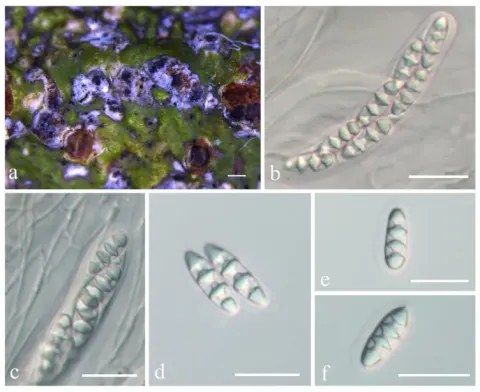
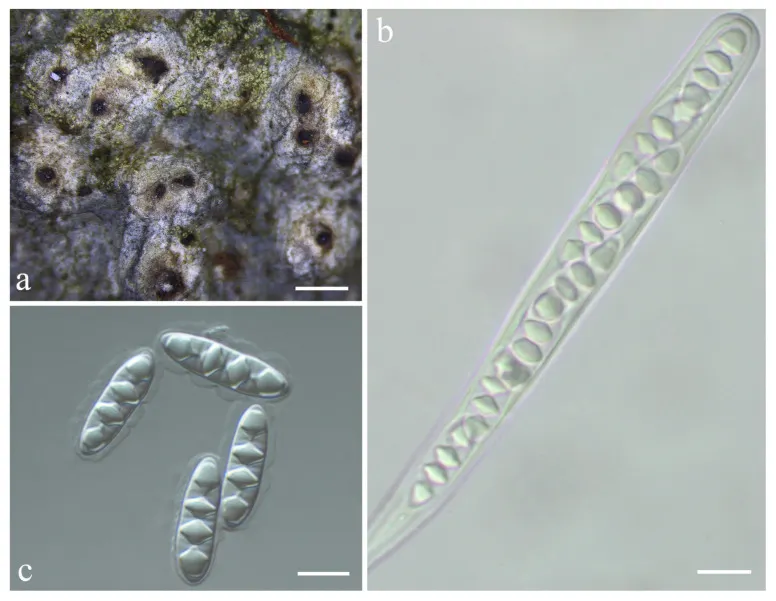
Diagnosis: The new species can be distinguished from the most related species Astrothelium eustominspersum Aptroot and Oliveira-Junior by the lichexanthone only contained in the thallus. Description: Thallus crustose, corticolous, greenish-grey to olive-green, smooth to uneven, somewhat shiny, continuous, covering areas up to 6 cm diam., 0.2–0.4 mm thick, not surrounded by a prothallus. Algae trentepohlioid. Ascomata perithecia, globose to pyriform, black, 0.15–0.4 mm diam., single to 2–15 aggregated groups immersed in pseudostromata. Pseudostromata surfaces white-grey to brownish, not concolorous to the thallus, raised, rounded to irregular. Ostiole eccentric, fused, black, 0.2–0.6 mm diam. Ascomata wall carbonized, 30–100 μm thick. Hamathecium hyaline, interspersed with oil droplets. Asci cylindrical to clavate, 88–170 × 13–17 μm. Ascospores eight per ascus, biseriate to irregular, hyaline, fusiform, transversely three-septate, 17–28 × 6–8 μm, lumina diamond-shaped, surrounded by a smooth gelatinous sheath, 1–6 μm wide. Pycnidia not seen.

Sebagian uraian ditampilkan dalam bahasa sumber; terjemahannya belum tersedia atau belum lolos pemeriksaan.

Rujukan: [1]

Pengukuran mengikuti objek, spesimen atau kultur, dan metode yang disebutkan sumber. Baca uraian asli untuk konteks lengkap.

02 / Kehidupan

Habitat dan peran ekologis

Habitat and distribution: The new species grows on the bark of tropical and subtropical regions and is currently only found in China.

Sebagian uraian ditampilkan dalam bahasa sumber; terjemahannya belum tersedia atau belum lolos pemeriksaan.

Rujukan: [1]

Habitat atau konteks temuan
Informasi belum tersedia pada sumber rilis ini.
Substrat
Informasi belum tersedia pada sumber rilis ini.
Peran atau konteks
Pembentuk liken
Temukan hubungan serupa
03 / Siklus hidup

Reproduksi

Description: Thallus crustose, corticolous, greenish-grey to olive-green, smooth to uneven, somewhat shiny, continuous, covering areas up to 6 cm diam., 0.2–0.4 mm thick, not surrounded by a prothallus. Algae trentepohlioid. Ascomata perithecia, globose to pyriform, black, 0.15–0.4 mm diam., single to 2–15 aggregated groups immersed in pseudostromata. Pseudostromata surfaces white-grey to brownish, not concolorous to the thallus, raised, rounded to irregular. Ostiole eccentric, fused, black, 0.2–0.6 mm diam. Ascomata wall carbonized, 30–100 μm thick. Hamathecium hyaline, interspersed with oil droplets. Asci cylindrical to clavate, 88–170 × 13–17 μm. Ascospores eight per ascus, biseriate to irregular, hyaline, fusiform, transversely three-septate, 17–28 × 6–8 μm, lumina diamond-shaped, surrounded by a smooth gelatinous sheath, 1–6 μm wide.

Sebagian uraian ditampilkan dalam bahasa sumber; terjemahannya belum tersedia atau belum lolos pemeriksaan.

Rujukan: [1]

04 / Batas informasi

Catatan identitas dan cakupan

  • Nama diterima mengikuti Catalogue of Life Base2026-09-11; uraian mempertahankan konsep dan nama sumber aslinya.
  • Preserve original treatment localities, hosts and substrate scope. Materials examined describe documented specimens, not the full global range.
  • Impor dan terjemahan otomatis belum diperiksa editorial per profil. Struktur reproduktif yang disebutkan tidak membuktikan seluruh siklus hidup diketahui.
  • Pengukuran pada uraian mengikuti spesimen, kultur, dan metode sumber; angka tidak diperluas ke semua populasi.

Catatan distribusi dalam narasi mengikuti sumbernya. Dokumentasi spesimen atau foto mengikuti catatan sumber. Bukti wilayah Indonesia dan penilaian konservasi tidak disimpulkan dari gambar.

05 / Dokumentasi

Melihat dengan konteks

Astrothelium subeustominspersum sp. nov. (holotype, HMAS–L 0152001). (a) Thallus with ascomata; (b) ascus; (c) ascospores. Scale bars: (a) = 1 mm; (b, c) = 10 µm.

Jenis
Pelat ilmiah
Kredit
© 2022 by the authors.
Lisensi
CC BY 4.0
Sumber media
Buka entri sumber

Gambar menunjukkan objek menurut identifikasi sumber, bukan verifikasi independen spesimen oleh Fungi. Tidak ada skala baru yang ditambahkan.

06 / Rujukan

Sumber profil

  1. [1] Morphological and Phylogenetic Characterizations Reveal Five New Species of Astrothelium (Trypetheliales, Ascomycota) from China — Astrothelium subeustominspersumBagian sumber: sec3dot2-jof-08-00994_paragraph_34
    Tanggal penghimpunan sumber: 2026-10-12
    Teks sumber: CC BY 4.0 · Jiang SH, Zhang C, Xue XD, Aptroot A, Wei JC, Wei XL.
  2. [2] Catalogue of Life Base2026-09-11 — Astrothelium subeustominspersumBagian sumber: ColDP NameUsage.tsv ID B2X3V; accepted species; source 2073
    Tanggal penghimpunan sumber: 2026-10-12
  3. [3] Dokumentasi visual — Astrothelium subeustominspersumBagian sumber: Individual media record; identification follows the source, not independent determination
    Tanggal penghimpunan sumber: 2026-10-12
    Media sumber: CC BY 4.0 · © 2022 by the authors.

Adaptasi teks: CC BY 4.0. Jiang SH, Zhang C, Xue XD, Aptroot A, Wei JC, Wei XL. — Morphological and Phylogenetic Characterizations Reveal Five New Species of Astrothelium (Trypetheliales, Ascomycota) from China — Astrothelium subeustominspersum

Uraian asli dan riwayat sumber

Riwayat atau halaman sumber

Ringkasan sumber

Diagnosis: The new species can be distinguished from the most related species Astrothelium eustominspersum Aptroot and Oliveira-Junior by the lichexanthone only contained in the thallus. Description: Thallus crustose, corticolous, greenish-grey to olive-green, smooth to uneven, somewhat shiny, continuous, covering areas up to 6 cm diam., 0.2–0.4 mm thick, not surrounded by a prothallus. Algae trentepohlioid. Ascomata perithecia, globose to pyriform, black, 0.15–0.4 mm diam., single to 2–15 aggregated groups immersed in pseudostromata.

Revisi sumber

Morfologi sumber

Diagnosis: The new species can be distinguished from the most related species Astrothelium eustominspersum Aptroot and Oliveira-Junior by the lichexanthone only contained in the thallus. Description: Thallus crustose, corticolous, greenish-grey to olive-green, smooth to uneven, somewhat shiny, continuous, covering areas up to 6 cm diam., 0.2–0.4 mm thick, not surrounded by a prothallus. Algae trentepohlioid. Ascomata perithecia, globose to pyriform, black, 0.15–0.4 mm diam., single to 2–15 aggregated groups immersed in pseudostromata. Pseudostromata surfaces white-grey to brownish, not concolorous to the thallus, raised, rounded to irregular. Ostiole eccentric, fused, black, 0.2–0.6 mm diam. Ascomata wall carbonized, 30–100 μm thick. Hamathecium hyaline, interspersed with oil droplets. Asci cylindrical to clavate, 88–170 × 13–17 μm. Ascospores eight per ascus, biseriate to irregular, hyaline, fusiform, transversely three-septate, 17–28 × 6–8 μm, lumina diamond-shaped, surrounded by a smooth gelatinous sheath, 1–6 μm wide. Pycnidia not seen.

Revisi sumber

Ekologi sumber

Habitat and distribution: The new species grows on the bark of tropical and subtropical regions and is currently only found in China.

Revisi sumber

Struktur reproduksi sumber

Description: Thallus crustose, corticolous, greenish-grey to olive-green, smooth to uneven, somewhat shiny, continuous, covering areas up to 6 cm diam., 0.2–0.4 mm thick, not surrounded by a prothallus. Algae trentepohlioid. Ascomata perithecia, globose to pyriform, black, 0.15–0.4 mm diam., single to 2–15 aggregated groups immersed in pseudostromata. Pseudostromata surfaces white-grey to brownish, not concolorous to the thallus, raised, rounded to irregular. Ostiole eccentric, fused, black, 0.2–0.6 mm diam. Ascomata wall carbonized, 30–100 μm thick. Hamathecium hyaline, interspersed with oil droplets. Asci cylindrical to clavate, 88–170 × 13–17 μm. Ascospores eight per ascus, biseriate to irregular, hyaline, fusiform, transversely three-septate, 17–28 × 6–8 μm, lumina diamond-shaped, surrounded by a smooth gelatinous sheath, 1–6 μm wide.

Revisi sumber

Rujukan halaman ini

Fungi. Astrothelium subeustominspersum. Rilis data fungi-2026-10-12-expansion-2. https://fungi-atlas.mgadib.chatgpt.site/jamur/astrothelium-subeustominspersum/.

Status: impor sumber; pemeriksaan editorial per profil belum selesai. Untuk klaim biologis, gunakan rujukan pada bagian terkait dan periksa konteks sumber aslinya.