Ciri dan struktur
Bacidina adastra is a crustose lichen characterized by its distinctive thallus (the main body of the lichen) that often forms extensive patches up to 0.5 metres in diameter. The thallus is thick and leprose (powdery), typically consisting of a cracked layer of soredia (specialized reproductive structures) up to 1 mm thick. When fresh, the thallus displays a vivid yellowish-green colour that resembles free-living green algae. When dried or in herbarium specimens, it tends to turn greenish-grey or brownish-grey. The individual soredia measure 30–50 μm in diameter. The photobiont (the algal partner in the lichen symbiosis) consists of chlorococcoid cells measuring 7–14 μm in diameter. Morphologically, B. adastra resembles B. neosquamulosa, a species complex that may include multiple distinct species. B. neosquamulosa in the strict sense forms imbricate, finely dissected microsquamules that may later disintegrate to form goniocysts. B. adastra, on the other hand, starts out as minute, somewhat flattened, granules that soon bud off new granules in a more or less coralloid manner, resulting in a thick, finely granular and pale green crust. In addition, the thallus surface tends to be more shiny in B. neosquamulosa than in B. adastra. Apothecia (fruiting bodies) are rarely present in Bacidina adastra. When they do appear, they are (attached directly to the surface without a stalk), constricted at the base, and measure (0.2-)0.4–0.7 mm in diameter. The disc of the apothecium ranges from flat to (wavy) and varies in colour from pale pink to dark blue-black, often with only partially coloured sections.
Habitat dan peran ekologis
Bacidina adastra has been documented in several Western European countries, including the Netherlands, Belgium, England, and Germany. Within the Netherlands, the species has been reported to be fairly common, with numerous putative specimens collected across different provinces including Drenthe, Noord-Holland, Overijssel, and Zuid-Holland. The first documented record of the species from eastern Europe was in Poland; it was later reported from Russia, Armenia, and Estonia. In Fennoscandia, it was first reported from Sweden in 2017, specifically from two sites in southern Skåne. Bacidina adastra is considered rare and strongly over-reported, as it is often confused with crusts of free-living green algae. The species occupies a variety of substrates, though it is primarily corticolous (growing on bark). It shows a preference for hypertrophicated (nutrient-enriched) bases of trees with neutral to basic bark, such as Populus (poplar), Salix (willow), and Ulmus (elm). It also colonizes trees with neutral to slightly acidic bark, including Frangula alnus (alder buckthorn) and Quercus robur (pedunculate oak). While primarily found on living trees, lignicolous (growing on wood), terricolous (growing on soil), and saxicolous (growing on rock) collections have also been documented.
- Habitat atau konteks temuan
- Informasi belum tersedia pada sumber rilis ini.
- Substrat
- kayu; kulit kayu; tanah
- Peran atau konteks
- Pembentuk liken
Reproduksi
Bacidina adastra is a crustose lichen characterized by its distinctive thallus (the main body of the lichen) that often forms extensive patches up to 0.5 metres in diameter. The thallus is thick and leprose (powdery), typically consisting of a cracked layer of soredia (specialized reproductive structures) up to 1 mm thick. When fresh, the thallus displays a vivid yellowish-green colour that resembles free-living green algae. When dried or in herbarium specimens, it tends to turn greenish-grey or brownish-grey. The individual soredia measure 30–50 μm in diameter. The photobiont (the algal partner in the lichen symbiosis) consists of chlorococcoid cells measuring 7–14 μm in diameter. The hymenium contains numerous paraphyses (sterile filaments) about 1 μm thick with tips widened to 5 μm, and (club-shaped) asci.
Catatan identitas dan cakupan
- Nama diterima mengikuti Catalogue of Life Base2026-09-11; uraian mempertahankan konsep dan nama sumber aslinya.
- Original geographic, specimen and life-cycle scope retained; source import awaits individual editorial review.
- Impor dan terjemahan otomatis belum diperiksa editorial per profil. Struktur reproduktif yang disebutkan tidak membuktikan seluruh siklus hidup diketahui.
- Pengukuran pada uraian mengikuti spesimen, kultur, dan metode sumber; angka tidak diperluas ke semua populasi.
Catatan distribusi dalam narasi mengikuti sumbernya. Dokumentasi spesimen atau foto mengikuti catatan sumber. Bukti wilayah Indonesia dan penilaian konservasi tidak disimpulkan dari gambar.
Melihat dengan konteks
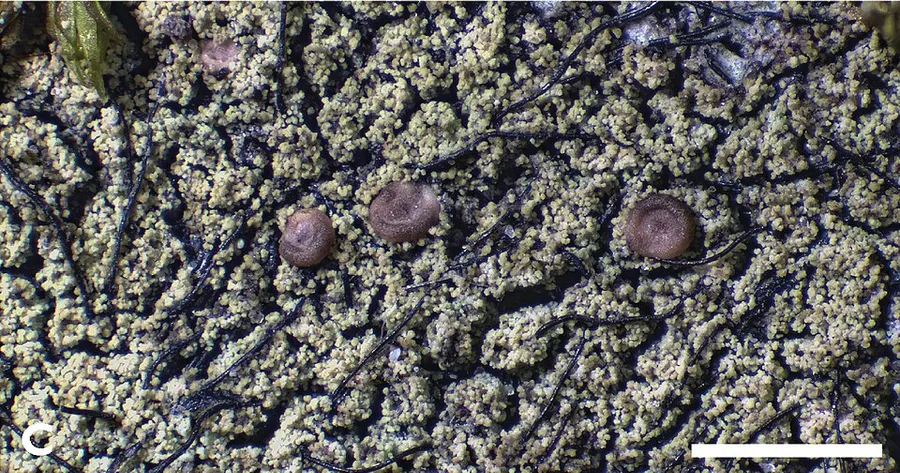
Dokumentasi Bacidina adastra dari Wikimedia Commons. Figure 1C ; Bacidina adastra , close-up of thallus with apothecia, note intermingled black fibers belonging to the polypropylene fabric on which the specimen grows (UPS L-779918). Scale bar: 1 mm. Identifikasi mengikuti record berkas sumber.
- Jenis
- Fotografi
- Kredit
- Svensson M, Ekman S, Klepsland JT, Nordin A, Thor G, von Hirschheydt G, Jonsson F, Knutsson T, Lif M, Spribille T, Westberg M (2017) Taxonomic novelties and new records of Fennoscandian crustose lichens. MycoKeys 25: 51-86. https://doi.org/10.3897/mycokeys.25.13375
- Lisensi
- CC BY 4.0
- Sumber media
- Buka entri sumber
Sumber profil
- [1] Bacidina adastra — Wikipedia (en)
- [2] Catalogue of Life Base2026-09-11 — Bacidina adastra
- [3] Dokumentasi visual — Bacidina adastra
Rujukan halaman ini
Fungi. Bacidina adastra. Rilis data fungi-2026-10-12-expansion-2. https://fungi-atlas.mgadib.chatgpt.site/jamur/bacidina-adastra/.
Status: impor sumber; pemeriksaan editorial per profil belum selesai. Untuk klaim biologis, gunakan rujukan pada bagian terkait dan periksa konteks sumber aslinya.