Ciri dan struktur
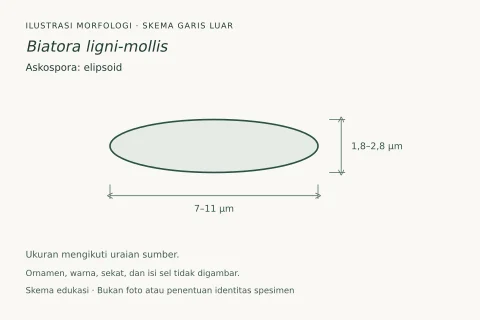
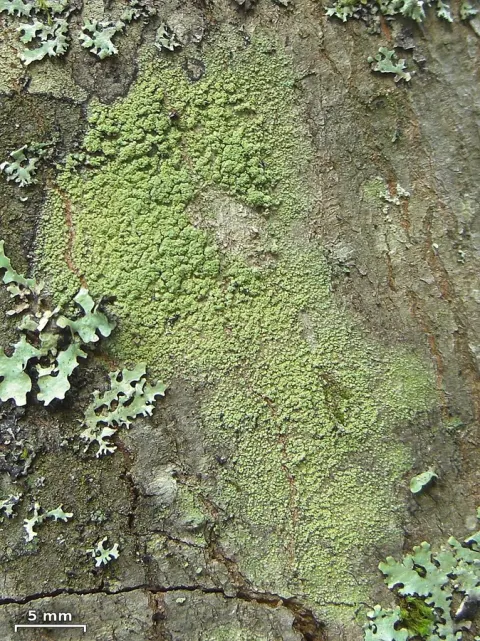
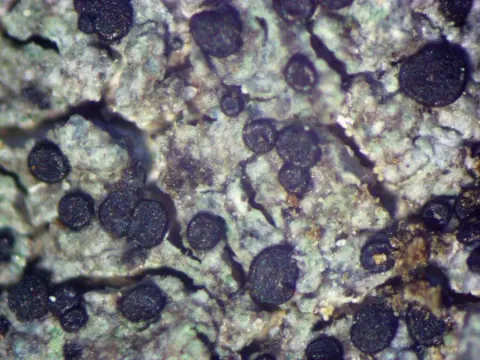
The thallus of Biatora kalbii is made of small round to elongated, convex green squamules (scales) measuring 0.1–0.3 mm in diameter. Some scales are arranged so that they are discrete, while others may overlap; all are attached closely to the substrate. Isidia are spherical; they lengthen by budding. The prothallus is pale and thin. Apothecia (sexual reproductive structures) are common in Biatora kalbii; they are circular with a pale to dark brown disc that is either flat or slightly convex, and a margin around the disc. The ascospores are ellipsoid to short-fusiform (tapering on both ends). Pycnidia are common on the lichen surface; they appear tan-coloured spots with orange to brown ostioles immersed in the thallus. The pycnidia produce straight, rod-shaped conidia that measure 9 by 1 μm. The lichen does not produce any secondary chemicals that could be detected with standard spot tests.
Habitat dan peran ekologis
Biatora kalbii has a pantropical distribution, with most records recorded from altitudes between 300 and 2400 m. Brako's original description includes records from the United States, Dominican Republic, Brazil, Kenya, and Tanzania.
- Habitat atau konteks temuan
- Informasi belum tersedia pada sumber rilis ini.
- Substrat
- Informasi belum tersedia pada sumber rilis ini.
- Peran atau konteks
- Pembentuk liken
Reproduksi
The thallus of Biatora kalbii is made of small round to elongated, convex green squamules (scales) measuring 0.1–0.3 mm in diameter. Some scales are arranged so that they are discrete, while others may overlap; all are attached closely to the substrate. Isidia are spherical; they lengthen by budding. The prothallus is pale and thin. Apothecia (sexual reproductive structures) are common in Biatora kalbii; they are circular with a pale to dark brown disc that is either flat or slightly convex, and a margin around the disc. The ascospores are ellipsoid to short-fusiform (tapering on both ends). Pycnidia are common on the lichen surface; they appear tan-coloured spots with orange to brown ostioles immersed in the thallus.
Catatan identitas dan cakupan
- Nama diterima mengikuti Catalogue of Life Base2026-09-11; uraian mempertahankan konsep dan nama sumber aslinya.
- Original geographic, specimen and life-cycle scope retained; source import awaits individual editorial review.
- Impor dan terjemahan otomatis belum diperiksa editorial per profil. Struktur reproduktif yang disebutkan tidak membuktikan seluruh siklus hidup diketahui.
- Pengukuran pada uraian mengikuti spesimen, kultur, dan metode sumber; angka tidak diperluas ke semua populasi.
Catatan distribusi dalam narasi mengikuti sumbernya. Dokumentasi spesimen atau foto mengikuti catatan sumber. Bukti wilayah Indonesia dan penilaian konservasi tidak disimpulkan dari gambar.
Melihat dengan konteks
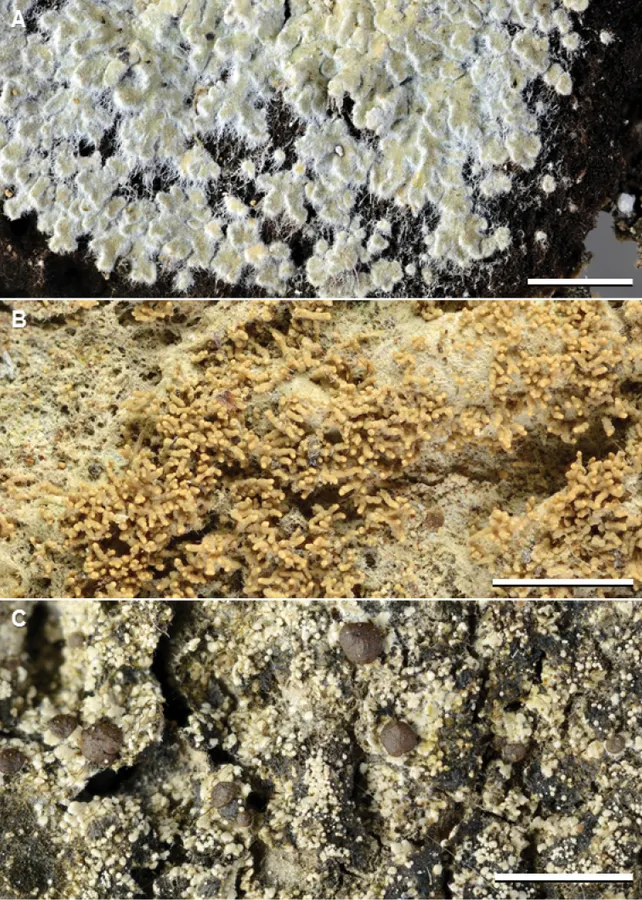
Species of Phyllopsora occurring in Asia and Melanesia. A Phyllopsora halei (Weerakoon 1008) B P. isidiosa (Diederich 13210) C P. kalbii (Aguirre, James & Wolseley 2695). Scale bars: 2 mm.
- Jenis
- Pelat ilmiah
- Kredit
- Sonja Kistenich, Mika Bendiksby, Charles S. Vairappan, Gothamie Weerakoon, Siril Wijesundara, Patricia A. Wolseley, Einar Timdal
- Lisensi
- CC BY 4.0
- Sumber media
- Buka entri sumber
Sumber profil
- [1] Biatora kalbii — Wikipedia (en)
- [2] Catalogue of Life Base2026-09-11 — Biatora kalbii
- [3] Dokumentasi visual — Phyllopsora kalbii
Rujukan halaman ini
Fungi. Biatora kalbii. Rilis data fungi-2026-10-12-expansion-2. https://fungi-atlas.mgadib.chatgpt.site/jamur/biatora-kalbii/.
Status: impor sumber; pemeriksaan editorial per profil belum selesai. Untuk klaim biologis, gunakan rujukan pada bagian terkait dan periksa konteks sumber aslinya.