Ciri dan struktur
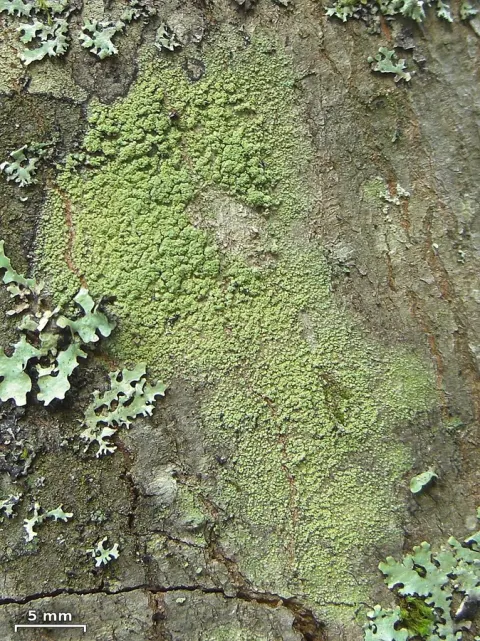
Similar to Biatora pallens (Kullh.) Printzen in having 3-septate ascospores and crystals in the exciple, but differs from that species primarily by the sorediate thallus, the production of atranorin in the thallus and proper exciple and in sometimes producing up to 7-septate ascospores. Thallus crustose, thin, continuous, finely cracked, whitish, forming ± convex pustules from which soralia develop. Pustules greenish (with no hint of yellow; pale grey in the herbarium), glossy, mostly discrete, firm, rounded or rarely ± ellipsoid in outline, 0.08–0.32 mm diam. when rounded and 0.12–0.60 × 0.10–0.36 mm diam. when ellipsoid. Soralia forming by disintegration of pustules into convex aggregations of yellowish grass-green (pale straw in the herbarium) and loosely arranged soredia, finally eroding into ± empty and shallow pits. Soredia mostly ellipsoid, rarely globose, strikingly similar in shape and size, firm (not easily disintegrating in squash preparations), 22–47–79 µm long (s = 14, n = 30) and 19–32–46 µm wide (s = 8, n = 30). Prothallus lacking. Photobiont unicellular, chlorococcoid, globose to (irregularly) ellipsoid, 7.5–12.5 µm long. Apothecia absent or sparse, sometimes abundant, biatorine, 0.3–0.5–0.9 mm diam. (s = 0.1, n = 50), at first flat, later moderately convex, epruinose or thinly pruinose on edge. Disc pale pink (or pale yellowish with age in the herbarium). Margin pale pink to almost white, concolorous with disc or slightly paler, thick, distinct, raised above disc in young apothecia, soon level with the disc, persistent. Proper exciple laterally 54–68 µm thick, with abundant minute crystals (< 1 µm diam.) that are soluble in KOH, colourless or diffusely pale orange-yellow, prosoplechtenchymatous, composed of radiating hyphae that branch in the inner but not outer part of the exciple, with gelatinised cell walls; cell lumina narrowly cylindrical, 0.7–0.8 µm wide (swelling in KOH); terminal cells not swollen or moderately swollen to 2 µm.
Habitat dan peran ekologis
Biatora alnetorum is known from the Pacific Northwest of North America in Washington and Alaska (U.S.A.) and British Columbia (Canada). Its vertical distribution ranges from 620 to 1450 m a.s.l. It occurs in openings in humid old-growth coniferous forest and Alnus woodlands and in the alpine scrub zone. B. alnetorum inhabits smooth bark of trunks or, occasionally, branches. The phorophyte is almost exclusively Alnus alnobetula subsp. sinuata (also known as Alnus viridis subsp. sinuata), except for a single record on Alnus rubra. Other lichens occurring together with B. alnetorum include (on Alnus alnobetula) Caloplaca sorocarpa (Vain.) Zahlbr., Biatora flavopunctata (Tønsberg) Hinter. & Printzen, B. toensbergii Holien & Printzen, B. vacciniicola (Tønsberg) Printzen and Pertusaria carneopallida (Nyl.) Anzi ex Nyl. and (on Alnus rubra) Parmeliopsis hyperopta (Ach.) Arnold, Japewia subaurifera Muhr & Tønsberg, and Phlyctis speirea G. Merr.
- Habitat atau konteks temuan
- hutan
- Substrat
- Informasi belum tersedia pada sumber rilis ini.
- Peran atau konteks
- Pembentuk liken
Reproduksi
Similar to Biatora pallens (Kullh.) Printzen in having 3-septate ascospores and crystals in the exciple, but differs from that species primarily by the sorediate thallus, the production of atranorin in the thallus and proper exciple and in sometimes producing up to 7-septate ascospores. Thallus crustose, thin, continuous, finely cracked, whitish, forming ± convex pustules from which soralia develop. Pustules greenish (with no hint of yellow; pale grey in the herbarium), glossy, mostly discrete, firm, rounded or rarely ± ellipsoid in outline, 0.08–0.32 mm diam. when rounded and 0.12–0.60 × 0.10–0.36 mm diam. when ellipsoid. Soralia forming by disintegration of pustules into convex aggregations of yellowish grass-green (pale straw in the herbarium) and loosely arranged soredia, finally eroding into ± empty and shallow pits.
Catatan identitas dan cakupan
- Nama diterima mengikuti Catalogue of Life Base2026-09-11; uraian mempertahankan konsep dan nama sumber aslinya.
- Preserve original treatment localities, hosts and substrate scope. Materials examined describe documented specimens, not the full global range.
- Impor dan terjemahan otomatis belum diperiksa editorial per profil. Struktur reproduktif yang disebutkan tidak membuktikan seluruh siklus hidup diketahui.
- Pengukuran pada uraian mengikuti spesimen, kultur, dan metode sumber; angka tidak diperluas ke semua populasi.
Catatan distribusi dalam narasi mengikuti sumbernya. Dokumentasi spesimen atau foto mengikuti catatan sumber. Bukti wilayah Indonesia dan penilaian konservasi tidak disimpulkan dari gambar.
Melihat dengan konteks
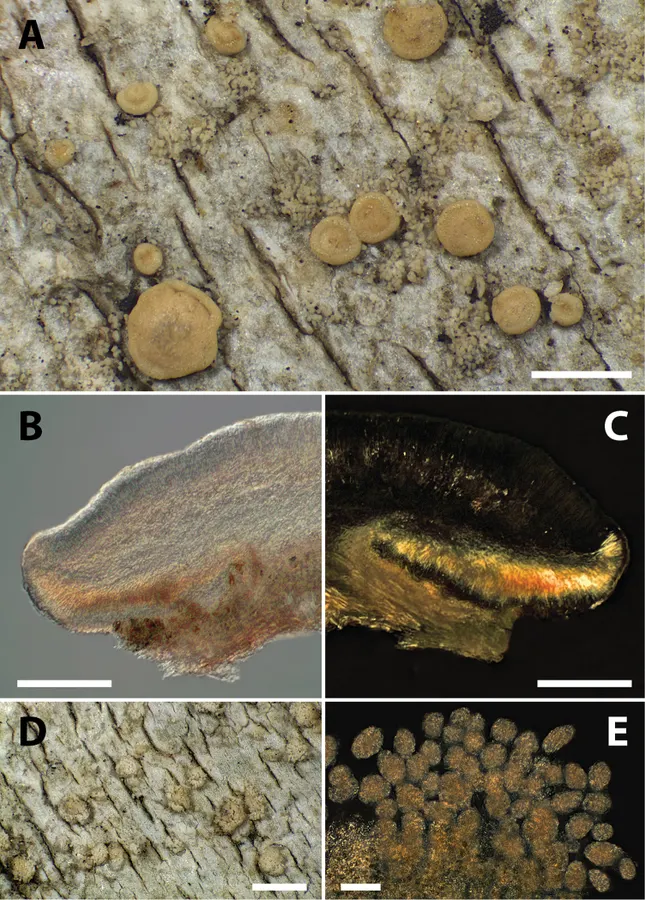
Morphology of Biatora alnetorum. A Habit of lichen thallus with apothecia and soralia in herbarium specimen from 1999 (Tønsberg 27500, BG) B, C section through apothecium (Tønsberg 24077, BG), B showing pigmentation in bright-field illumination and C showing crystals in the proper exciple in cross-polarised light D thallus with soralia in herbarium specimen from 2000 (Tønsberg 28771a, BG) E soralium with soredia in cross-polarised light (Tønsberg 28771a, BG). Scale bars: 0.5 mm (A), 100 µm (B, C), 0.5 mm (D), 50 µm (E).
- Jenis
- Pelat ilmiah
- Kredit
- Stefan Ekman, Tor Tønsberg
- Lisensi
- CC BY 4.0
- Sumber media
- Buka entri sumber
Dokumentasi tambahan
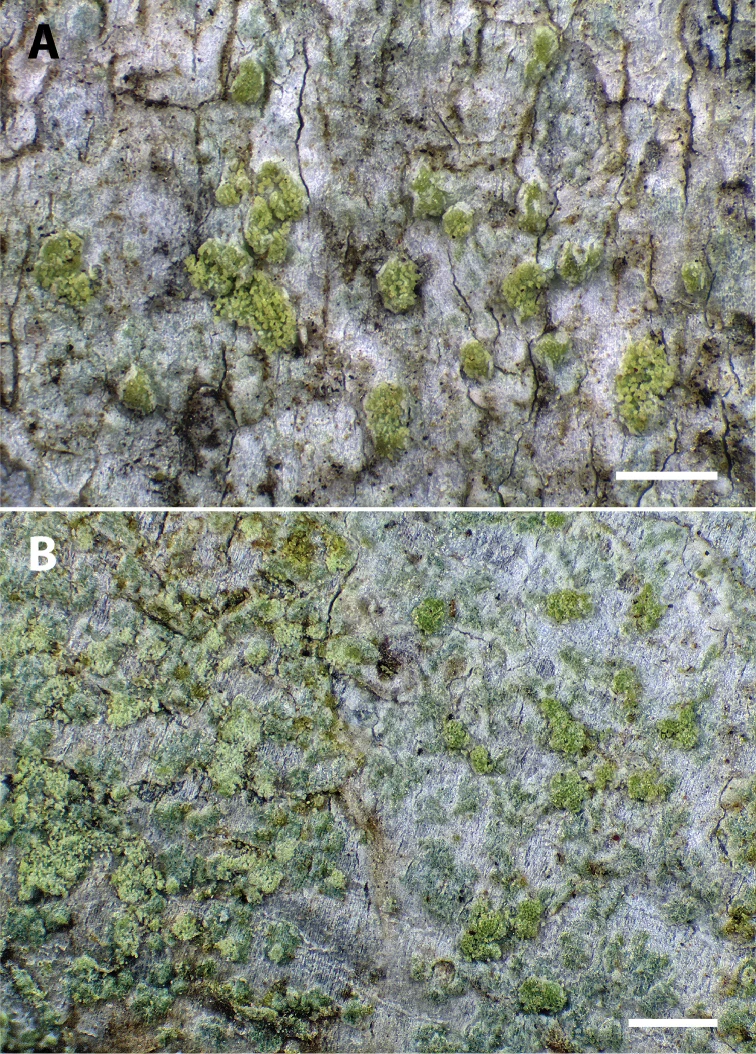
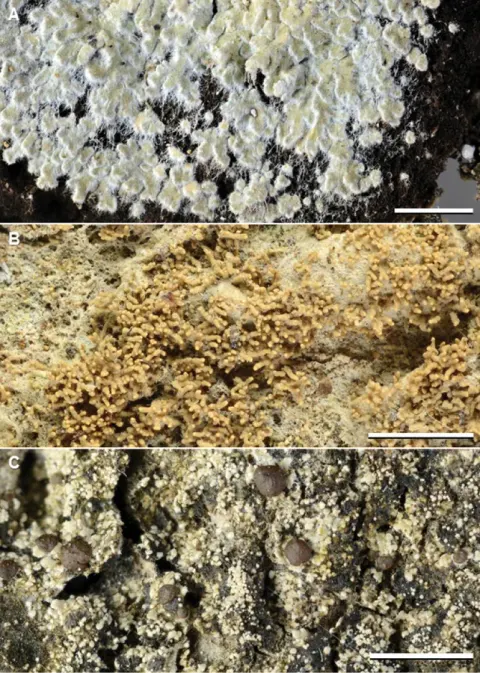
Morphology of Biatora alnetorum. A Thallus with soralia in freshly collected specimen (Tønsberg 48200, UPS) B thalli with soralia in freshly collected specimens: Biatora alnetorum to the right and the similar B. flavopunctata to the left (Tønsberg 48202, BG), separated more or less by the approximately vertical, shallow crack at the centre of the image. Scale bars: 0.5 mm (A, B).
Kredit dan penggunaan
Stefan Ekman, Tor Tønsberg
Ukuran dan format gambar disesuaikan tanpa pemotongan, retus, atau penambahan skala. Lisensi sumber dipertahankan.
Sumber profil
- [1] Biatora alnetorum (Ramalinaceae, Lecanorales), a new lichen species from western North America — Biatora alnetorum
- [2] Catalogue of Life Base2026-09-11 — Biatora alnetorum
- [3] Dokumentasi visual — Biatora alnetorum
- [4] Dokumentasi visual — Biatora alnetorum
Rujukan halaman ini
Fungi. Biatora alnetorum. Rilis data fungi-2026-10-12-expansion-2. https://fungi-atlas.mgadib.chatgpt.site/jamur/biatora-alnetorum/.
Status: impor sumber; pemeriksaan editorial per profil belum selesai. Untuk klaim biologis, gunakan rujukan pada bagian terkait dan periksa konteks sumber aslinya.