Ciri dan struktur
B. dendrobatidis infects the keratinized skin of amphibians. The fungus in the epidermis has a thallus bearing a network of rhizoids and smooth-walled, roughly spherical, inoperculate (without an operculum) sporangia. Each sporangium produces a single tube to discharge spores.
Habitat dan peran ekologis
The fungus grows on amphibian skin and produces aquatic zoospores. It is widespread and ranges from lowland forests to cold mountain tops. It is sometimes a non-lethal parasite and possibly a saprophyte. The fungus is associated with host mortality in highlands or during winter, and becomes more pathogenic at lower temperatures. It has been suggested that B. dendrobatidis originated in Africa or Asia and subsequently spread to other parts of the world by trade in African clawed frogs (Xenopus laevis). In this study, 697 archived specimens of three species of Xenopus, previously collected from 1879 to 1999 in southern Africa, were examined. The earliest case of chytridiomycosis was found in a X. laevis specimen from 1938. The study also suggests that chytridiomycosis had been a stable infection in southern Africa from 23 years prior to finding any infected outside of Africa. American bullfrogs (Lithobates catesbeianus), also widely distributed, are also thought to be carriers of the disease due to their inherent low susceptibility to B. dendrobatidis infection. The bullfrog often escapes captivity and can establish feral populations where it may introduce the disease to new areas. Infections have been linked to mass mortalities of amphibians in North America, South America, Central America, Europe and Australia.
- Habitat atau konteks temuan
- hutan
- Substrat
- Informasi belum tersedia pada sumber rilis ini.
- Peran atau konteks
- Pembentuk liken
Reproduksi
B. dendrobatidis infects the keratinized skin of amphibians. The fungus in the epidermis has a thallus bearing a network of rhizoids and smooth-walled, roughly spherical, inoperculate (without an operculum) sporangia. Each sporangium produces a single tube to discharge spores.
Catatan identitas dan cakupan
- Nama diterima mengikuti Catalogue of Life Base2026-09-11; uraian mempertahankan konsep dan nama sumber aslinya.
- Original geographic, specimen and life-cycle scope retained; source import awaits individual editorial review.
- Impor dan terjemahan otomatis belum diperiksa editorial per profil. Struktur reproduktif yang disebutkan tidak membuktikan seluruh siklus hidup diketahui.
- Pengukuran pada uraian mengikuti spesimen, kultur, dan metode sumber; angka tidak diperluas ke semua populasi.
Catatan distribusi dalam narasi mengikuti sumbernya. Dokumentasi spesimen atau foto mengikuti catatan sumber. Bukti wilayah Indonesia dan penilaian konservasi tidak disimpulkan dari gambar.
Melihat dengan konteks
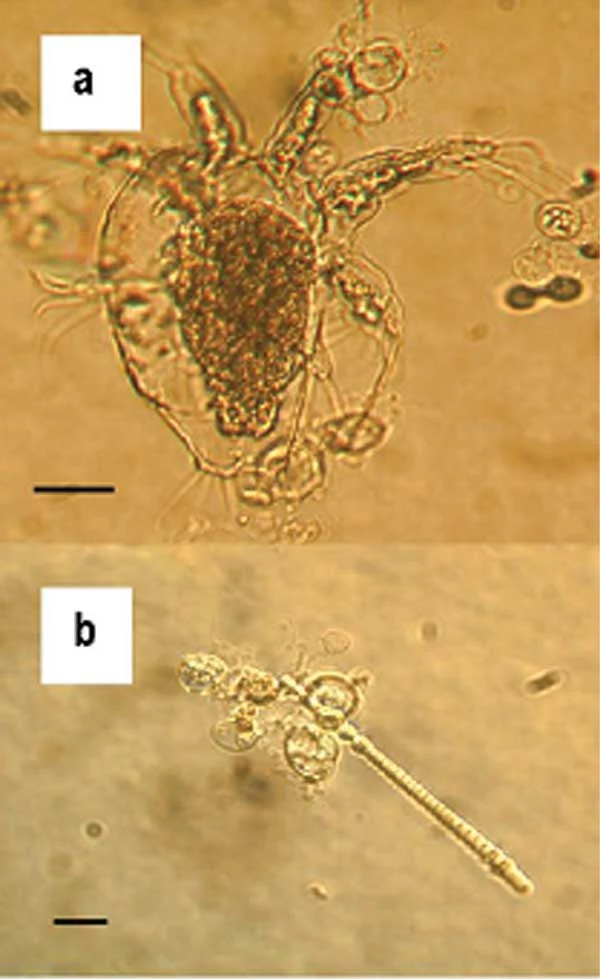
Zoosporangium Batrachochytrium dendrobatidis strain 98-1810/3 tampak sebagai bola transparan pada artropoda air tawar (a) dan alga (b). Identitas mengikuti keterangan berkas sumber.
- Jenis
- Mikrograf
- Kredit
- Johnson/Speare (publication does not specify), Emerging Infectious Diseases (2003); via Wikimedia Commons
- Lisensi
- Public domain
- Sumber media
- Buka entri sumber
Sumber profil
- [1] Batrachochytrium dendrobatidis — Wikipedia (en)
- [2] Catalogue of Life Base2026-09-11 — Batrachochytrium dendrobatidis
- [3] Dokumentasi visual — Batrachochytrium dendrobatidis
Rujukan halaman ini
Fungi. Batrachochytrium dendrobatidis. Rilis data fungi-2026-10-12-expansion-2. https://fungi-atlas.mgadib.chatgpt.site/jamur/batrachochytrium-dendrobatidis/.
Status: impor sumber; pemeriksaan editorial per profil belum selesai. Untuk klaim biologis, gunakan rujukan pada bagian terkait dan periksa konteks sumber aslinya.