01 / Morfologi

Ciri dan struktur

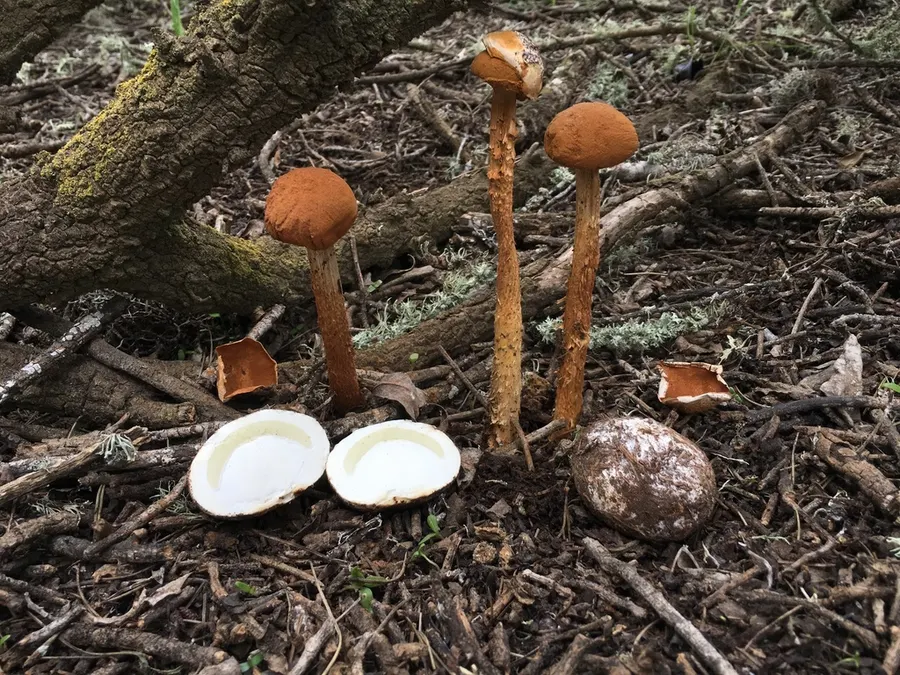
Mature specimens of Battarrea phalloides roughly resemble the typical agaric mushroom stature of stem and cap. However, rather than a cap with gills, this species has a spore sac atop the stem. When young, the fruit body is roughly spherical and completely encased in an outer wall (exoperidium) that later splits in a circumscissile fashion (along a circular or equatorial line), the lower wall forming a volva and the upper part forming scales that cover the inner wall. The upper part rolls upward and backward and eventually falls away in one piece, exposing a spore sac lined with a narrow ring of capillitium and spores. The spores are sticky. As these are carried away by the wind, the drying action of the latter cause the edges of the peridium to shrivel and roll up more, exposing more spores. This is continued until the upper half of the peridium has shriveled and blown away and there remains only a few spores, which may be washed away by rain. The fruit body develops rapidly; when mature, it is rust-colored, with a hemispherical to somewhat conical "head" 1 to 3 cm in diameter, and with a stalk up to 40 cm long by 0.4 to 1.5 cm thick. One study reported a specimen found in Mexico with a length of 70 cm. Typically, the spore case is 3 to 5 cm broad by 1 to 3.5 cm tall. The hollow stalk is pale brown to brown, woody, and has a fibrous, scaly, or even woolly surface. The mature gleba, which is eventually exposed when the peridial cap is shed, has a rust-brown color. The cap may persist after the spore mass is dispersed and form a disc-like unit that slides down the stalk like a ring.

Sebagian uraian ditampilkan dalam bahasa sumber; terjemahannya belum tersedia atau belum lolos pemeriksaan.

Rujukan: [1]

Pengukuran mengikuti objek, spesimen atau kultur, dan metode yang disebutkan sumber. Baca uraian asli untuk konteks lengkap.

02 / Kehidupan

Habitat dan peran ekologis

Battarrea phalloides dapat ditemukan tumbuh bersendirian hingga tersebar di tempat-tempat yang kering dan berpasir (tembok atau fitur batas yang terangkat, sering di atasnya dengan pagar), kadang-kadang tumbuh di antara pemanis elm. Ini adalah spesies yang relatif langka, tetapi mungkin banyak di beberapa tempat. China, Due to penurunan pengamatan, B. phalloides diberikan perlindungan hukum di Hungary in 2005, sehingga merupakan pelanggaran yang dapat diselesaikan untuk memilih mereka. Ia menerima status perlindungan yang sama di Amerika Serikat Kingdom in 1998. Habitat dan rentang habitat B. stevenii termasuk daerah kering di barat dan barat daya Amerika Serikat, Australia, Aotearoa Selandia Baru, Afrika Selatan, dan beberapa European countries, termasuk Rusia.

Rujukan: [1]

Habitat atau konteks temuan
Informasi belum tersedia pada sumber rilis ini.
Substrat
Informasi belum tersedia pada sumber rilis ini.
Peran atau konteks
Belum dikategorikan pada rilis ini.
Temukan hubungan serupa
03 / Siklus hidup

Reproduksi

Mature specimens of Battarrea phalloides roughly resemble the typical agaric mushroom stature of stem and cap. However, rather than a cap with gills, this species has a spore sac atop the stem. When young, the fruit body is roughly spherical and completely encased in an outer wall (exoperidium) that later splits in a circumscissile fashion (along a circular or equatorial line), the lower wall forming a volva and the upper part forming scales that cover the inner wall. The upper part rolls upward and backward and eventually falls away in one piece, exposing a spore sac lined with a narrow ring of capillitium and spores. The spores are sticky. As these are carried away by the wind, the drying action of the latter cause the edges of the peridium to shrivel and roll up more, exposing more spores.

Sebagian uraian ditampilkan dalam bahasa sumber; terjemahannya belum tersedia atau belum lolos pemeriksaan.

Rujukan: [1]

Sinonim menurut acuan taksonomi rilis: Battarrea franciscana; Battarrea gaudichaudii; Battarrea guachiparum; Battarrea guicciardiniana; Battarrea katzlerae; Battarrea laciniata; Battarrea levispora; Battarrea muelleri; Battarrea patagonica; Battarrea phalloides var. stevenii; Battarrea stevenii; Battarrea tepperiana; Dendromyces stevenii; Ithyphallus campanulatus; Phallus campanulatus; Sphaericeps lignipes; Sphaerocybis lignipes
04 / Batas informasi

Catatan identitas dan cakupan

  • Nama diterima mengikuti Catalogue of Life Base2026-09-11; uraian mempertahankan konsep dan nama sumber aslinya.
  • Original geographic, specimen and life-cycle scope retained; source import awaits individual editorial review.
  • Impor dan terjemahan otomatis belum diperiksa editorial per profil. Struktur reproduktif yang disebutkan tidak membuktikan seluruh siklus hidup diketahui.
  • Pengukuran pada uraian mengikuti spesimen, kultur, dan metode sumber; angka tidak diperluas ke semua populasi.

Catatan distribusi dalam narasi mengikuti sumbernya. Dokumentasi spesimen atau foto mengikuti catatan sumber. Bukti wilayah Indonesia dan penilaian konservasi tidak disimpulkan dari gambar.

05 / Dokumentasi

Melihat dengan konteks

Dokumentasi Battarrea phalloides menurut asosiasi foto pada record takson iNaturalist. Kredit: Adam J. Searcy. Identitas mengikuti sumber; bukan penentuan spesimen independen.

Jenis
Fotografi
Kredit
(c) Adam J. Searcy, some rights reserved (CC BY), uploaded by Adam J. Searcy
Lisensi
CC BY 4.0
Sumber media
Buka entri sumber

Gambar menunjukkan objek menurut identifikasi sumber, bukan verifikasi independen spesimen oleh Fungi. Tidak ada skala baru yang ditambahkan.

06 / Rujukan

Sumber profil

  1. [1] Battarrea phalloides — Wikipedia (en)Bagian sumber: Frozen revision 1376101246
    Tanggal penghimpunan sumber: 2026-10-12
    Teks sumber: CC BY-SA4.0 · Wikipedia contributors
  2. [2] Catalogue of Life Base2026-09-11 — Battarrea phalloidesBagian sumber: ColDP NameUsage.tsv ID L3K2; accepted species; source 2073
    Tanggal penghimpunan sumber: 2026-10-12
  3. [3] Dokumentasi visual — Battarrea phalloidesBagian sumber: Individual media record; identification follows the source, not independent determination
    Tanggal penghimpunan sumber: 2026-10-12
    Media sumber: CC BY 4.0 · (c) Adam J. Searcy, some rights reserved (CC BY), uploaded by Adam J. Searcy

Adaptasi teks: CC BY-SA 4.0. Wikipedia contributors — Battarrea phalloides — Wikipedia (en)

Uraian asli dan riwayat sumber

Riwayat atau halaman sumber

Ringkasan sumber

Battarrea phalloides is a species of mushroom in the family Agaricaceae, and the type species of the genus Battarrea. Its common names include the scaley-stalked puffball, sandy stiltball, and desert stalked puffball. The European B. stevenii is a potential synonym. B. phalloides has a woody, slender, and shaggy or scaly stem that is typically up to 40 cm in length. Although its general appearance resembles an agaric with stem and gills, atop the stem is a spore sac, consisting of a peridium and a powdery internal gleba.

Revisi sumber

Morfologi sumber

Mature specimens of Battarrea phalloides roughly resemble the typical agaric mushroom stature of stem and cap. However, rather than a cap with gills, this species has a spore sac atop the stem. When young, the fruit body is roughly spherical and completely encased in an outer wall (exoperidium) that later splits in a circumscissile fashion (along a circular or equatorial line), the lower wall forming a volva and the upper part forming scales that cover the inner wall. The upper part rolls upward and backward and eventually falls away in one piece, exposing a spore sac lined with a narrow ring of capillitium and spores. The spores are sticky. As these are carried away by the wind, the drying action of the latter cause the edges of the peridium to shrivel and roll up more, exposing more spores. This is continued until the upper half of the peridium has shriveled and blown away and there remains only a few spores, which may be washed away by rain. The fruit body develops rapidly; when mature, it is rust-colored, with a hemispherical to somewhat conical "head" 1 to 3 cm in diameter, and with a stalk up to 40 cm long by 0.4 to 1.5 cm thick. One study reported a specimen found in Mexico with a length of 70 cm. Typically, the spore case is 3 to 5 cm broad by 1 to 3.5 cm tall. The hollow stalk is pale brown to brown, woody, and has a fibrous, scaly, or even woolly surface. The mature gleba, which is eventually exposed when the peridial cap is shed, has a rust-brown color. The cap may persist after the spore mass is dispersed and form a disc-like unit that slides down the stalk like a ring.

Revisi sumber

Ekologi sumber

Battarrea phalloides may be found growing solitary to scattered on dry, sandy hedgebanks (raised or mounded boundary feature, often topped by a hedgerow), sometimes growing amongst elm suckers. It is a relatively rare species, but may be locally abundant in some locations. China, Due to a decline in sightings, B. phalloides was granted legal protection in Hungary in 2005, making it a finable offense to pick them. It received similar protected status in the United Kingdom in 1998. The habitat and range of B. stevenii include arid regions of the western and southwestern United States, Australia, Aotearoa New Zealand, South Africa, and several European countries, including Russia.

Revisi sumber

Struktur reproduksi sumber

Mature specimens of Battarrea phalloides roughly resemble the typical agaric mushroom stature of stem and cap. However, rather than a cap with gills, this species has a spore sac atop the stem. When young, the fruit body is roughly spherical and completely encased in an outer wall (exoperidium) that later splits in a circumscissile fashion (along a circular or equatorial line), the lower wall forming a volva and the upper part forming scales that cover the inner wall. The upper part rolls upward and backward and eventually falls away in one piece, exposing a spore sac lined with a narrow ring of capillitium and spores. The spores are sticky. As these are carried away by the wind, the drying action of the latter cause the edges of the peridium to shrivel and roll up more, exposing more spores.

Revisi sumber

Rujukan halaman ini

Fungi. Battarrea phalloides. Rilis data fungi-2026-10-12-expansion-2. https://fungi-atlas.mgadib.chatgpt.site/jamur/battarrea-phalloides/.

Status: impor sumber; pemeriksaan editorial per profil belum selesai. Untuk klaim biologis, gunakan rujukan pada bagian terkait dan periksa konteks sumber aslinya.