Ciri dan struktur
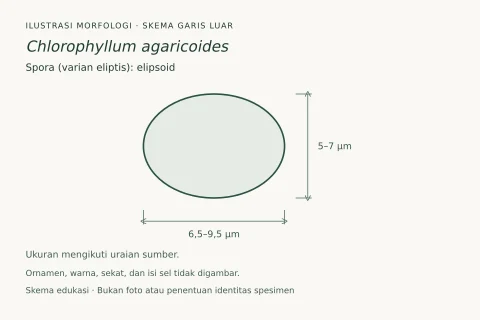
This species is distinguished from other Chlorophyllum species by relatively small basidiocarps with yellow grey to grey orange (5B4) furfuraceous squamules, the squamules composed of a hymenidermal layer made up of greyish-yellow to dull yellow, narrowly clavate to clavate elements, the hyaline ellipsoid basidiospores without a germ pore and the hyaline, cylindric to slightly fusiform cheilocystidia. Pileus 30–50 mm broad, hemispherical to convex when young, expanding to broadly convex or applanate with age, sometimes with a prominent umbo; margin sulcate striate; surface covered with thin, yellow grey (4B2–4B3), orange grey (6B2) to grey orange (5B4) furfuraceous squamules, these remaining intact on the disc but elsewhere diffracted-scaly with expansion and receding from pileus margin. Lamellae free and remote from stipe, white to off white, crowded, narrow, up to 6 mm deep, with 1–2 series of lamellulae; edges entire, white. Stipe 35–60 × 3–6 mm, subcylindric, slightly enlarged at base, glabrous, white to light brown, hollow, nearly stuffed, with a simple annulus about 10–15 mm from top of the stipe. Context white, 1–2 mm thick in pileus, discolouring brown to red where bruised or handled, with strong mushroom odour, taste mild. Spore print white to cream. Basidiospores (7.5)8.0–9.0 × (5.5) 6.0–6.5(7.0) μm (mean 8.2 ± 0.4 × 6.2 ± 0.3 μm), Q = (1.2)1.3–1.4 (1.5), Qav = 1.3 ± 0.05, ellipsoid, occasionally ovoid in side view or in frontal view, with rounded apex, smooth, hyaline, congophilous, dextrinoid, with one guttule in most cases, without germ pore, slightly thick walled, becoming purplish-red (14A6–14A7) in cresyl blue.
Habitat dan peran ekologis
Saprotrophic, solitary to scattered, terrestrial. SOUTH AFRICA. 2229 BB Beit Bridge, Farm Matolege 133MS, −22°14.66'S, 29°46.75'E, 574 m, on soil. 10 January 2014, Van Der Walt, R787 (PREM 62140). 2229 BD Kamkusi, Farm Ludwigslust 163 MS (Farm Yard), −22°16.64'S, 29°48.22'E, alt. ca. 610 m, 9 March 2014, Van Der Walt, R935 (PREM 62141). Scattered in sandy soil of semi-shade to full sun, cleared area. Chlorophyllum africanum is morphologically very similar to C. bharatense Sathe & S.M. Kulk. Both species have a small-sized convex to applanate pileus covered with pale olivaceous brown squamules, clavate cheilocystidia and broadly ellipsoid basidiospores. However, C. bharatense differs from C. africanum by the umbonate pileus, lamellae that become reddish- brown on drying, basidiospores with an indistinct or absent germpore and squamules composed of a trichodermal layer (Sathe et al. 1981 (‘1980’)). Chlorophyllum africanum is also similar to C. hortense on account of the small-sized basidiocarps, ellipsoid basidiospores and subcylindrical cheilocystidia. However, C. hortense differs from C. africanum by 2-spored basidia and the whitish context of the stipe becoming reddish where bruised (Akers and Sundberg 1997; Vellinga 2003b).
- Habitat atau konteks temuan
- Informasi belum tersedia pada sumber rilis ini.
- Substrat
- tanah
- Peran atau konteks
- Pengurai
Reproduksi
This species is distinguished from other Chlorophyllum species by relatively small basidiocarps with yellow grey to grey orange (5B4) furfuraceous squamules, the squamules composed of a hymenidermal layer made up of greyish-yellow to dull yellow, narrowly clavate to clavate elements, the hyaline ellipsoid basidiospores without a germ pore and the hyaline, cylindric to slightly fusiform cheilocystidia. Pileus 30–50 mm broad, hemispherical to convex when young, expanding to broadly convex or applanate with age, sometimes with a prominent umbo; margin sulcate striate; surface covered with thin, yellow grey (4B2–4B3), orange grey (6B2) to grey orange (5B4) furfuraceous squamules, these remaining intact on the disc but elsewhere diffracted-scaly with expansion and receding from pileus margin.
Catatan identitas dan cakupan
- Nama diterima mengikuti Catalogue of Life Base2026-09-11; uraian mempertahankan konsep dan nama sumber aslinya.
- Preserve original treatment localities, hosts and substrate scope. Materials examined describe documented specimens, not the full global range.
- Impor dan terjemahan otomatis belum diperiksa editorial per profil. Struktur reproduktif yang disebutkan tidak membuktikan seluruh siklus hidup diketahui.
- Pengukuran pada uraian mengikuti spesimen, kultur, dan metode sumber; angka tidak diperluas ke semua populasi.
Catatan distribusi dalam narasi mengikuti sumbernya. Dokumentasi spesimen atau foto mengikuti catatan sumber. Bukti wilayah Indonesia dan penilaian konservasi tidak disimpulkan dari gambar.
Melihat dengan konteks
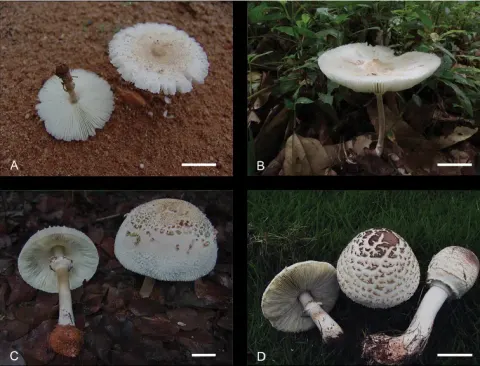
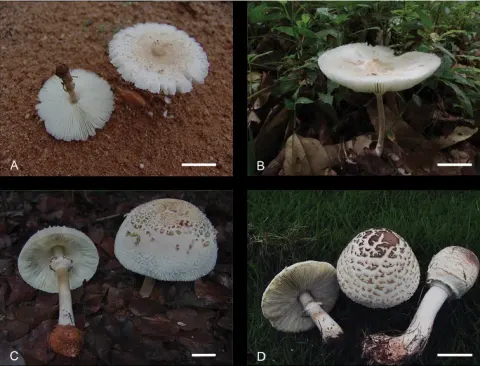
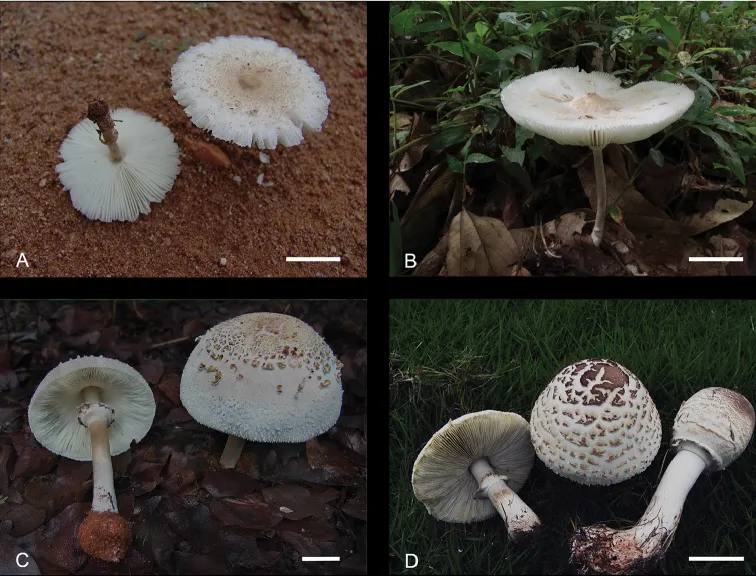
Basidiocarps of representative species of Chlorophyllum. A Chlorophyllum africanum (PREM 62141) B Chlorophyllum demangei (HKAS 89157) C Chlorophyllum globosum (PREM 62152) D Chlorophyllum palaeotropicum (HKAS 60195).
- Jenis
- Pelat ilmiah
- Kredit
- Zai-Wei Ge, Adriaana Jacobs, Else C. Vellinga, Phongeun Sysouphanthong, Retha van der Walt, Carmine Lavorato, Yi-Feng An, Zhu L. Yang
- Lisensi
- CC BY 4.0
- Sumber media
- Buka entri sumber
Dokumentasi tambahan
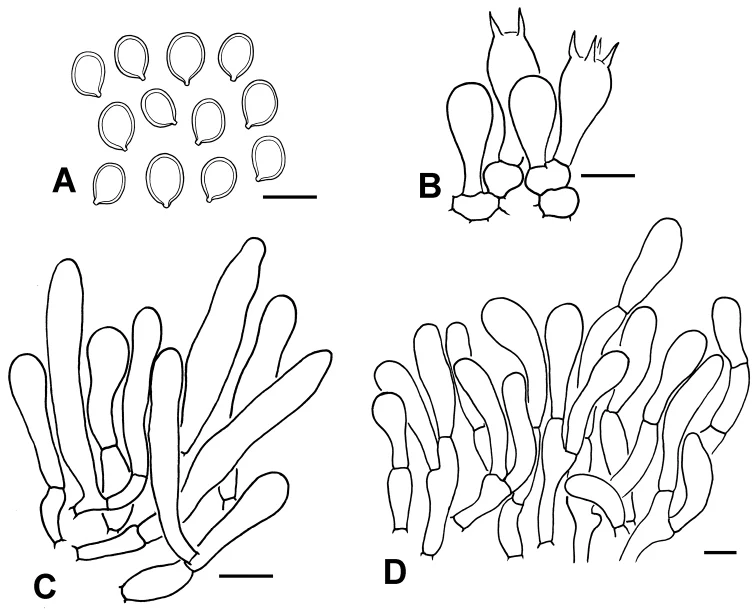
Micro-morphological features of C. africanum (PREM 62143, type). A Basidiospores B Basidia C Cheilocystidia D Elements of squamules on pileus. Scale bars: 10 μm (A, D); 20 μm (B, C).
Kredit dan penggunaan
Zai-Wei Ge, Adriaana Jacobs, Else C. Vellinga, Phongeun Sysouphanthong, Retha van der Walt, Carmine Lavorato, Yi-Feng An, Zhu L. Yang
Ukuran dan format gambar disesuaikan tanpa pemotongan, retus, atau penambahan skala. Lisensi sumber dipertahankan.
Sumber profil
- [1] A multi-gene phylogeny of Chlorophyllum (Agaricaceae, Basidiomycota): new species, new combination and infrageneric classification — Chlorophyllum africanum
- [2] Catalogue of Life Base2026-09-11 — Chlorophyllum africanum
- [3] Dokumentasi visual — Chlorophyllum africanum
- [4] Dokumentasi visual — Chlorophyllum africanum
Rujukan halaman ini
Fungi. Chlorophyllum africanum. Rilis data fungi-2026-10-12-expansion-2. https://fungi-atlas.mgadib.chatgpt.site/jamur/chlorophyllum-africanum/.
Status: impor sumber; pemeriksaan editorial per profil belum selesai. Untuk klaim biologis, gunakan rujukan pada bagian terkait dan periksa konteks sumber aslinya.