Ciri dan struktur
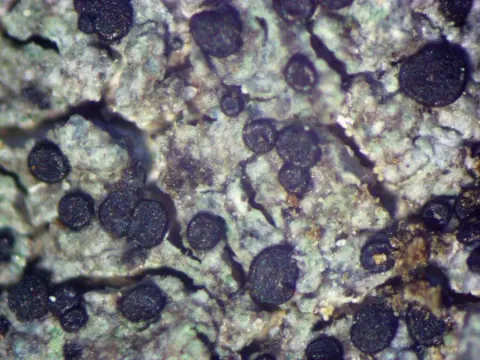
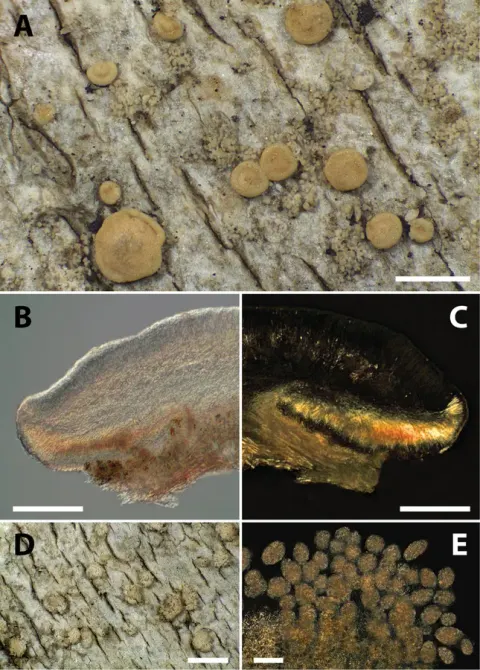
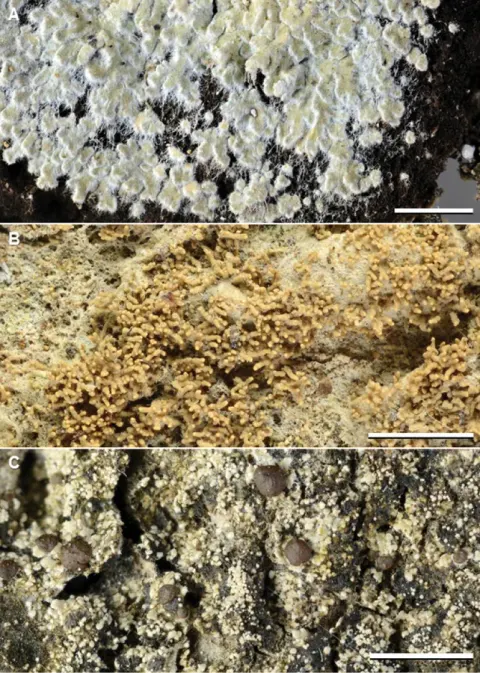
The thallus of Biatora pontica is formed from , or small rounded areas. These areoles, in the non-sorediate parts, can either be embedded within or superficially connected to the . Their colour can range from a verdant green to yellowish-grey, and each areola can reach up to 1.2 mm in diameter. Bright green to yellowish-grey soralia (groups of reproductive structures) characterise this lichen, initially taking on a , or point-like shape. These soralia gradually merge over time. The presence of , or fruiting bodies where sexual reproduction occurs, is relatively rare in Biatora pontica. These (typical to the genus Biatora), rounded, and sessile structures vary from 0.5 to 0.7 mm in diameter. A , or the rim surrounding the apothecium, is typically visible in younger apothecia only and is colourless when examined in section. The , located at the centre of the apothecium, takes on a shade varying from dark grey-ochre to brown-grey and is flat to slightly convex in structure. The underlying layer, or , is mainly colourless, with fragments showcasing pigments of Pontica-blue and Pontica-red. The hymenium, or tissue layer containing the asci (spore-bearing cells), either bears no colour or is bright olive, measuring approximately 40 μm in height. Each ascus of the Biatora type carries eight spores. These are non-septate and take on an ellipsoidal shape, their size ranging from 12 to 14 μm in length and 3.5 to 3.7 μm in width.
Habitat dan peran ekologis
Biatora pontica is widely distributed in Europe, having been recorded in Austria, Italy, Norway, Poland, Russia, and Slovenia. It also occurs in Africa, Asia, and North America.
- Habitat atau konteks temuan
- Informasi belum tersedia pada sumber rilis ini.
- Substrat
- Informasi belum tersedia pada sumber rilis ini.
- Peran atau konteks
- Pembentuk liken
Reproduksi
The thallus of Biatora pontica is formed from , or small rounded areas. These areoles, in the non-sorediate parts, can either be embedded within or superficially connected to the . Their colour can range from a verdant green to yellowish-grey, and each areola can reach up to 1.2 mm in diameter. Bright green to yellowish-grey soralia (groups of reproductive structures) characterise this lichen, initially taking on a , or point-like shape. These soralia gradually merge over time. The presence of , or fruiting bodies where sexual reproduction occurs, is relatively rare in Biatora pontica. These (typical to the genus Biatora), rounded, and sessile structures vary from 0.5 to 0.7 mm in diameter. A , or the rim surrounding the apothecium, is typically visible in younger apothecia only and is colourless when examined in section.
Catatan identitas dan cakupan
- Nama diterima mengikuti Catalogue of Life Base2026-09-11; uraian mempertahankan konsep dan nama sumber aslinya.
- Original geographic, specimen and life-cycle scope retained; source import awaits individual editorial review.
- Impor dan terjemahan otomatis belum diperiksa editorial per profil. Struktur reproduktif yang disebutkan tidak membuktikan seluruh siklus hidup diketahui.
- Pengukuran pada uraian mengikuti spesimen, kultur, dan metode sumber; angka tidak diperluas ke semua populasi.
Catatan distribusi dalam narasi mengikuti sumbernya. Dokumentasi spesimen atau foto mengikuti catatan sumber. Bukti wilayah Indonesia dan penilaian konservasi tidak disimpulkan dari gambar.
Melihat dengan konteks
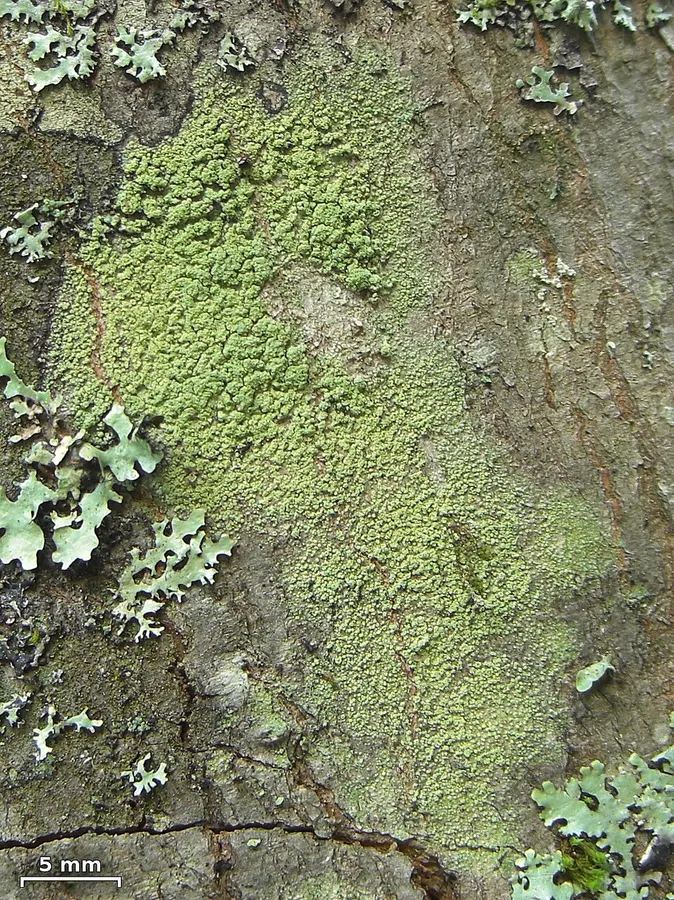
Dokumentasi Biatora pontica dari Wikimedia Commons. Smokies, North Carolina, 20130919 Identifikasi mengikuti record berkas sumber.
- Jenis
- Fotografi
- Kredit
- Jason Hollinger
- Lisensi
- CC BY 2.0
- Sumber media
- Buka entri sumber
Sumber profil
- [1] Biatora pontica — Wikipedia (en)
- [2] Catalogue of Life Base2026-09-11 — Biatora pontica
- [3] Dokumentasi visual — Biatora pontica
Rujukan halaman ini
Fungi. Biatora pontica. Rilis data fungi-2026-10-12-expansion-2. https://fungi-atlas.mgadib.chatgpt.site/jamur/biatora-pontica/.
Status: impor sumber; pemeriksaan editorial per profil belum selesai. Untuk klaim biologis, gunakan rujukan pada bagian terkait dan periksa konteks sumber aslinya.