01 / Morfologi

Ciri dan struktur

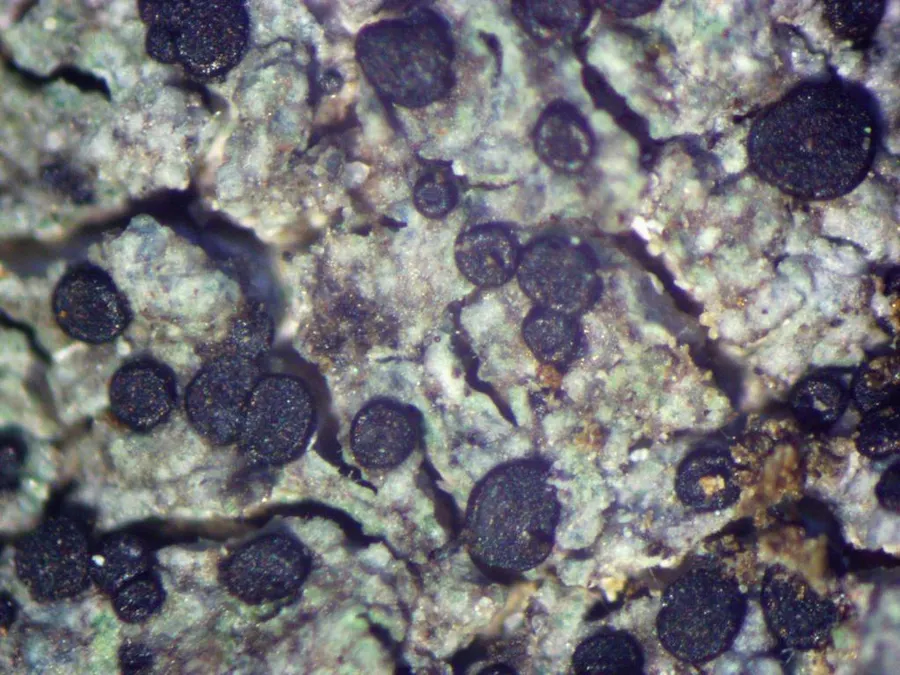
The dull green-grey to olive-green crustose thallus of Biatora radicicola has irregular cracks and sometimes tiny warts on an otherwise smooth surface. There is no visible hypothallus, and the lichen also lacks the vegetative propagules soredia and isidia. The photobiont partner of the lichen is chlorococcoid, i.e., green algae cells that are roughly spherical, and these cells measure 5–12 μm in diameter. Apothecia are abundant, typically occurring singly although occasionally in small clusters of two to five. They are spherical to somewhat deformed, measuring 0.23–0.39 mm in diameter (with a maximum measured diameter of 0.8 mm); the disc is flat and either black or more rarely a mixture olive, grey and beige hues. The asci are of the Biatora-type and contain eight spores. Ascospores are colourless with a narrowly ellipsoid shape, usually lack a septum (rarely, some spores have a single septum) and typically measure 8.3 –10.4 by 2.9–3.5 μm. No lichen products were detected using thin-layer chromatography, but the apothecia contain an insoluble pigment named in addition to an unidentified brown pigment.

Sebagian uraian ditampilkan dalam bahasa sumber; terjemahannya belum tersedia atau belum lolos pemeriksaan.

Rujukan: [1]

Pengukuran mengikuti objek, spesimen atau kultur, dan metode yang disebutkan sumber. Baca uraian asli untuk konteks lengkap.

02 / Kehidupan

Habitat dan peran ekologis

Biatora radicicola prefers to grow on the exposed roots of trees, and also below overhangs, especially along river banks. The authors suggest that the lichen is able to tolerate flooding and note that some of the collected specimens were subject to occasional water spray. Generally, B. radicicola is not found with other accompanying lichens, and is often poorly developed. The habitat data accumulated so far suggests that the species is shade tolerant, and somewhat nitrophytic (i.e., thriving in nitrogen-rich habitats) or nitrogen tolerant. Specimens collected from well-lit locations tend to be better developed, with greater apothecial pigmentation and thalli that are thicker and paler. Documented localities for the lichen include several places in Europe, including the Czech Republic, Ukraine, the Republic of Adygea in the Russian North Caucasus, Finland, Norway, and Sweden. Specimens collected from latter two countries were all growing on rocks near rapids subjected to water spray.

Sebagian uraian ditampilkan dalam bahasa sumber; terjemahannya belum tersedia atau belum lolos pemeriksaan.

Rujukan: [1]

Habitat atau konteks temuan
Informasi belum tersedia pada sumber rilis ini.
Substrat
Informasi belum tersedia pada sumber rilis ini.
Peran atau konteks
Pembentuk liken
Temukan hubungan serupa
03 / Siklus hidup

Reproduksi

The dull green-grey to olive-green crustose thallus of Biatora radicicola has irregular cracks and sometimes tiny warts on an otherwise smooth surface. There is no visible hypothallus, and the lichen also lacks the vegetative propagules soredia and isidia. The photobiont partner of the lichen is chlorococcoid, i.e., green algae cells that are roughly spherical, and these cells measure 5–12 μm in diameter. Apothecia are abundant, typically occurring singly although occasionally in small clusters of two to five. They are spherical to somewhat deformed, measuring 0.23–0.39 mm in diameter (with a maximum measured diameter of 0.8 mm); the disc is flat and either black or more rarely a mixture olive, grey and beige hues.

Sebagian uraian ditampilkan dalam bahasa sumber; terjemahannya belum tersedia atau belum lolos pemeriksaan.

Rujukan: [1]

04 / Batas informasi

Catatan identitas dan cakupan

  • Nama diterima mengikuti Catalogue of Life Base2026-09-11; uraian mempertahankan konsep dan nama sumber aslinya.
  • Original geographic, specimen and life-cycle scope retained; source import awaits individual editorial review.
  • Impor dan terjemahan otomatis belum diperiksa editorial per profil. Struktur reproduktif yang disebutkan tidak membuktikan seluruh siklus hidup diketahui.
  • Pengukuran pada uraian mengikuti spesimen, kultur, dan metode sumber; angka tidak diperluas ke semua populasi.

Catatan distribusi dalam narasi mengikuti sumbernya. Dokumentasi spesimen atau foto mengikuti catatan sumber. Bukti wilayah Indonesia dan penilaian konservasi tidak disimpulkan dari gambar.

05 / Dokumentasi

Melihat dengan konteks

Dokumentasi Biatora radicicola menurut asosiasi foto pada record takson iNaturalist. Kredit: Valerii Darmostuk. Identitas mengikuti sumber; bukan penentuan spesimen independen.

Jenis
Fotografi
Kredit
(c) Valerii Darmostuk, some rights reserved (CC BY), uploaded by Valerii Darmostuk
Lisensi
CC BY 4.0
Sumber media
Buka entri sumber

Gambar menunjukkan objek menurut identifikasi sumber, bukan verifikasi independen spesimen oleh Fungi. Tidak ada skala baru yang ditambahkan.

06 / Rujukan

Sumber profil

  1. [1] Biatora radicicola — Wikipedia (en)Bagian sumber: Frozen revision 1273743066
    Tanggal penghimpunan sumber: 2026-10-12
    Teks sumber: CC BY-SA4.0 · Wikipedia contributors
  2. [2] Catalogue of Life Base2026-09-11 — Biatora radicicolaBagian sumber: ColDP NameUsage.tsv ID LQR7; accepted species; source 2073
    Tanggal penghimpunan sumber: 2026-10-12
  3. [3] Dokumentasi visual — Biatora radicicolaBagian sumber: Individual media record; identification follows the source, not independent determination
    Tanggal penghimpunan sumber: 2026-10-12
    Media sumber: CC BY 4.0 · (c) Valerii Darmostuk, some rights reserved (CC BY), uploaded by Valerii Darmostuk

Adaptasi teks: CC BY-SA 4.0. Wikipedia contributors — Biatora radicicola — Wikipedia (en)

Uraian asli dan riwayat sumber

Riwayat atau halaman sumber

Ringkasan sumber

Biatora radicicola is a species of corticolous (bark-dwelling) and saxicolous (rock-dwelling), crustose lichen in the family Ramalinaceae. It is found in various locations in Europe, where it grows in sheltered and humid microhabitats, often on exposed root bark at the base of trees.

Revisi sumber

Morfologi sumber

The dull green-grey to olive-green crustose thallus of Biatora radicicola has irregular cracks and sometimes tiny warts on an otherwise smooth surface. There is no visible hypothallus, and the lichen also lacks the vegetative propagules soredia and isidia. The photobiont partner of the lichen is chlorococcoid, i.e., green algae cells that are roughly spherical, and these cells measure 5–12 μm in diameter. Apothecia are abundant, typically occurring singly although occasionally in small clusters of two to five. They are spherical to somewhat deformed, measuring 0.23–0.39 mm in diameter (with a maximum measured diameter of 0.8 mm); the disc is flat and either black or more rarely a mixture olive, grey and beige hues. The asci are of the Biatora-type and contain eight spores. Ascospores are colourless with a narrowly ellipsoid shape, usually lack a septum (rarely, some spores have a single septum) and typically measure 8.3 –10.4 by 2.9–3.5 μm. No lichen products were detected using thin-layer chromatography, but the apothecia contain an insoluble pigment named in addition to an unidentified brown pigment.

Revisi sumber

Ekologi sumber

Biatora radicicola prefers to grow on the exposed roots of trees, and also below overhangs, especially along river banks. The authors suggest that the lichen is able to tolerate flooding and note that some of the collected specimens were subject to occasional water spray. Generally, B. radicicola is not found with other accompanying lichens, and is often poorly developed. The habitat data accumulated so far suggests that the species is shade tolerant, and somewhat nitrophytic (i.e., thriving in nitrogen-rich habitats) or nitrogen tolerant. Specimens collected from well-lit locations tend to be better developed, with greater apothecial pigmentation and thalli that are thicker and paler. Documented localities for the lichen include several places in Europe, including the Czech Republic, Ukraine, the Republic of Adygea in the Russian North Caucasus, Finland, Norway, and Sweden. Specimens collected from latter two countries were all growing on rocks near rapids subjected to water spray.

Revisi sumber

Struktur reproduksi sumber

The dull green-grey to olive-green crustose thallus of Biatora radicicola has irregular cracks and sometimes tiny warts on an otherwise smooth surface. There is no visible hypothallus, and the lichen also lacks the vegetative propagules soredia and isidia. The photobiont partner of the lichen is chlorococcoid, i.e., green algae cells that are roughly spherical, and these cells measure 5–12 μm in diameter. Apothecia are abundant, typically occurring singly although occasionally in small clusters of two to five. They are spherical to somewhat deformed, measuring 0.23–0.39 mm in diameter (with a maximum measured diameter of 0.8 mm); the disc is flat and either black or more rarely a mixture olive, grey and beige hues.

Revisi sumber

Rujukan halaman ini

Fungi. Biatora radicicola. Rilis data fungi-2026-10-12-expansion-2. https://fungi-atlas.mgadib.chatgpt.site/jamur/biatora-radicicola/.

Status: impor sumber; pemeriksaan editorial per profil belum selesai. Untuk klaim biologis, gunakan rujukan pada bagian terkait dan periksa konteks sumber aslinya.