Ciri dan struktur
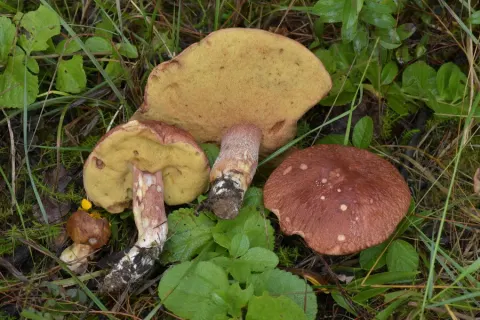
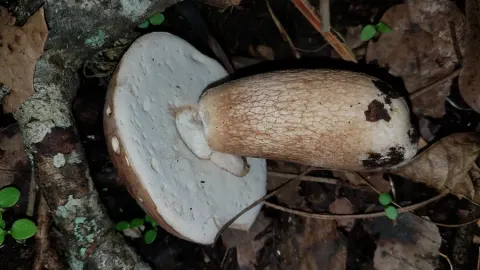
The cap (pileus) measures 15–35 cm across, occasionally up to 50 cm, its surface smooth to almost smooth and greyish brown—sometimes yellowish or dark brown—and becoming slightly viscid when wet. The margin may appear gently wrinkled when mature. On the underside is the hymenophore, composed of tubes 2–4 cm long that begin yellow, turn greenish yellow and finally greyish yellow‑green; the small, round pores match the tube colour. The stipe (stem) is 10–20 cm tall and 3–5 cm wide, cylindrical or tapering slightly at the base, whitish with a brownish tint and overlaid by a distinct, white reticulation (net‑pattern) whose meshes measure up to 10 by 2 mm. The flesh is firm and white, tinged yellowish brown beneath the cap cuticle, with a pleasant taste and a strong, agreeable aroma. Microscopically, spores are elongated (fusiform), smooth, thick‑walled and measure 16.5–19 by 5.5–6.5 micrometre (μm) (average 17.5 by 5.8 μm). Caulocystidia—flask‑shaped cells on the stipe surface—are 70–160 by 13–30 μm and broader at the tip. The cap cuticle (pileipellis) consists of long, variably pigmented hyphae whose terminal cells are cylindrical to slightly club‑shaped, 30–60 by 6–12 μm.
Habitat dan peran ekologis
Boletus pinetorum forms ectomycorrhizal associations exclusively with Pinus sylvestris (Scots pine). It is most often encountered in dry, sandy pine heaths and dry to moderately moist coniferous forests, fruiting later in the season than many other boletes (typically late summer). To date it has been recorded from across Fennoscandia, including Finland, Sweden and Estonia.
- Habitat atau konteks temuan
- hutan
- Substrat
- Informasi belum tersedia pada sumber rilis ini.
- Peran atau konteks
- Mitra tumbuhan
Reproduksi
Microscopically, spores are elongated (fusiform), smooth, thick‑walled and measure 16.5–19 by 5.5–6.5 micrometre (μm) (average 17.5 by 5.8 μm). Caulocystidia—flask‑shaped cells on the stipe surface—are 70–160 by 13–30 μm and broader at the tip. The cap cuticle (pileipellis) consists of long, variably pigmented hyphae whose terminal cells are cylindrical to slightly club‑shaped, 30–60 by 6–12 μm.
Catatan identitas dan cakupan
- Nama diterima mengikuti Catalogue of Life Base2026-09-11; uraian mempertahankan konsep dan nama sumber aslinya.
- Original geographic, specimen and life-cycle scope retained; source import awaits individual editorial review.
- Impor dan terjemahan otomatis belum diperiksa editorial per profil. Struktur reproduktif yang disebutkan tidak membuktikan seluruh siklus hidup diketahui.
- Pengukuran pada uraian mengikuti spesimen, kultur, dan metode sumber; angka tidak diperluas ke semua populasi.
Catatan distribusi dalam narasi mengikuti sumbernya. Dokumentasi spesimen atau foto mengikuti catatan sumber. Bukti wilayah Indonesia dan penilaian konservasi tidak disimpulkan dari gambar.
Melihat dengan konteks
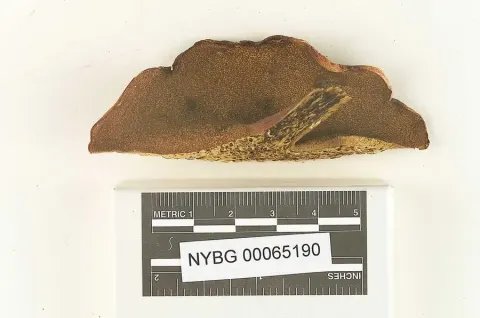
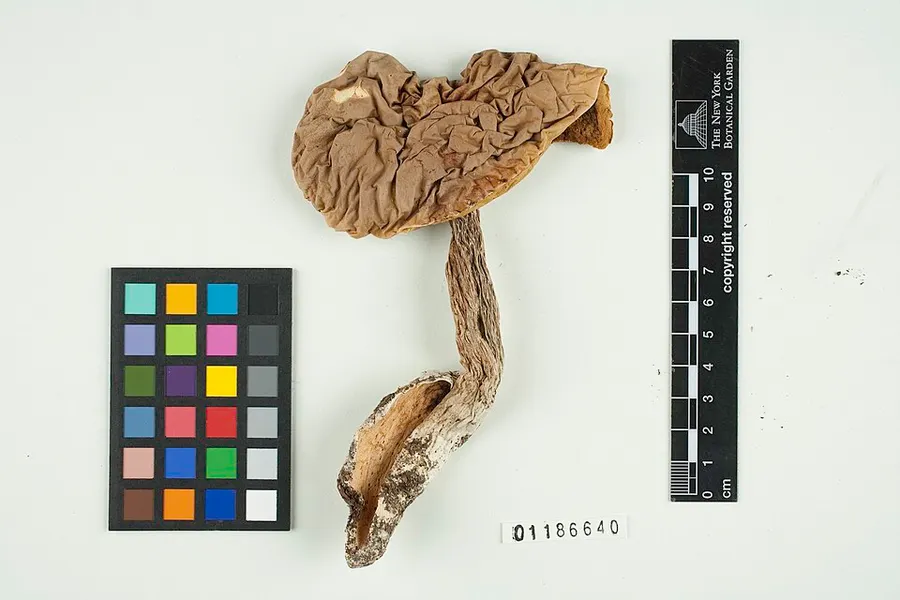
Dokumentasi Boletus pinetorum dari Wikimedia Commons. Boletus pinetorum M.Korhonen, 2009 : collected and recorded in Hanko. 1 km N of Tvärminneby in Finland in a dry pine forest (Pinus sylvestris) on sand by M. Korhonen (Ex Museo Botanico Universitatis Helsinki (H)) for The New York Botanical Garden (record number 11925) Identifikasi mengikuti record berkas sumber.
- Jenis
- Fotografi
- Kredit
- The New York Botanical Garden
- Lisensi
- CC BY 4.0
- Sumber media
- Buka entri sumber
Sumber profil
- [1] Boletus pinetorum — Wikipedia (en)
- [2] Catalogue of Life Base2026-09-11 — Boletus pinetorum
- [3] Dokumentasi visual — Boletus pinetorum
Rujukan halaman ini
Fungi. Boletus pinetorum. Rilis data fungi-2026-10-12-expansion-2. https://fungi-atlas.mgadib.chatgpt.site/jamur/boletus-pinetorum/.
Status: impor sumber; pemeriksaan editorial per profil belum selesai. Untuk klaim biologis, gunakan rujukan pada bagian terkait dan periksa konteks sumber aslinya.