Ciri dan struktur
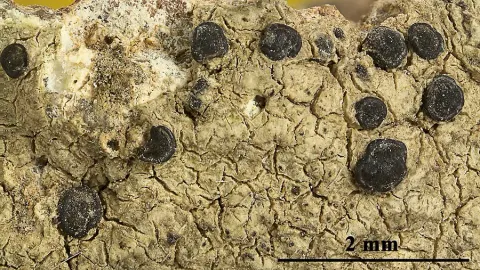
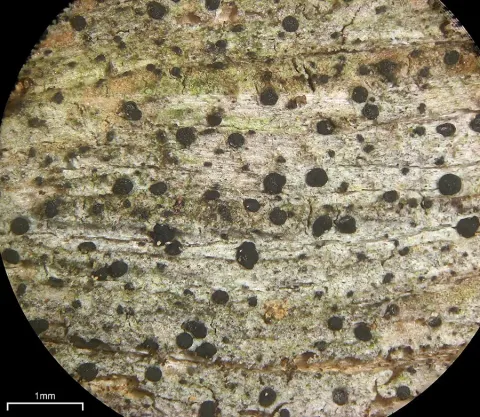
The thallus of Buellia oidalea is crustose, varying from thin and rimose-areolate to thick and rugose-verrucose or even subsquamulose. The prothallus is often present, appearing black. The thallus surface is yellowish white to glaucous gray, smooth, and esorediate. The medulla is white and lacks calcium oxalate. The apothecia of B. oidalea are lecideine and commonly found, ranging from 0.2 to 2 mm in diameter, and are sessile in nature. Initially, the disc is black, devoid of pruina, and flat, but as it matures, it becomes convex. The margin starts as distinct but eventually becomes excluded and black. The proper exciple measures between 35 and 95 μm in thickness, lacking secondary metabolites, and appears uniformly dark brown throughout, with carbonized cells smaller than 6 μm. It is transient and accompanied by a brown hypothecium, which is less than 280 μm thick. The epihymenium shares a continuous brown pigmentation with the outer exciple. The hymenium is hyaline, generously interspersed with oil droplets, and measures 115 to 165 μm in height. The tips of the paraphyses typically measure less than 3 μm in width and are adorned with distinct apical caps. Asci are clavate, of Bacidia-type, measuring 95 to 112 x 20 to 40 μm, and typically contain 8 spores. The ascospores of B. oidalea typically exhibit a hyaline to ±olive coloration, eventually transitioning to brown, while often retaining unpigmented apices. They possess a muriform structure, comprising 13–40 cells in optical section, and are ellipsoid to oblong in shape, measuring (29.5-)33.7-[39.6]-45.5(-57) x (12.5-)13.3-[15.5]-17.7(-26.5) μm.
Habitat dan peran ekologis
Buellia oidalea thrives on the bark and wood surfaces of trunks, branches, and twigs found on both broad-leaved and coniferous trees and shrubs. Its habitat encompasses various open environments along the Pacific coast, including dune areas, salt marshes, chaparral, and coastal deserts. This species is predominantly found along the Pacific coast and islands of North America, spanning from Coos County, Oregon to Baja California Sur. Notably, within the Sonoran region, it has been documented in the coastal fog zones of southern California, Baja California, and Baja California Sur.
- Habitat atau konteks temuan
- Informasi belum tersedia pada sumber rilis ini.
- Substrat
- Informasi belum tersedia pada sumber rilis ini.
- Peran atau konteks
- Pembentuk liken
Reproduksi
The apothecia of B. oidalea are lecideine and commonly found, ranging from 0.2 to 2 mm in diameter, and are sessile in nature. Initially, the disc is black, devoid of pruina, and flat, but as it matures, it becomes convex. The margin starts as distinct but eventually becomes excluded and black. The proper exciple measures between 35 and 95 μm in thickness, lacking secondary metabolites, and appears uniformly dark brown throughout, with carbonized cells smaller than 6 μm. It is transient and accompanied by a brown hypothecium, which is less than 280 μm thick. The epihymenium shares a continuous brown pigmentation with the outer exciple. The hymenium is hyaline, generously interspersed with oil droplets, and measures 115 to 165 μm in height.
Catatan identitas dan cakupan
- Nama diterima mengikuti Catalogue of Life Base2026-09-11; uraian mempertahankan konsep dan nama sumber aslinya.
- Original geographic, specimen and life-cycle scope retained; source import awaits individual editorial review.
- Impor dan terjemahan otomatis belum diperiksa editorial per profil. Struktur reproduktif yang disebutkan tidak membuktikan seluruh siklus hidup diketahui.
- Pengukuran pada uraian mengikuti spesimen, kultur, dan metode sumber; angka tidak diperluas ke semua populasi.
Catatan distribusi dalam narasi mengikuti sumbernya. Dokumentasi spesimen atau foto mengikuti catatan sumber. Bukti wilayah Indonesia dan penilaian konservasi tidak disimpulkan dari gambar.
Melihat dengan konteks
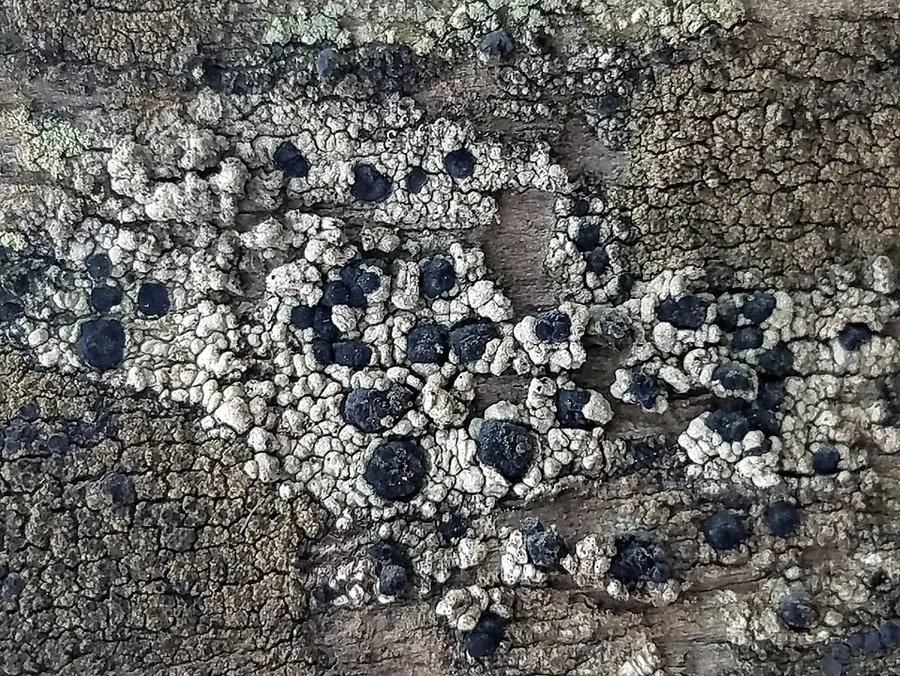
Dokumentasi Buellia oidalea dari Wikimedia Commons. The crustose lichen Buellia oidalea , found growing on a wood fence post in coastal bluff scrub habitat in Santa Barbara Co., California, USA. Identifikasi mengikuti record berkas sumber.
- Jenis
- Fotografi
- Kredit
- J-Dar
- Lisensi
- CC BY-SA 3.0
- Sumber media
- Buka entri sumber
Sumber profil
- [1] Buellia oidalea — Wikipedia (en)
- [2] Catalogue of Life Base2026-09-11 — Buellia oidalea
- [3] Dokumentasi visual — Buellia oidalea
Rujukan halaman ini
Fungi. Buellia oidalea. Rilis data fungi-2026-10-12-expansion-2. https://fungi-atlas.mgadib.chatgpt.site/jamur/buellia-oidalea/.
Status: impor sumber; pemeriksaan editorial per profil belum selesai. Untuk klaim biologis, gunakan rujukan pada bagian terkait dan periksa konteks sumber aslinya.