01 / Morfologi

Ciri dan struktur

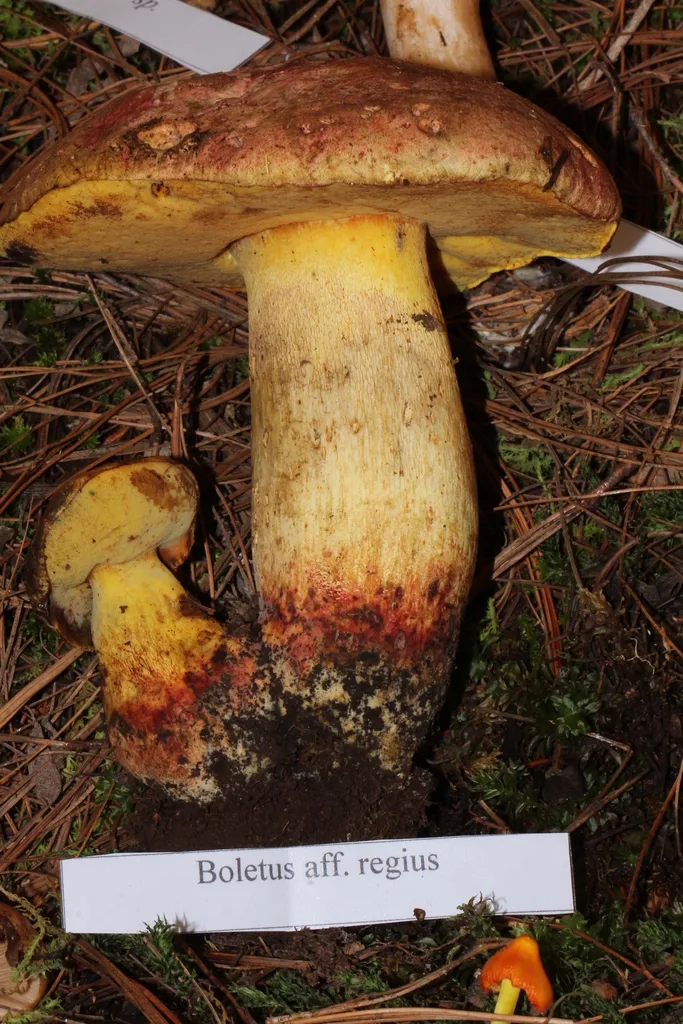
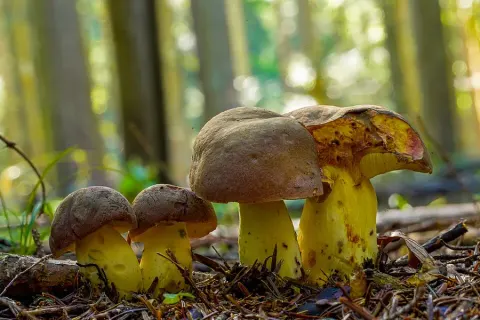
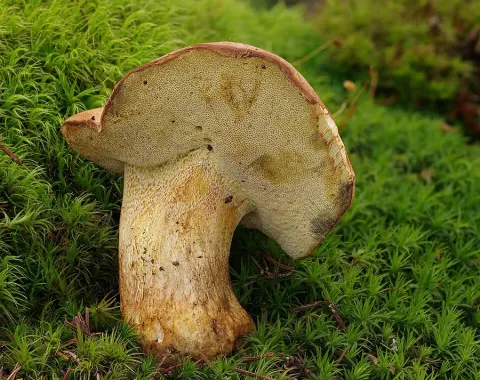
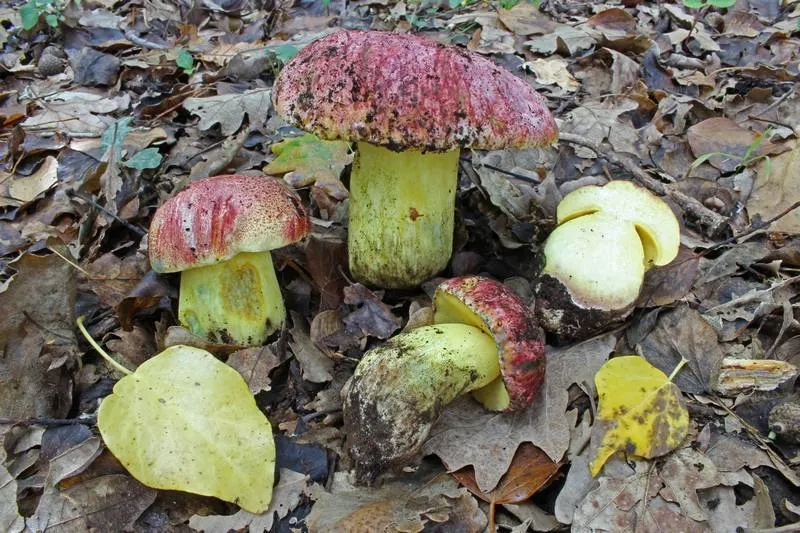
The caps are convex or flat, reaching a diameter of 6–20 cm wide. The cap surface is pink to red, occasionally with hints of yellow or brown, more so around the margin. Initially velvety to slightly tomentose (hairy) when young, these minute hairs tend to slough off with age, and the cap develops wrinkles and pits. The cap flesh is yellow, usually slowly and erratically bruising blue in North American specimens. In Europe, it does not stain when exposed to air or stains weakly. The pores on the underside of the cap are angular and measure about 1–2 per millimetre. The color of the pore surface is bright yellow to start, but eventually darkens somewhat, and will stain blue with damage. The depth of the tubes comprising the pores extends to 0.8–2.5 cm. The stem measures 5–14 cm long and 2.5–6 cm thick, typically with a thick, bulbous base. It is solid (i.e., not hollow), and a bright yellow color, often with reddish tones, particularly near the base of the stem. The stem surface can be covered with fine yellow reticulations either throughout its length, or just on the upper portion. The spore print is olive-brown. The smooth, hyaline (translucent) spores are roughly elliptical to somewhat fusoid (wider in the middle and tapering toward the ends) to more or less cylindrical, and have dimensions of 12–17 by 4–5 μm. Chemical tests can be used to help identify B. regius in the field. The cap cuticle will stain a pale purple color if FeSO4 is applied; this same test will turn the flesh grayish.

Sebagian uraian ditampilkan dalam bahasa sumber; terjemahannya belum tersedia atau belum lolos pemeriksaan.

Rujukan: [1]

Pengukuran mengikuti objek, spesimen atau kultur, dan metode yang disebutkan sumber. Baca uraian asli untuk konteks lengkap.

02 / Kehidupan

Habitat dan peran ekologis

Butyriboletus regius adalah spesies ektomikoriza dengan rentang inang yang luas, terkait dengan ek dan konifer, terutama fir. The fruit bodies grow singly, scattered, or grouped together. In North America, they usually appear from August to November, although they also appear between May and June. Bagian Utara American distribution termasuk Pasifik Northwest states California, Oregon, dan Washington, di mana frekuensi kejadiannya berkisar dari "jarang hingga berlimpah di daerah setempat". Hal ini langka di Eropa, muncul di beberapa negara di Wilayah Merah List of dan dianggap terancam punah di Republik Ceko. Spesies ini juga telah tercatat dari Cina.

Sebagian uraian ditampilkan dalam bahasa sumber; terjemahannya belum tersedia atau belum lolos pemeriksaan.

Rujukan: [1]

Habitat atau konteks temuan
Informasi belum tersedia pada sumber rilis ini.
Substrat
Informasi belum tersedia pada sumber rilis ini.
Peran atau konteks
Mitra tumbuhan
Temukan hubungan serupa
03 / Siklus hidup

Reproduksi

The stem measures 5–14 cm long and 2.5–6 cm thick, typically with a thick, bulbous base. It is solid (i.e., not hollow), and a bright yellow color, often with reddish tones, particularly near the base of the stem. The stem surface can be covered with fine yellow reticulations either throughout its length, or just on the upper portion. The spore print is olive-brown. The smooth, hyaline (translucent) spores are roughly elliptical to somewhat fusoid (wider in the middle and tapering toward the ends) to more or less cylindrical, and have dimensions of 12–17 by 4–5 μm.

Sebagian uraian ditampilkan dalam bahasa sumber; terjemahannya belum tersedia atau belum lolos pemeriksaan.

Rujukan: [1]

Sinonim menurut acuan taksonomi rilis: Boletus appendiculatus subsp. regius; Boletus appendiculatus var. regius; Boletus regius; Boletus regius f. aureus; Boletus regius var. peltereaui; Boletus subtomentosus subsp. cerasinus; Butyriboletus regius f. aureus; Dictyopus appendiculatus var. regius; Dictyopus regius; Suillus regius; Tubiporus regius
04 / Batas informasi

Catatan identitas dan cakupan

  • Nama diterima mengikuti Catalogue of Life Base2026-09-11; uraian mempertahankan konsep dan nama sumber aslinya.
  • Original geographic, specimen and life-cycle scope retained; source import awaits individual editorial review.
  • Impor dan terjemahan otomatis belum diperiksa editorial per profil. Struktur reproduktif yang disebutkan tidak membuktikan seluruh siklus hidup diketahui.
  • Pengukuran pada uraian mengikuti spesimen, kultur, dan metode sumber; angka tidak diperluas ke semua populasi.

Catatan distribusi dalam narasi mengikuti sumbernya. Dokumentasi spesimen atau foto mengikuti catatan sumber. Bukti wilayah Indonesia dan penilaian konservasi tidak disimpulkan dari gambar.

05 / Dokumentasi

Melihat dengan konteks

Dokumentasi Butyriboletus regius menurut asosiasi foto pada record takson iNaturalist. Kredit: Davide Puddu. Identitas mengikuti sumber; bukan penentuan spesimen independen.

Jenis
Fotografi
Kredit
(c) Davide Puddu, some rights reserved (CC BY), uploaded by Davide Puddu
Lisensi
CC BY 4.0
Sumber media
Buka entri sumber

Gambar menunjukkan objek menurut identifikasi sumber, bukan verifikasi independen spesimen oleh Fungi. Tidak ada skala baru yang ditambahkan.

Dokumentasi tambahan

06 / Rujukan

Sumber profil

  1. [1] Butyriboletus regius — Wikipedia (en)Bagian sumber: Frozen revision 1296008845
    Tanggal penghimpunan sumber: 2026-10-12
    Teks sumber: CC BY-SA4.0 · Wikipedia contributors
  2. [2] Catalogue of Life Base2026-09-11 — Butyriboletus regiusBagian sumber: ColDP NameUsage.tsv ID NZ86; accepted species; source 2073
    Tanggal penghimpunan sumber: 2026-10-12
  3. [3] Dokumentasi visual — Butyriboletus regiusBagian sumber: Identitas mengikuti sumber dokumentasi; bukan penentuan spesimen independen.
    Tanggal penghimpunan sumber: 2026-10-17
    Media sumber: CC BY 4.0 · (c) Davide Puddu, some rights reserved (CC BY), uploaded by Davide Puddu
  4. [4] Dokumentasi visual — Butyriboletus regiusBagian sumber: Identitas mengikuti sumber dokumentasi; bukan penentuan spesimen independen.
    Tanggal penghimpunan sumber: 2026-10-17
    Teks sumber: CC BY 4.0 · (c) Alan Rockefeller, some rights reserved (CC BY), uploaded by Alan Rockefeller

Adaptasi teks: CC BY-SA 4.0. Wikipedia contributors — Butyriboletus regius — Wikipedia (en)

Uraian asli dan riwayat sumber

Riwayat atau halaman sumber

Ringkasan sumber

Butyriboletus regius (formerly Boletus regius), commonly known as the royal bolete or red-capped butter bolete, is a basidiomycete species of fungus in the genus Butyriboletus. It has a pink cap, yellow flesh, and a reticulate pattern on the stem. The mushroom is found in North America, Europe, and China. North America specimens stain blue when exposed to air, but European specimens do not, or only stain weakly. Both are edible and considered choice.

Revisi sumber

Morfologi sumber

The caps are convex or flat, reaching a diameter of 6–20 cm wide. The cap surface is pink to red, occasionally with hints of yellow or brown, more so around the margin. Initially velvety to slightly tomentose (hairy) when young, these minute hairs tend to slough off with age, and the cap develops wrinkles and pits. The cap flesh is yellow, usually slowly and erratically bruising blue in North American specimens. In Europe, it does not stain when exposed to air or stains weakly. The pores on the underside of the cap are angular and measure about 1–2 per millimetre. The color of the pore surface is bright yellow to start, but eventually darkens somewhat, and will stain blue with damage. The depth of the tubes comprising the pores extends to 0.8–2.5 cm. The stem measures 5–14 cm long and 2.5–6 cm thick, typically with a thick, bulbous base. It is solid (i.e., not hollow), and a bright yellow color, often with reddish tones, particularly near the base of the stem. The stem surface can be covered with fine yellow reticulations either throughout its length, or just on the upper portion. The spore print is olive-brown. The smooth, hyaline (translucent) spores are roughly elliptical to somewhat fusoid (wider in the middle and tapering toward the ends) to more or less cylindrical, and have dimensions of 12–17 by 4–5 μm. Chemical tests can be used to help identify B. regius in the field. The cap cuticle will stain a pale purple color if FeSO4 is applied; this same test will turn the flesh grayish.

Revisi sumber

Ekologi sumber

Butyriboletus regius is an ectomycorrhizal species with a broad host range, associating with oak and conifers, especially fir. The fruit bodies grow singly, scattered, or grouped together. In North America, they usually appear from August to November, although they also appear between May and June. The North American distribution includes the Pacific Northwest states of California, Oregon, and Washington, where its frequency of occurrence ranges from "rare to locally abundant". It is rare in Europe, appearing on the Regional Red List of several countries and being considered endangered in the Czech Republic. The species has also been recorded from China.

Revisi sumber

Struktur reproduksi sumber

The stem measures 5–14 cm long and 2.5–6 cm thick, typically with a thick, bulbous base. It is solid (i.e., not hollow), and a bright yellow color, often with reddish tones, particularly near the base of the stem. The stem surface can be covered with fine yellow reticulations either throughout its length, or just on the upper portion. The spore print is olive-brown. The smooth, hyaline (translucent) spores are roughly elliptical to somewhat fusoid (wider in the middle and tapering toward the ends) to more or less cylindrical, and have dimensions of 12–17 by 4–5 μm.

Revisi sumber

Rujukan halaman ini

Fungi. Butyriboletus regius. Rilis data fungi-2026-10-12-expansion-2. https://fungi-atlas.mgadib.chatgpt.site/jamur/butyriboletus-regius/.

Status: impor sumber; pemeriksaan editorial per profil belum selesai. Untuk klaim biologis, gunakan rujukan pada bagian terkait dan periksa konteks sumber aslinya.