Ciri dan struktur
Saprobic on decaying wood of Fagaceae. Sexual morph: Ascomata 586–690 × 425–630 μm (x̄ = 638 × 527 µm, n = 5), scattered, solitary, mostly superficial, unilocular, globose to subglobose, covered with dense dark brown setae (2–6 μm wide), dark brown to black, coriaceous, ostiolate. Ostiole central, wide, with a pore-like opening visible on the host, orange to yellow. Peridium 54–69 μm wide, multilayered, heavily pigmented, comprising 13–16 layers, hyaline to dark brown cells of textura angularis to textura prismatica. Hamathecium comprising 1.5–3.3 μm wide, dense, septate, filiform, branching pseudoparaphyses, embedded in a gelatinous matrix. Asci 115–146 × 9–12 μm (x̄ = 127 × 10 μm, n = 20), 8-spored, bitunicate, fissitunicate, cylindrical to clavate, apically rounded, with a well-developed ocular chamber, long pedicellate (46–53 μm long). Ascospores 31.6–37.6 × 6–7.6 μm (x̄ = 34 × 7 μm, n = 20), biseriate, overlapping, oblong fusiform, hyaline to pale brown, tapering towards both ends, smooth-walled, slightly curved, 1-septate, constricted at the septa, without mucilaginous sheath. Asexual morph: Undetermined. Single ascospores germinate on MEA within 24 h. Colonies on MEA, fast growing, full plate within one week at 25 °C, medium dense, convex, velvety with white aerial mycelium, entire, reverse dark orange, pale yellow at margin. Orange pigmentation diffused into the media.
Habitat dan peran ekologis
Saprobic on decaying wood of Fagaceae. Sexual morph: Ascomata 586–690 × 425–630 μm (x̄ = 638 × 527 µm, n = 5), scattered, solitary, mostly superficial, unilocular, globose to subglobose, covered with dense dark brown setae (2–6 μm wide), dark brown to black, coriaceous, ostiolate. Ostiole central, wide, with a pore-like opening visible on the host, orange to yellow. Peridium 54–69 μm wide, multilayered, heavily pigmented, comprising 13–16 layers, hyaline to dark brown cells of textura angularis to textura prismatica. Hamathecium comprising 1.5–3.3 μm wide, dense, septate, filiform, branching pseudoparaphyses, embedded in a gelatinous matrix. Asci 115–146 × 9–12 μm (x̄ = 127 × 10 μm, n = 20), 8-spored, bitunicate, fissitunicate, cylindrical to clavate, apically rounded, with a well-developed ocular chamber, long pedicellate (46–53 μm long). Ascospores 31.6–37.6 × 6–7.6 μm (x̄ = 34 × 7 μm, n = 20), biseriate, overlapping, oblong fusiform, hyaline to pale brown, tapering towards both ends, smooth-walled, slightly curved, 1-septate, constricted at the septa, without mucilaginous sheath. Asexual morph: Undetermined. Byssosphaeria siamensis was originally discovered from decaying wood of an unidentified host in Thailand (Tian et al. 2018).
- Habitat atau konteks temuan
- Informasi belum tersedia pada sumber rilis ini.
- Substrat
- kayu
- Peran atau konteks
- Pengurai
Reproduksi
Saprobic on decaying wood of Fagaceae. Sexual morph: Ascomata 586–690 × 425–630 μm (x̄ = 638 × 527 µm, n = 5), scattered, solitary, mostly superficial, unilocular, globose to subglobose, covered with dense dark brown setae (2–6 μm wide), dark brown to black, coriaceous, ostiolate. Ostiole central, wide, with a pore-like opening visible on the host, orange to yellow. Peridium 54–69 μm wide, multilayered, heavily pigmented, comprising 13–16 layers, hyaline to dark brown cells of textura angularis to textura prismatica. Hamathecium comprising 1.5–3.3 μm wide, dense, septate, filiform, branching pseudoparaphyses, embedded in a gelatinous matrix. Asci 115–146 × 9–12 μm (x̄ = 127 × 10 μm, n = 20), 8-spored, bitunicate, fissitunicate, cylindrical to clavate, apically rounded, with a well-developed ocular chamber, long pedicellate (46–53 μm long).
Catatan identitas dan cakupan
- Nama diterima mengikuti Catalogue of Life Base2026-09-11; uraian mempertahankan konsep dan nama sumber aslinya.
- Preserve original treatment localities, hosts and substrate scope. Materials examined describe documented specimens, not the full global range.
- Impor dan terjemahan otomatis belum diperiksa editorial per profil. Struktur reproduktif yang disebutkan tidak membuktikan seluruh siklus hidup diketahui.
- Pengukuran pada uraian mengikuti spesimen, kultur, dan metode sumber; angka tidak diperluas ke semua populasi.
Catatan distribusi dalam narasi mengikuti sumbernya. Dokumentasi spesimen atau foto mengikuti catatan sumber. Bukti wilayah Indonesia dan penilaian konservasi tidak disimpulkan dari gambar.
Melihat dengan konteks
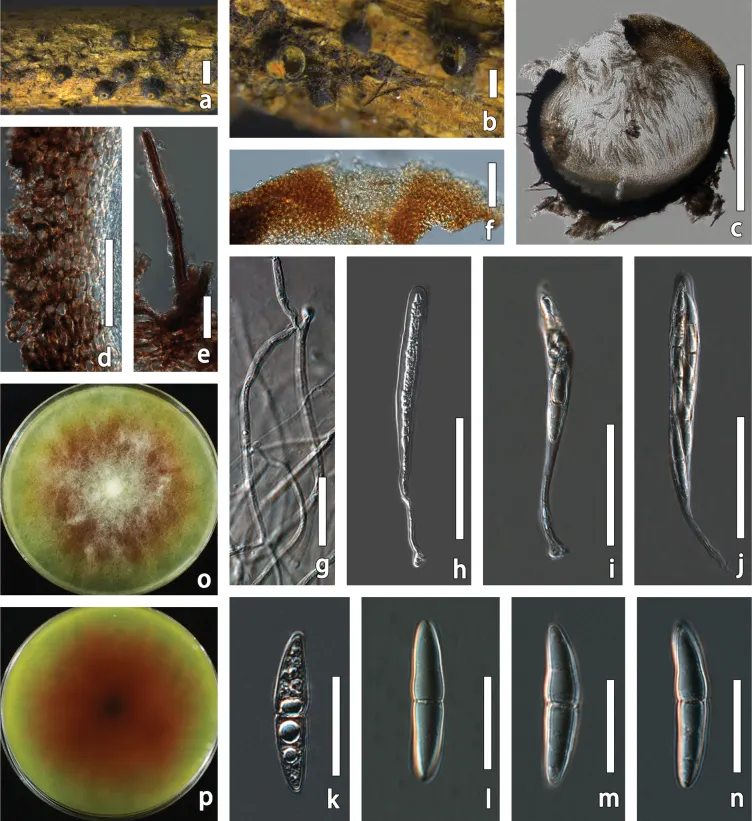
Byssosphaeria siamensis (HMJAU 70075). a, b. Ascomata on host surface; c. Vertical section through partial ascoma; d. Peridium; e. Setae on the ascomata; f. Ostiole; g. Pseudoparaphyses; h–j. Asci; k–n. Ascospores; o. Cultural characteristics of the PDA in front; p. Cultural characteristics of the PDA in back. Scale bars: 1 mm (a); 500 µm (b, c); 50 µm (d, f, h–j); 20 µm (e, g, k–n).
- Jenis
- Pelat ilmiah
- Kredit
- Wen-Xin Su, Ranagul Tieliwadi, Wen-Ying Su, Xiao Li, Rong Xu
- Lisensi
- CC BY 4.0
- Sumber media
- Buka entri sumber
Dokumentasi tambahan
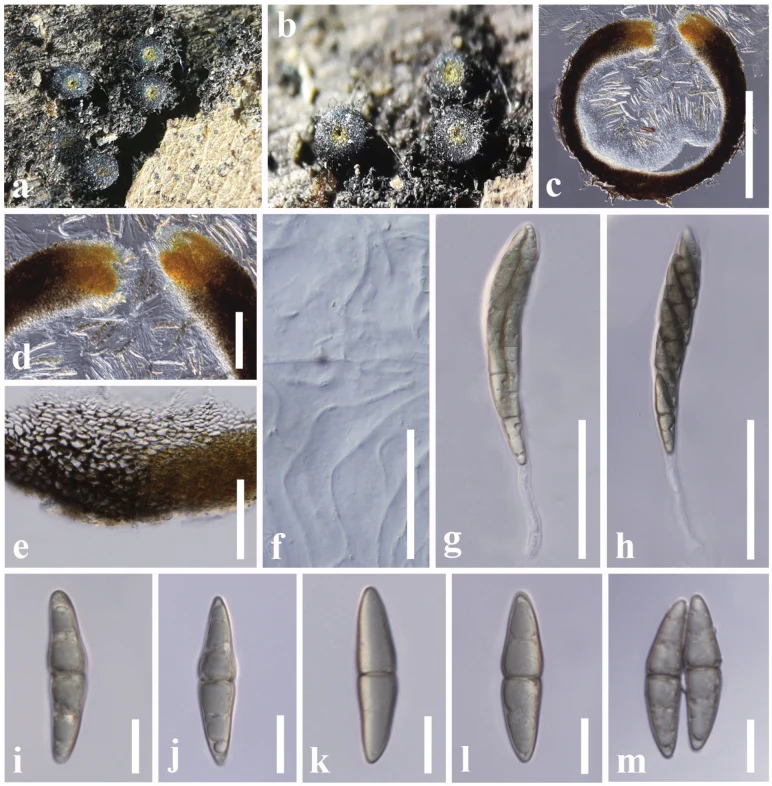
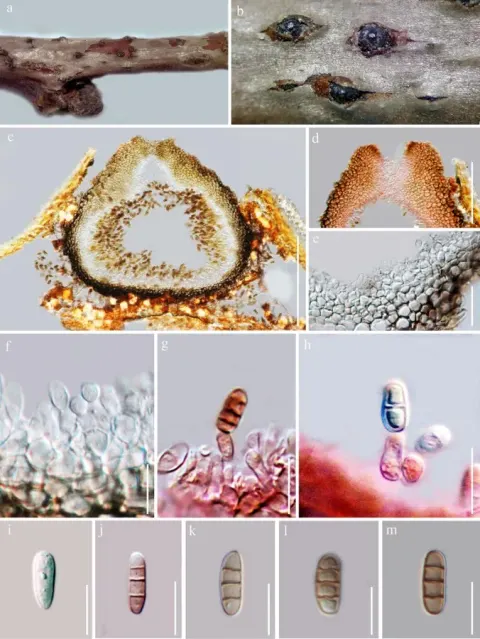
Byssosphaeria siamensis (HFJAU 10336, new host record) a appearance of ascomata on the host b close-up of ascomata c vertical section of an ascoma d ostiole e peridium f pseudoparaphyses g, h asci i–m ascospores. Scale bars: 200 µm (c); 20 µm (d, e); 50 µm (f–h); 10 µm (i–m).
Kredit dan penggunaan
Danushka S. Tennakoon, Kasun M. Thambugala, Nimali I. de Silva, Hai-Yan Song, Nakarin Suwannarach, Fu-Sheng Chen, Dian-Ming Hu
Ukuran dan format gambar disesuaikan tanpa pemotongan, retus, atau penambahan skala. Lisensi sumber dipertahankan.
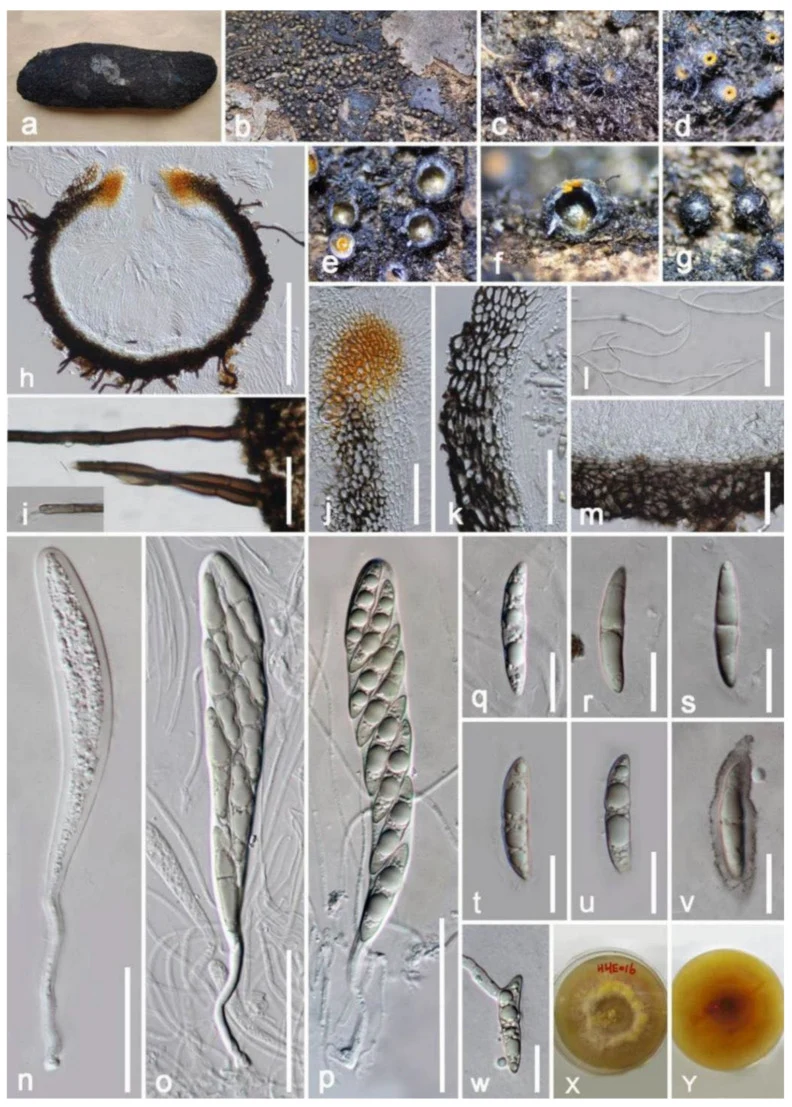
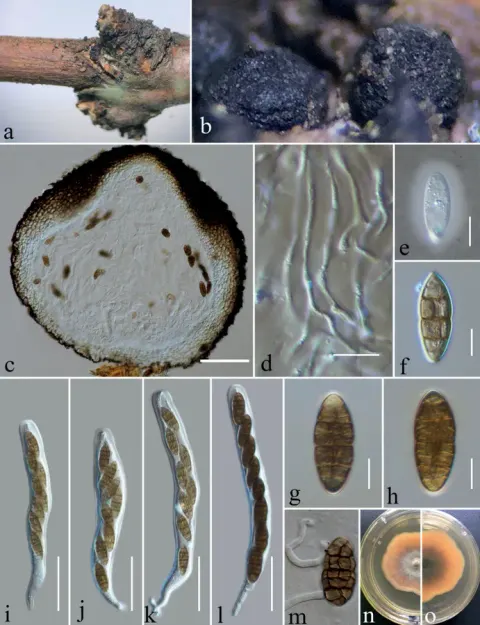
Byssosphaeria siamensis (HKAS 122197). (a) Ascomata on decayed endocarp of Mangifera indica; (b – d) close-up of ascomata; (e) horizontal section of ascomata; (f) vertical section of ascomata; (g) bottom of ascoma; (h) section of ascomata; (i) setae; (j) peridium near ostiole; (k) peridium at side; (l) pseudoparaphyses; (m) peridium at base; (n – p) immature and mature asci; (q – v) ascospores; (w) germinated ascospore; (x, y) colony on PDA with pigment. Scale bars: (h) = 200 μm; (j, k, m, o, p) = 50 μm; (i, l, n) = 30 μm; (q – w) = 15 μm.
Kredit dan penggunaan
© 2022 by the authors.
Ukuran dan format gambar disesuaikan tanpa pemotongan, retus, atau penambahan skala. Lisensi sumber dipertahankan.
Sumber profil
- [1] Additions to woody litter fungi of Byssosphaeria, Phaeoseptum and Pseudothyridariella (Pleosporales, Ascomycota) from China — Byssosphaeria siamensis
- [2] Catalogue of Life Base2026-09-11 — Byssosphaeria siamensis
- [3] Dokumentasi visual — Byssosphaeria siamensis
- [4] Dokumentasi visual — Byssosphaeria siamensis
- [5] Dokumentasi visual — Byssosphaeria siamensis
Rujukan halaman ini
Fungi. Byssosphaeria siamensis. Rilis data fungi-2026-10-12-expansion-2. https://fungi-atlas.mgadib.chatgpt.site/jamur/byssosphaeria-siamensis/.
Status: impor sumber; pemeriksaan editorial per profil belum selesai. Untuk klaim biologis, gunakan rujukan pada bagian terkait dan periksa konteks sumber aslinya.