01 / Morfologi

Ciri dan struktur

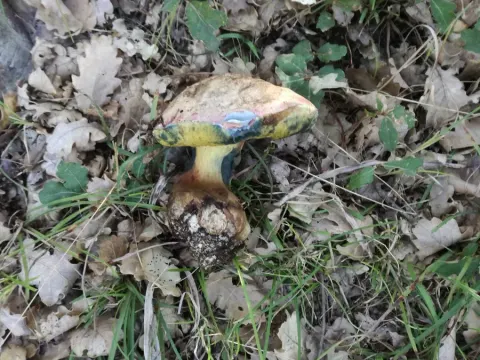
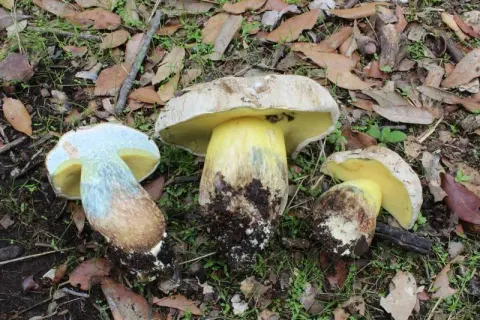
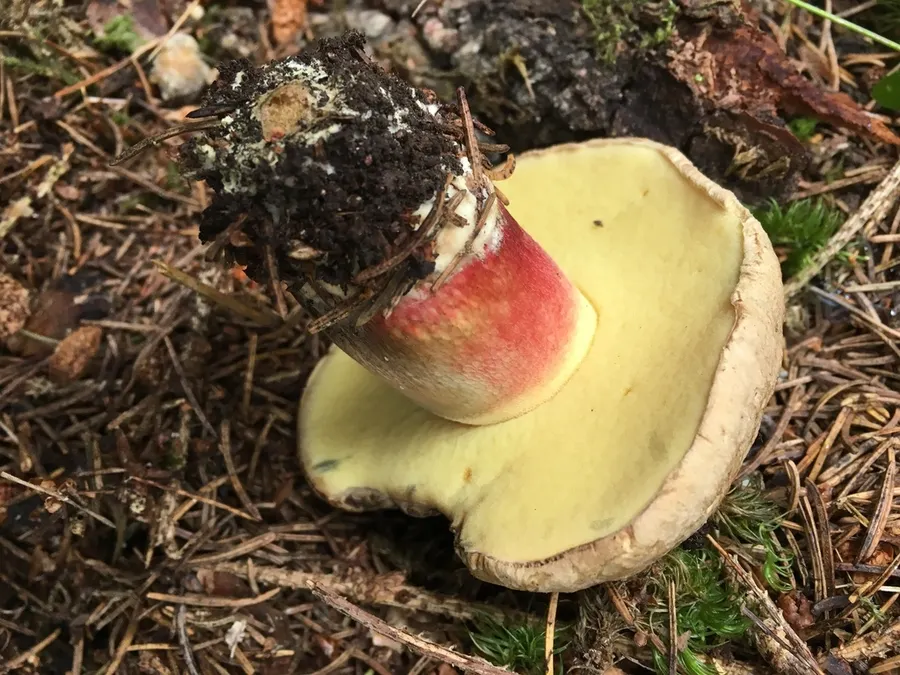
Up to 15 cm or rarely 20 cm (8 in) in diameter, the cap is beige to olive and initially almost globular before opening out to a hemispherical and then convex shape. The surface of the cap is smooth or has minute hairs, and sometimes develops cracks with age. The cap cuticle hangs over the cap margin. The pore surface is initially pale yellow before deepening to an olive-yellow in maturity, and quickly turns blue when it is injured. The pores, numbering one or two per millimetre, are circular when young but become more angular as the mushroom ages. The tubes are up to 2 cm deep. The attractively coloured stipe is typically yellow above to pink-red below, with a straw-coloured network (reticulation) near the top or over the upper half; occasionally the entire stipe is reddish. It measures 7–15 cm long by 2–5 cm thick, and is either fairly equal in width throughout, or thicker towards the base. Sometimes, the reddish stipe colour of mature mushrooms or harvested specimens that are a few days old disappears completely, and is replaced with ochre-brown tones. The pale yellow flesh stains blue when broken, the discolouration spreading out from the damaged area. Its smell can be strong, and has been likened to ink. The spore print is olive to olive-brown. The spores are smooth and elliptical, measuring 13–19 by 5–6 μm. The basidia (spore-bearing cells) are club-shaped, four-spored, and measure 30–38 by 9–12 μm. The cystidia are club-shaped to spindle-shaped, hyaline, and measure 25–40 by 10–15 μm. Variety frustosus is morphologically similar to the main type, but its cap becomes areolate (marked out into small areas by cracks and crevices) in maturity.

Sebagian uraian ditampilkan dalam bahasa sumber; terjemahannya belum tersedia atau belum lolos pemeriksaan.

Rujukan: [1]

Pengukuran mengikuti objek, spesimen atau kultur, dan metode yang disebutkan sumber. Baca uraian asli untuk konteks lengkap.

02 / Kehidupan

Habitat dan peran ekologis

An ectomycorrhizal species, Caloboletus calopus grows in coniferous and deciduous woodland, often at higher altitudes, especially under beech and oak. Fruit bodies occur singly or in large groups. The species grows on chalky ground from July to December, in Northern Europe, and North America's Pacific Northwest and Michigan. In North America, its range extends south to Mexico. Variety frustosus is known from California and the Rocky Mountains of Idaho. In 1968, after comparing European and North American collections, Miller and Watling suggested that the typical form of C. calopus does not occur in the United States. Similar comparisons by other authors have led them to the opposite conclusion, and the species has since been included in several North American field guides. The bolete has been recorded from the Black Sea region in Turkey, from under Populus ciliata and Abies pindrow in Rawalpindi and Nathia Gali in Pakistan, Yunnan Province in China, Korea, and Taiwan.

Sebagian uraian ditampilkan dalam bahasa sumber; terjemahannya belum tersedia atau belum lolos pemeriksaan.

Rujukan: [1]

Habitat atau konteks temuan
hutan
Substrat
Informasi belum tersedia pada sumber rilis ini.
Peran atau konteks
Mitra tumbuhan
Temukan hubungan serupa
03 / Siklus hidup

Reproduksi

The attractively coloured stipe is typically yellow above to pink-red below, with a straw-coloured network (reticulation) near the top or over the upper half; occasionally the entire stipe is reddish. It measures 7–15 cm long by 2–5 cm thick, and is either fairly equal in width throughout, or thicker towards the base. Sometimes, the reddish stipe colour of mature mushrooms or harvested specimens that are a few days old disappears completely, and is replaced with ochre-brown tones. The pale yellow flesh stains blue when broken, the discolouration spreading out from the damaged area. Its smell can be strong, and has been likened to ink. The spore print is olive to olive-brown. The spores are smooth and elliptical, measuring 13–19 by 5–6 μm.

Sebagian uraian ditampilkan dalam bahasa sumber; terjemahannya belum tersedia atau belum lolos pemeriksaan.

Rujukan: [1]

Sinonim menurut acuan taksonomi rilis: Boletus calopus; Boletus calopus var. ruforubriporus; Boletus lapidum; Boletus olivaceus; Boletus pachypus var. olivaceus; Boletus subtomentosus subsp. calopus; Boletus subtomentosus var. calopus; Caloboletus calopus var. ruforubriporus; Dictyopus calopus; Dictyopus olivaceus; Suillus calopus; Suillus olivaceus; Tubiporus calopus; Tubiporus olivaceus
04 / Batas informasi

Catatan identitas dan cakupan

  • Nama diterima mengikuti Catalogue of Life Base2026-09-11; uraian mempertahankan konsep dan nama sumber aslinya.
  • Original geographic, specimen and life-cycle scope retained; source import awaits individual editorial review.
  • Impor dan terjemahan otomatis belum diperiksa editorial per profil. Struktur reproduktif yang disebutkan tidak membuktikan seluruh siklus hidup diketahui.
  • Pengukuran pada uraian mengikuti spesimen, kultur, dan metode sumber; angka tidak diperluas ke semua populasi.

Catatan distribusi dalam narasi mengikuti sumbernya. Dokumentasi spesimen atau foto mengikuti catatan sumber. Bukti wilayah Indonesia dan penilaian konservasi tidak disimpulkan dari gambar.

05 / Dokumentasi

Melihat dengan konteks

Dokumentasi Caloboletus calopus menurut asosiasi foto pada record takson iNaturalist. Kredit: Sigrid Jakob. Identitas mengikuti sumber; bukan penentuan spesimen independen.

Jenis
Fotografi
Kredit
no rights reserved, uploaded by Sigrid Jakob
Lisensi
CC0 1.0
Sumber media
Buka entri sumber

Gambar menunjukkan objek menurut identifikasi sumber, bukan verifikasi independen spesimen oleh Fungi. Tidak ada skala baru yang ditambahkan.

06 / Rujukan

Sumber profil

  1. [1] Caloboletus calopus — Wikipedia (en)Bagian sumber: Frozen revision 1299899510
    Tanggal penghimpunan sumber: 2026-10-12
    Teks sumber: CC BY-SA4.0 · Wikipedia contributors
  2. [2] Catalogue of Life Base2026-09-11 — Caloboletus calopusBagian sumber: ColDP NameUsage.tsv ID 5X7DN; accepted species; source 2073
    Tanggal penghimpunan sumber: 2026-10-12
  3. [3] Dokumentasi visual — Caloboletus calopusBagian sumber: Individual media record; identification follows the source, not independent determination
    Tanggal penghimpunan sumber: 2026-10-12
    Media sumber: CC0 1.0 · no rights reserved, uploaded by Sigrid Jakob

Adaptasi teks: CC BY-SA 4.0. Wikipedia contributors — Caloboletus calopus — Wikipedia (en)

Uraian asli dan riwayat sumber

Riwayat atau halaman sumber

Ringkasan sumber

Caloboletus calopus, commonly known as the bitter bolete, bitter beech bolete or scarlet-stemmed bolete, is a species of fungus in the bolete family. Christiaan Persoon first described Boletus calopus in 1801. Modern molecular phylogenetics showed that it was only distantly related to the type species of Boletus and required placement in a new genus; Caloboletus was erected in 2014, with C. calopus designated as the type species. The stout fruit bodies are attractively coloured, with a beige to olive cap up to 15 cm (6 in) across, yellow pores, and a reddish stipe up to 15 cm long and 5 cm wide.

Revisi sumber

Morfologi sumber

Up to 15 cm or rarely 20 cm (8 in) in diameter, the cap is beige to olive and initially almost globular before opening out to a hemispherical and then convex shape. The surface of the cap is smooth or has minute hairs, and sometimes develops cracks with age. The cap cuticle hangs over the cap margin. The pore surface is initially pale yellow before deepening to an olive-yellow in maturity, and quickly turns blue when it is injured. The pores, numbering one or two per millimetre, are circular when young but become more angular as the mushroom ages. The tubes are up to 2 cm deep. The attractively coloured stipe is typically yellow above to pink-red below, with a straw-coloured network (reticulation) near the top or over the upper half; occasionally the entire stipe is reddish. It measures 7–15 cm long by 2–5 cm thick, and is either fairly equal in width throughout, or thicker towards the base. Sometimes, the reddish stipe colour of mature mushrooms or harvested specimens that are a few days old disappears completely, and is replaced with ochre-brown tones. The pale yellow flesh stains blue when broken, the discolouration spreading out from the damaged area. Its smell can be strong, and has been likened to ink. The spore print is olive to olive-brown. The spores are smooth and elliptical, measuring 13–19 by 5–6 μm. The basidia (spore-bearing cells) are club-shaped, four-spored, and measure 30–38 by 9–12 μm. The cystidia are club-shaped to spindle-shaped, hyaline, and measure 25–40 by 10–15 μm. Variety frustosus is morphologically similar to the main type, but its cap becomes areolate (marked out into small areas by cracks and crevices) in maturity.

Revisi sumber

Ekologi sumber

An ectomycorrhizal species, Caloboletus calopus grows in coniferous and deciduous woodland, often at higher altitudes, especially under beech and oak. Fruit bodies occur singly or in large groups. The species grows on chalky ground from July to December, in Northern Europe, and North America's Pacific Northwest and Michigan. In North America, its range extends south to Mexico. Variety frustosus is known from California and the Rocky Mountains of Idaho. In 1968, after comparing European and North American collections, Miller and Watling suggested that the typical form of C. calopus does not occur in the United States. Similar comparisons by other authors have led them to the opposite conclusion, and the species has since been included in several North American field guides. The bolete has been recorded from the Black Sea region in Turkey, from under Populus ciliata and Abies pindrow in Rawalpindi and Nathia Gali in Pakistan, Yunnan Province in China, Korea, and Taiwan.

Revisi sumber

Struktur reproduksi sumber

The attractively coloured stipe is typically yellow above to pink-red below, with a straw-coloured network (reticulation) near the top or over the upper half; occasionally the entire stipe is reddish. It measures 7–15 cm long by 2–5 cm thick, and is either fairly equal in width throughout, or thicker towards the base. Sometimes, the reddish stipe colour of mature mushrooms or harvested specimens that are a few days old disappears completely, and is replaced with ochre-brown tones. The pale yellow flesh stains blue when broken, the discolouration spreading out from the damaged area. Its smell can be strong, and has been likened to ink. The spore print is olive to olive-brown. The spores are smooth and elliptical, measuring 13–19 by 5–6 μm.

Revisi sumber

Rujukan halaman ini

Fungi. Caloboletus calopus. Rilis data fungi-2026-10-12-expansion-2. https://fungi-atlas.mgadib.chatgpt.site/jamur/caloboletus-calopus/.

Status: impor sumber; pemeriksaan editorial per profil belum selesai. Untuk klaim biologis, gunakan rujukan pada bagian terkait dan periksa konteks sumber aslinya.