01 / Morfologi

Ciri dan struktur

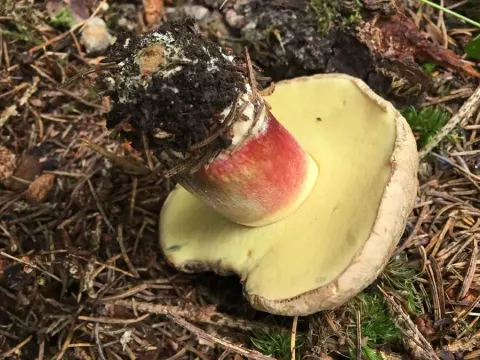
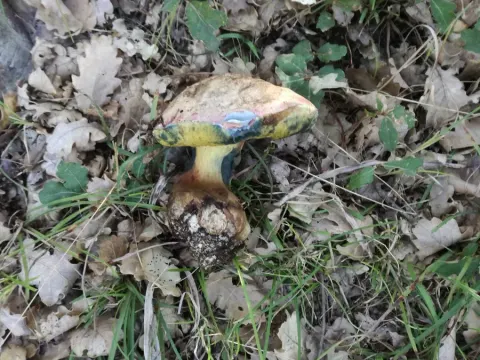
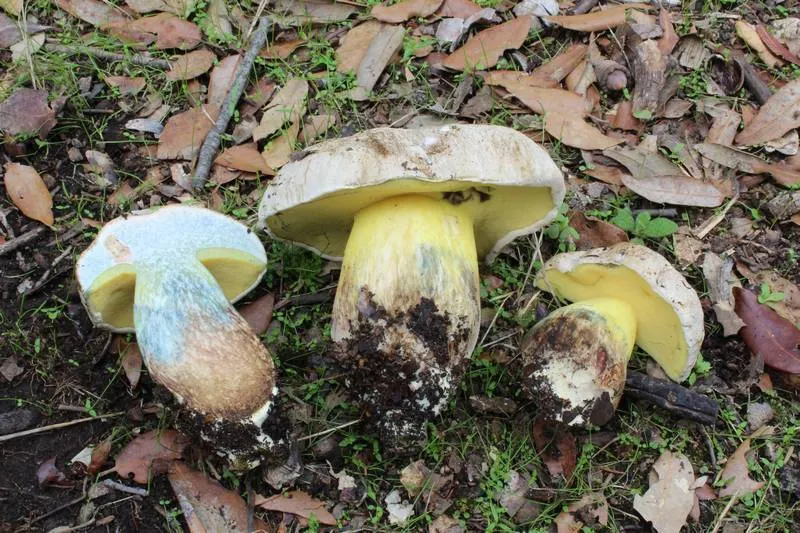
The cap diameter ranges from 7.5 to 30 cm across, and is usually dirty white, greyish-white, ivory white or buff, downy at first, but often finely cracking at the centre as the cap expands. The stipe is 5 - 8 cm tall by 3 - 4 cm wide, usually swollen or barrel-shaped when young, but soon becoming elongated and more or less fusiform, with a tapering base usually rooting into the substrate. The apex is typically bright lemon yellow, but fading below. There is a light straw-coloured reticulation at the upper part of the stipe, though in rare occasions this may be indistinct. The flesh is pale yellow, somewhat paler whitish to straw-coloured in the cap, instantly turning dark blue when cut. The pores are lemon yellow, small and rounded, bruising blue when touched or injured. The spore print is olivaceous walnut-brown. Microscopically, it has ellipsoid to fusiform spores measuring 11.5–14 × 4–5.5 μm. The hyphal structure of the cap is a trichodermium of interwoven septate hyphae, often finely incrusted.

Sebagian uraian ditampilkan dalam bahasa sumber; terjemahannya belum tersedia atau belum lolos pemeriksaan.

Rujukan: [1]

Pengukuran mengikuti objek, spesimen atau kultur, dan metode yang disebutkan sumber. Baca uraian asli untuk konteks lengkap.

02 / Kehidupan

Habitat dan peran ekologis

Fruiting during musim panas dan awal musim gugur, Caloboletus radicans secara ekologi serbaguna. It forms ectomycorrhizal associations with a wide range of broad-leaved trees, including oaks (Quercus), beech (Fagus), hornbeam (Carpinus), chestnut (Castanea) and lime (Tilia). Tumbuhan ini tumbuh di tanah berkalkar (chalk) dan tanah asam di selatan Inggris (di mana ini umum) dan di sebagian besar Eropa.

Sebagian uraian ditampilkan dalam bahasa sumber; terjemahannya belum tersedia atau belum lolos pemeriksaan.

Rujukan: [1]

Habitat atau konteks temuan
Informasi belum tersedia pada sumber rilis ini.
Substrat
Informasi belum tersedia pada sumber rilis ini.
Peran atau konteks
Mitra tumbuhan
Temukan hubungan serupa
03 / Siklus hidup

Reproduksi

The cap diameter ranges from 7.5 to 30 cm across, and is usually dirty white, greyish-white, ivory white or buff, downy at first, but often finely cracking at the centre as the cap expands. The stipe is 5 - 8 cm tall by 3 - 4 cm wide, usually swollen or barrel-shaped when young, but soon becoming elongated and more or less fusiform, with a tapering base usually rooting into the substrate. The apex is typically bright lemon yellow, but fading below. There is a light straw-coloured reticulation at the upper part of the stipe, though in rare occasions this may be indistinct. The flesh is pale yellow, somewhat paler whitish to straw-coloured in the cap, instantly turning dark blue when cut. The pores are lemon yellow, small and rounded, bruising blue when touched or injured.

Sebagian uraian ditampilkan dalam bahasa sumber; terjemahannya belum tersedia atau belum lolos pemeriksaan.

Rujukan: [1]

Sinonim menurut acuan taksonomi rilis: Boletus albidus subsp. eupachypus; Boletus albidus var. communis; Boletus albidus var. constrictus; Boletus amarus; Boletus auricomus; Boletus pachypus; Boletus pachypus var. amarus; Boletus pachypus var. candicans; Boletus pachypus var. vitellinus; Boletus radicans; Boletus radicans var. pachypus; Boletus sanguineipes; Boletus subtomentosus var. radicans; Boletus vitellinus; Dictyopus albidus; Dictyopus amarus; Dictyopus pachypus; Suillus amarus; Suillus pachypus; Suillus radicans; Tubiporus pachypus; Versipellis radicans; Xerocomus radicans
04 / Batas informasi

Catatan identitas dan cakupan

  • Nama diterima mengikuti Catalogue of Life Base2026-09-11; uraian mempertahankan konsep dan nama sumber aslinya.
  • Original geographic, specimen and life-cycle scope retained; source import awaits individual editorial review.
  • Impor dan terjemahan otomatis belum diperiksa editorial per profil. Struktur reproduktif yang disebutkan tidak membuktikan seluruh siklus hidup diketahui.
  • Pengukuran pada uraian mengikuti spesimen, kultur, dan metode sumber; angka tidak diperluas ke semua populasi.

Catatan distribusi dalam narasi mengikuti sumbernya. Dokumentasi spesimen atau foto mengikuti catatan sumber. Bukti wilayah Indonesia dan penilaian konservasi tidak disimpulkan dari gambar.

05 / Dokumentasi

Melihat dengan konteks

Dokumentasi Caloboletus radicans menurut asosiasi foto pada record takson iNaturalist. Kredit: Davide Puddu. Identitas mengikuti sumber; bukan penentuan spesimen independen.

Jenis
Fotografi
Kredit
(c) Davide Puddu, some rights reserved (CC BY), uploaded by Davide Puddu
Lisensi
CC BY 4.0
Sumber media
Buka entri sumber

Gambar menunjukkan objek menurut identifikasi sumber, bukan verifikasi independen spesimen oleh Fungi. Tidak ada skala baru yang ditambahkan.

06 / Rujukan

Sumber profil

  1. [1] Caloboletus radicans — Wikipedia (en)Bagian sumber: Frozen revision 1280180064
    Tanggal penghimpunan sumber: 2026-10-12
    Teks sumber: CC BY-SA4.0 · Wikipedia contributors
  2. [2] Catalogue of Life Base2026-09-11 — Caloboletus radicansBagian sumber: ColDP NameUsage.tsv ID PWYN; accepted species; source 2073
    Tanggal penghimpunan sumber: 2026-10-12
  3. [3] Dokumentasi visual — Caloboletus radicansBagian sumber: Individual media record; identification follows the source, not independent determination
    Tanggal penghimpunan sumber: 2026-10-12
    Media sumber: CC BY 4.0 · (c) Davide Puddu, some rights reserved (CC BY), uploaded by Davide Puddu

Adaptasi teks: CC BY-SA 4.0. Wikipedia contributors — Caloboletus radicans — Wikipedia (en)

Uraian asli dan riwayat sumber

Riwayat atau halaman sumber

Ringkasan sumber

Caloboletus radicans, also known as the rooting bolete or whitish bolete, is a large ectomycorrhizal fungus found in Europe under broad-leaved trees, fruiting during the summer and autumn months. It has a pale buff or greyish-white cap, yellow pores and a stout stipe, and stains intensely blue when handled or cut. Bitter and inedible, it can cause severe vomiting and diarrhoea if eaten. Until 2014 it was placed in genus Boletus, but has since been transferred to the new genus Caloboletus based on molecular phylogenetic data.

Revisi sumber

Morfologi sumber

The cap diameter ranges from 7.5 to 30 cm across, and is usually dirty white, greyish-white, ivory white or buff, downy at first, but often finely cracking at the centre as the cap expands. The stipe is 5 - 8 cm tall by 3 - 4 cm wide, usually swollen or barrel-shaped when young, but soon becoming elongated and more or less fusiform, with a tapering base usually rooting into the substrate. The apex is typically bright lemon yellow, but fading below. There is a light straw-coloured reticulation at the upper part of the stipe, though in rare occasions this may be indistinct. The flesh is pale yellow, somewhat paler whitish to straw-coloured in the cap, instantly turning dark blue when cut. The pores are lemon yellow, small and rounded, bruising blue when touched or injured. The spore print is olivaceous walnut-brown. Microscopically, it has ellipsoid to fusiform spores measuring 11.5–14 × 4–5.5 μm. The hyphal structure of the cap is a trichodermium of interwoven septate hyphae, often finely incrusted.

Revisi sumber

Ekologi sumber

Fruiting during warm spells in the summer and early autumn, Caloboletus radicans is ecologically versatile. It forms ectomycorrhizal associations with a wide range of broad-leaved trees, including oaks (Quercus), beech (Fagus), hornbeam (Carpinus), chestnut (Castanea) and lime (Tilia). It grows on both calcareous (chalk) and acidic soils in southern England (where it is common) and across much of Europe.

Revisi sumber

Struktur reproduksi sumber

The cap diameter ranges from 7.5 to 30 cm across, and is usually dirty white, greyish-white, ivory white or buff, downy at first, but often finely cracking at the centre as the cap expands. The stipe is 5 - 8 cm tall by 3 - 4 cm wide, usually swollen or barrel-shaped when young, but soon becoming elongated and more or less fusiform, with a tapering base usually rooting into the substrate. The apex is typically bright lemon yellow, but fading below. There is a light straw-coloured reticulation at the upper part of the stipe, though in rare occasions this may be indistinct. The flesh is pale yellow, somewhat paler whitish to straw-coloured in the cap, instantly turning dark blue when cut. The pores are lemon yellow, small and rounded, bruising blue when touched or injured.

Revisi sumber

Rujukan halaman ini

Fungi. Caloboletus radicans. Rilis data fungi-2026-10-12-expansion-2. https://fungi-atlas.mgadib.chatgpt.site/jamur/caloboletus-radicans/.

Status: impor sumber; pemeriksaan editorial per profil belum selesai. Untuk klaim biologis, gunakan rujukan pada bagian terkait dan periksa konteks sumber aslinya.