Ciri dan struktur
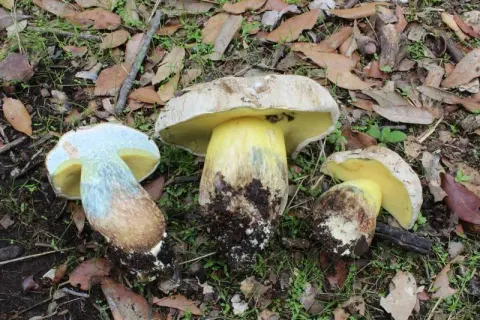
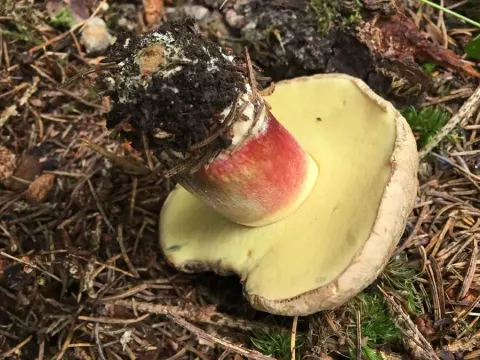
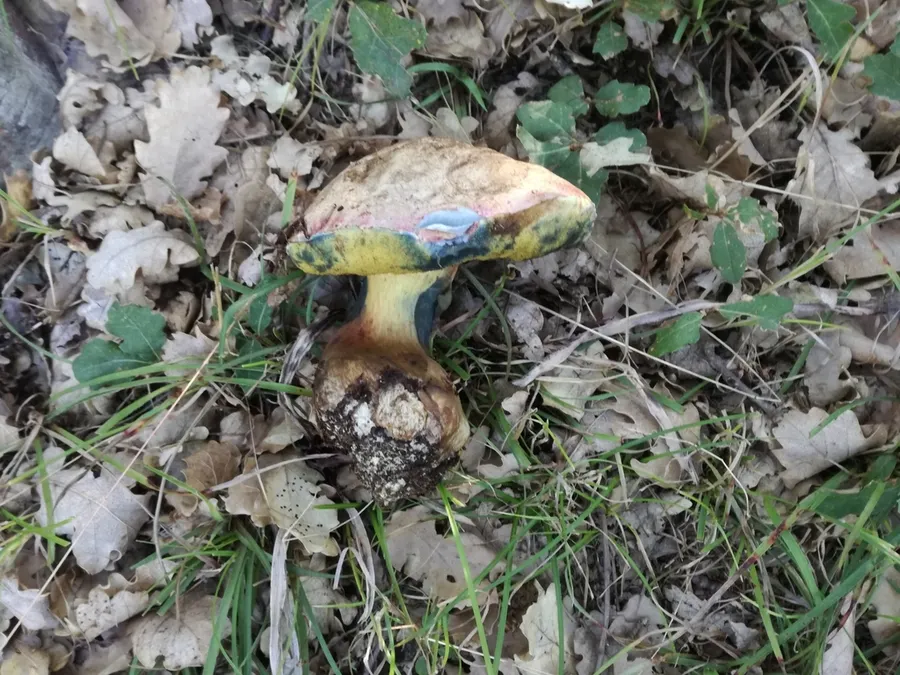
Caloboletus kluzakii is characterized by a distinctive colour progression of its cap (pileus). When young, the cap appears whitish or pale, sometimes with a slight pinkish tint. As it matures, the cap develops a more pronounced rose-pink or purplish-pink colouration, occasionally showing purple-reddish areas. An identifying feature is that the cap surface quickly turns red when touched or bruised. The underside of the cap features a yellow spore-bearing surface (hymenophore) with small, round pores that turn blue when bruised. The stipe is yellow and decorated with a yellow mesh-like pattern (reticulation). The flesh (context) beneath the cap's outer layer is red or purplish-red, while in other parts of the mushroom it appears pale yellowish or bright yellow. When cut or damaged, the flesh turns blue. The mushroom has a distinctly bitter taste. Microscopically, C. kluzakii has smooth, spindle-shaped spores measuring about 11.5–14 by 4.8–6 micrometres. The cap's surface consists of a layer of upright filamentous cells (trichoderm) that gradually collapse as the mushroom matures. Caloboletus kluzakii is closely related to Caloboletus radicans (formerly Boletus radicans), but can be distinguished by its red or purplish-red layer under the cap surface and its tendency to develop pink to reddish colouration as it ages.
Habitat dan peran ekologis
Caloboletus kluzakii has a limited known distribution, having been documented primarily in southern Bohemia in the Czech Republic. The species was first discovered in 1992 at an ecological site known as the Luční fish-pond dam near Sezimovo Ústí. This location, designated as a "national natural monument" (Luční), has been recognized for its ecological significance and placed under environmental protection. The mushroom appears to have very specific habitat requirements. It grows solitarily on soil in a grassy area under oak trees (Quercus robur), sometimes with Scots pine (Pinus sylvestris) in the vicinity. The elevation of its documented habitat is roughly 420 metres above sea level. Fruiting patterns suggest C. kluzakii is relatively uncommon even within its known habitat. Documented collections indicate it typically appears in late summer to early autumn, with most specimens found in September. Between 1992 and 2000, researchers observed only ten fruiting bodies of this bolete at the NNM Luční site, with most appearing in September and one recorded in July. No specimens were found during surveys in 1993, 1995, 1998, 1999, or between 2001 and 2005, suggesting that fruiting might be irregular or dependent on specific environmental conditions.
- Habitat atau konteks temuan
- Informasi belum tersedia pada sumber rilis ini.
- Substrat
- tanah
- Peran atau konteks
- Belum dikategorikan pada rilis ini.
Reproduksi
The underside of the cap features a yellow spore-bearing surface (hymenophore) with small, round pores that turn blue when bruised. The stipe is yellow and decorated with a yellow mesh-like pattern (reticulation). The flesh (context) beneath the cap's outer layer is red or purplish-red, while in other parts of the mushroom it appears pale yellowish or bright yellow. When cut or damaged, the flesh turns blue. The mushroom has a distinctly bitter taste. Microscopically, C. kluzakii has smooth, spindle-shaped spores measuring about 11.5–14 by 4.8–6 micrometres. The cap's surface consists of a layer of upright filamentous cells (trichoderm) that gradually collapse as the mushroom matures.
Catatan identitas dan cakupan
- Nama diterima mengikuti Catalogue of Life Base2026-09-11; uraian mempertahankan konsep dan nama sumber aslinya.
- Original geographic, specimen and life-cycle scope retained; source import awaits individual editorial review.
- Impor dan terjemahan otomatis belum diperiksa editorial per profil. Struktur reproduktif yang disebutkan tidak membuktikan seluruh siklus hidup diketahui.
- Pengukuran pada uraian mengikuti spesimen, kultur, dan metode sumber; angka tidak diperluas ke semua populasi.
Catatan distribusi dalam narasi mengikuti sumbernya. Dokumentasi spesimen atau foto mengikuti catatan sumber. Bukti wilayah Indonesia dan penilaian konservasi tidak disimpulkan dari gambar.
Melihat dengan konteks
Dokumentasi Caloboletus kluzakii menurut asosiasi foto pada record takson iNaturalist. Kredit: Davide Puddu. Identitas mengikuti sumber; bukan penentuan spesimen independen.
- Jenis
- Fotografi
- Kredit
- (c) Davide Puddu, einige Rechte vorbehalten (CC BY), hochgeladen von Davide Puddu
- Lisensi
- CC BY 4.0
- Sumber media
- Buka entri sumber
Sumber profil
- [1] Caloboletus kluzakii — Wikipedia (en)
- [2] Catalogue of Life Base2026-09-11 — Caloboletus kluzakii
- [3] Dokumentasi visual — Caloboletus kluzakii
Rujukan halaman ini
Fungi. Caloboletus kluzakii. Rilis data fungi-2026-10-12-expansion-2. https://fungi-atlas.mgadib.chatgpt.site/jamur/caloboletus-kluzakii/.
Status: impor sumber; pemeriksaan editorial per profil belum selesai. Untuk klaim biologis, gunakan rujukan pada bagian terkait dan periksa konteks sumber aslinya.