01 / Morfologi

Ciri dan struktur

Candelariella boleana forms small, scattered yellowish to greenish on tree bark, each measuring 0.05-0.15 millimetres (mm) in diameter. Unlike many lichens that form continuous crusty patches, this species appears as individual tiny bumps that do not connect to form a solid covering. The lichen lacks a (a preliminary fungal growth stage seen in many lichen species). The reproductive structures (apothecia) are small disc-like formations measuring 0.2–0.4 mm across. These appear bright yellow due to yellow (a powdery coating) and can be either flat or slightly convex as they mature. The apothecia contain the lichen's spore-producing structures. A distinctive feature of C. boleana is found under microscopic examination: its asci (spore-containing sacs) are club-shaped and unusually large, measuring 35–52 by 14–20 micrometres (μm). Each ascus contains 16–32 spores, which is significantly more than the typical 8 spores found in most lichen species. The spores themselves are perfectly spherical, colourless, and measure 4–5.5 μm in diameter—a unique characteristic that immediately distinguishes this species from all other known Candelariella species. The lichen's algal partner () belongs to the family Chlorococcaceae, with individual algal cells measuring 9–20 μm in diameter. Chemical analysis reveals that the species contains only pulvinic acid, which contributes to its characteristic yellow colouration.

Sebagian uraian ditampilkan dalam bahasa sumber; terjemahannya belum tersedia atau belum lolos pemeriksaan.

Rujukan: [1]

Pengukuran mengikuti objek, spesimen atau kultur, dan metode yang disebutkan sumber. Baca uraian asli untuk konteks lengkap.

02 / Kehidupan

Habitat dan peran ekologis

Candelariella boleana has a limited and scattered distribution across southern and central Europe, having been documented in Spain, Greece, and Slovakia. The species appears to be rare, with only eight known collections despite being recognized by researchers for over 15 years. In Spain's Pyrenees mountains (Huesca and Navarra), the species grows on the bark of Scots pine (Pinus sylvestris) and oak (Quercus) trees in woodland environments at elevations between 850 and 1,200 metres above sea level. In Greece, it has been found growing on Mediterranean cypress (Cupressus sempervirens) and stinking juniper (Juniperus foetidissima) at elevations of 1,050 to 1,150 metres. The Slovak populations represent the species' northernmost known limit, occurring in well-lit, dry oak woodlands dominated by Dalechamp's oak (Quercus dalechampii) and Hungarian oak (Q. polycarpa) on limestone bedrock in Muránska planina National Park in the Western Carpathians, at roughly 550 metres elevation. This region is known for hosting several lichen species that typically have more southern distributions in Europe. Recent discoveries have significantly expanded the known range of C. boleana to include Germany and France.

Sebagian uraian ditampilkan dalam bahasa sumber; terjemahannya belum tersedia atau belum lolos pemeriksaan.

Rujukan: [1]

Habitat atau konteks temuan
hutan
Substrat
Informasi belum tersedia pada sumber rilis ini.
Peran atau konteks
Pembentuk liken
Temukan hubungan serupa
03 / Siklus hidup

Reproduksi

Candelariella boleana forms small, scattered yellowish to greenish on tree bark, each measuring 0.05-0.15 millimetres (mm) in diameter. Unlike many lichens that form continuous crusty patches, this species appears as individual tiny bumps that do not connect to form a solid covering. The lichen lacks a (a preliminary fungal growth stage seen in many lichen species). The reproductive structures (apothecia) are small disc-like formations measuring 0.2–0.4 mm across. These appear bright yellow due to yellow (a powdery coating) and can be either flat or slightly convex as they mature. The apothecia contain the lichen's spore-producing structures. A distinctive feature of C. boleana is found under microscopic examination: its asci (spore-containing sacs) are club-shaped and unusually large, measuring 35–52 by 14–20 micrometres (μm).

Sebagian uraian ditampilkan dalam bahasa sumber; terjemahannya belum tersedia atau belum lolos pemeriksaan.

Rujukan: [1]

04 / Batas informasi

Catatan identitas dan cakupan

  • Nama diterima mengikuti Catalogue of Life Base2026-09-11; uraian mempertahankan konsep dan nama sumber aslinya.
  • Original geographic, specimen and life-cycle scope retained; source import awaits individual editorial review.
  • Impor dan terjemahan otomatis belum diperiksa editorial per profil. Struktur reproduktif yang disebutkan tidak membuktikan seluruh siklus hidup diketahui.
  • Pengukuran pada uraian mengikuti spesimen, kultur, dan metode sumber; angka tidak diperluas ke semua populasi.

Catatan distribusi dalam narasi mengikuti sumbernya. Dokumentasi spesimen atau foto mengikuti catatan sumber. Bukti wilayah Indonesia dan penilaian konservasi tidak disimpulkan dari gambar.

05 / Dokumentasi

Melihat dengan konteks

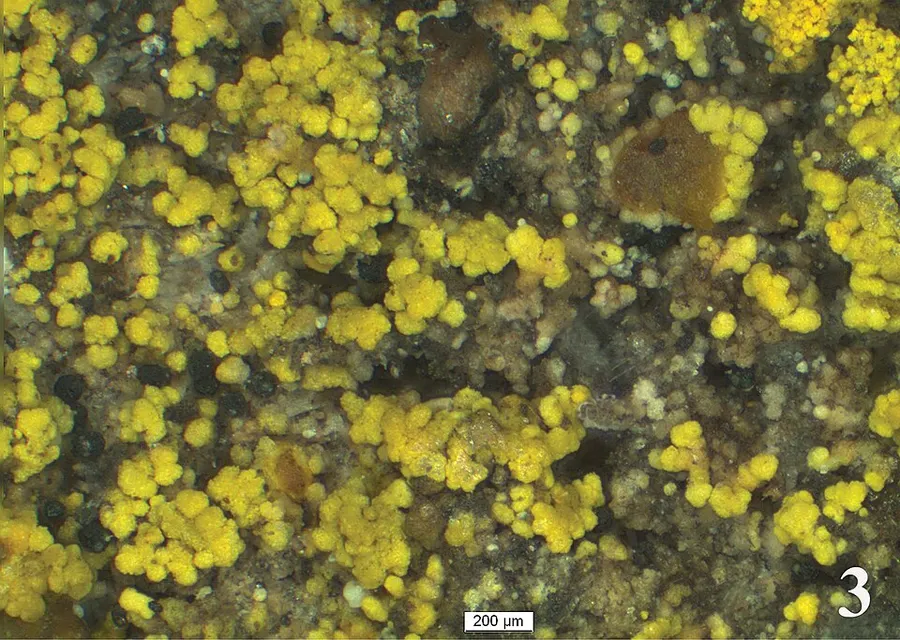
Dokumentasi Candelariella boleana dari Wikimedia Commons. Figure 3 ; Candelariella boleana – granular thallus becoming somewhat areolate with deeply incised areoles, or showing aggregates of smaller granules here and there Identifikasi mengikuti record berkas sumber.

Jenis
Fotografi
Kredit
Westberg M, Clerc P (2012) Five species of Candelaria and Candelariella (Ascomycota, Candelariales) new to Switzerland. MycoKeys 3: 1-12. https://doi.org/10.3897/mycokeys.3.2864
Lisensi
CC BY 3.0
Sumber media
Buka entri sumber

Gambar menunjukkan objek menurut identifikasi sumber, bukan verifikasi independen spesimen oleh Fungi. Tidak ada skala baru yang ditambahkan.

06 / Rujukan

Sumber profil

  1. [1] Candelariella boleana — Wikipedia (en)Bagian sumber: Frozen revision 1335801916
    Tanggal penghimpunan sumber: 2026-10-12
    Teks sumber: CC BY-SA4.0 · Wikipedia contributors
  2. [2] Catalogue of Life Base2026-09-11 — Candelariella boleanaBagian sumber: ColDP NameUsage.tsv ID 5X9SR; accepted species; source 2073
    Tanggal penghimpunan sumber: 2026-10-12
  3. [3] Dokumentasi visual — Candelariella boleanaBagian sumber: Individual media record; identification follows the source, not independent determination
    Tanggal penghimpunan sumber: 2026-10-12
    Media sumber: CC BY 3.0 · Westberg M, Clerc P (2012) Five species of Candelaria and Candelariella (Ascomycota, Candelariales) new to Switzerland. MycoKeys 3: 1-12. https://doi.org/10.3897/mycokeys.3.2864

Adaptasi teks: CC BY-SA 4.0. Wikipedia contributors — Candelariella boleana — Wikipedia (en)

Uraian asli dan riwayat sumber

Riwayat atau halaman sumber

Ringkasan sumber

Candelariella boleana is a species of lichen in the family Candelariaceae, first described from Europe in 2009. It is distinguished from all other members of its genus by its distinctly spherical ascospores, which are contained in unusually large numbers (16–32) within each spore-bearing structure. The species forms small yellowish on the bark of deciduous and coniferous trees in montane forests across southern and central Europe, including Spain, Greece, Slovakia, Germany, and France. C. boleana has likely been overlooked for many years due to its small size and resemblance to the more common Candelariella xanthostigma.

Revisi sumber

Morfologi sumber

Candelariella boleana forms small, scattered yellowish to greenish on tree bark, each measuring 0.05-0.15 millimetres (mm) in diameter. Unlike many lichens that form continuous crusty patches, this species appears as individual tiny bumps that do not connect to form a solid covering. The lichen lacks a (a preliminary fungal growth stage seen in many lichen species). The reproductive structures (apothecia) are small disc-like formations measuring 0.2–0.4 mm across. These appear bright yellow due to yellow (a powdery coating) and can be either flat or slightly convex as they mature. The apothecia contain the lichen's spore-producing structures. A distinctive feature of C. boleana is found under microscopic examination: its asci (spore-containing sacs) are club-shaped and unusually large, measuring 35–52 by 14–20 micrometres (μm). Each ascus contains 16–32 spores, which is significantly more than the typical 8 spores found in most lichen species. The spores themselves are perfectly spherical, colourless, and measure 4–5.5 μm in diameter—a unique characteristic that immediately distinguishes this species from all other known Candelariella species. The lichen's algal partner () belongs to the family Chlorococcaceae, with individual algal cells measuring 9–20 μm in diameter. Chemical analysis reveals that the species contains only pulvinic acid, which contributes to its characteristic yellow colouration.

Revisi sumber

Ekologi sumber

Candelariella boleana has a limited and scattered distribution across southern and central Europe, having been documented in Spain, Greece, and Slovakia. The species appears to be rare, with only eight known collections despite being recognized by researchers for over 15 years. In Spain's Pyrenees mountains (Huesca and Navarra), the species grows on the bark of Scots pine (Pinus sylvestris) and oak (Quercus) trees in woodland environments at elevations between 850 and 1,200 metres above sea level. In Greece, it has been found growing on Mediterranean cypress (Cupressus sempervirens) and stinking juniper (Juniperus foetidissima) at elevations of 1,050 to 1,150 metres. The Slovak populations represent the species' northernmost known limit, occurring in well-lit, dry oak woodlands dominated by Dalechamp's oak (Quercus dalechampii) and Hungarian oak (Q. polycarpa) on limestone bedrock in Muránska planina National Park in the Western Carpathians, at roughly 550 metres elevation. This region is known for hosting several lichen species that typically have more southern distributions in Europe. Recent discoveries have significantly expanded the known range of C. boleana to include Germany and France.

Revisi sumber

Struktur reproduksi sumber

Candelariella boleana forms small, scattered yellowish to greenish on tree bark, each measuring 0.05-0.15 millimetres (mm) in diameter. Unlike many lichens that form continuous crusty patches, this species appears as individual tiny bumps that do not connect to form a solid covering. The lichen lacks a (a preliminary fungal growth stage seen in many lichen species). The reproductive structures (apothecia) are small disc-like formations measuring 0.2–0.4 mm across. These appear bright yellow due to yellow (a powdery coating) and can be either flat or slightly convex as they mature. The apothecia contain the lichen's spore-producing structures. A distinctive feature of C. boleana is found under microscopic examination: its asci (spore-containing sacs) are club-shaped and unusually large, measuring 35–52 by 14–20 micrometres (μm).

Revisi sumber

Rujukan halaman ini

Fungi. Candelariella boleana. Rilis data fungi-2026-10-12-expansion-2. https://fungi-atlas.mgadib.chatgpt.site/jamur/candelariella-boleana/.

Status: impor sumber; pemeriksaan editorial per profil belum selesai. Untuk klaim biologis, gunakan rujukan pada bagian terkait dan periksa konteks sumber aslinya.