Ciri dan struktur
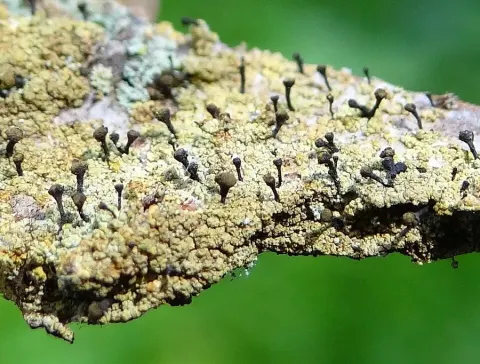
Chaenotheca brachypoda is a tiny pin lichen whose main body (the thallus) lives almost entirely inside the bark it colonises, so little more than a faint stain is usually visible on the surface. Its internal algal partner (Stichococcus) forms a thin green layer that keeps the lichen self-sufficient by providing photosynthate. Above the bark rise the minute fruiting structures that give the species its pin-like appearance. Each consists of a hair-fine stalk only 0.04–0.08 mm thick that lifts the spore-bearing head 0.4–1.4 mm into the air. Both stalk and head are cloaked in a dense yellow-green —a frost-like coating of crystalline pigments containing vulpinic and pulvinic acids—which sometimes leaves the lower half of the stalk exposed as glossy black. The head itself is near-spherical, just 0.1–0.2 mm across. Its outer rim () is poorly developed and may appear only as a slight collar sitting below the dark-brown , the powdery mass of mature spores. Microscopically, the sacs that produce spores (asci) grow in chains and vary in outline from cylindrical to irregular. Each ascus releases numerous spherical to cuboid ascospores 3–4 μm in diameter. The spore walls are unevenly thickened and show a network of fine cracks, features that help separate C. brachypoda from closely related species.
Habitat dan peran ekologis
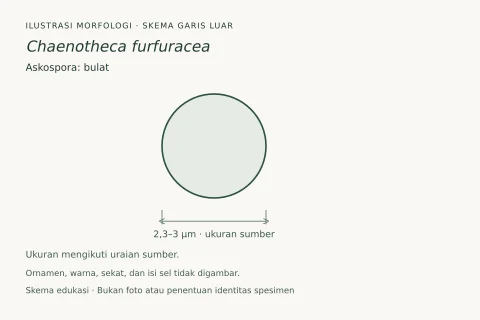
Microscopically, the sacs that produce spores (asci) grow in chains and vary in outline from cylindrical to irregular. Each ascus releases numerous spherical to cuboid ascospores 3–4 μm in diameter. The spore walls are unevenly thickened and show a network of fine cracks, features that help separate C. brachypoda from closely related species.
- Habitat atau konteks temuan
- Informasi belum tersedia pada sumber rilis ini.
- Substrat
- Informasi belum tersedia pada sumber rilis ini.
- Peran atau konteks
- Pembentuk liken
Reproduksi
Chaenotheca brachypoda is a tiny pin lichen whose main body (the thallus) lives almost entirely inside the bark it colonises, so little more than a faint stain is usually visible on the surface. Its internal algal partner (Stichococcus) forms a thin green layer that keeps the lichen self-sufficient by providing photosynthate. Above the bark rise the minute fruiting structures that give the species its pin-like appearance. Each consists of a hair-fine stalk only 0.04–0.08 mm thick that lifts the spore-bearing head 0.4–1.4 mm into the air. Both stalk and head are cloaked in a dense yellow-green —a frost-like coating of crystalline pigments containing vulpinic and pulvinic acids—which sometimes leaves the lower half of the stalk exposed as glossy black.
Catatan identitas dan cakupan
- Nama diterima mengikuti Catalogue of Life Base2026-09-11; uraian mempertahankan konsep dan nama sumber aslinya.
- Original geographic, specimen and life-cycle scope retained; source import awaits individual editorial review.
- Impor dan terjemahan otomatis belum diperiksa editorial per profil. Struktur reproduktif yang disebutkan tidak membuktikan seluruh siklus hidup diketahui.
- Pengukuran pada uraian mengikuti spesimen, kultur, dan metode sumber; angka tidak diperluas ke semua populasi.
Catatan distribusi dalam narasi mengikuti sumbernya. Dokumentasi spesimen atau foto mengikuti catatan sumber. Bukti wilayah Indonesia dan penilaian konservasi tidak disimpulkan dari gambar.
Melihat dengan konteks
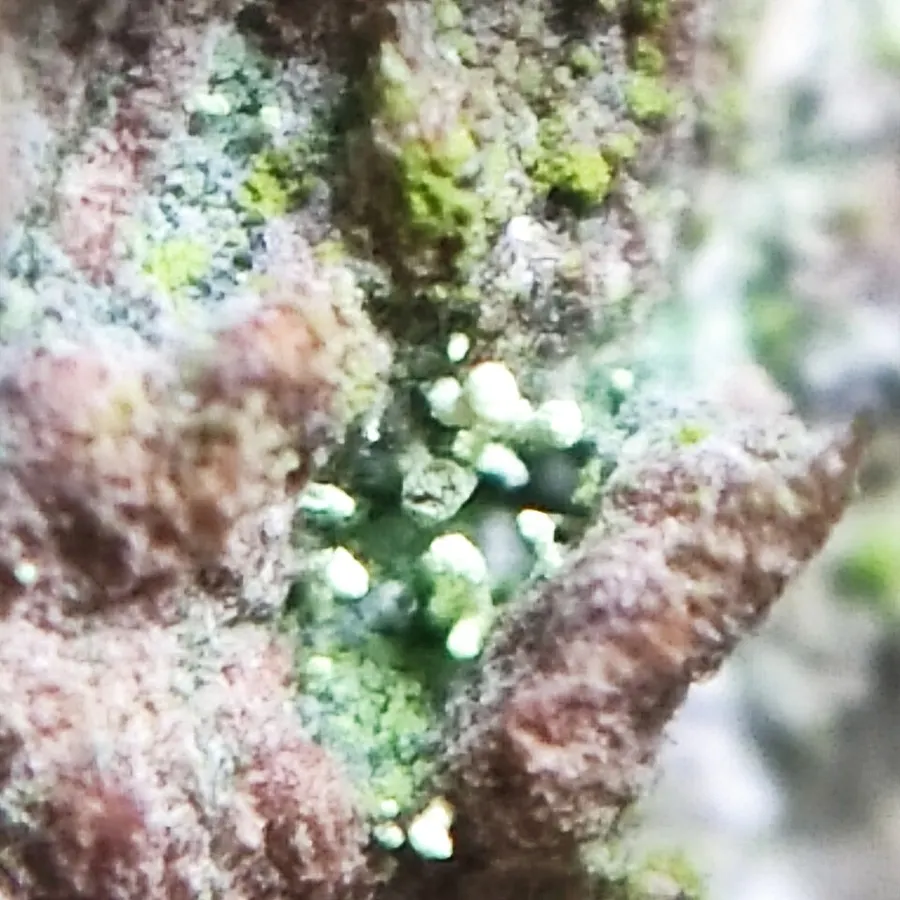
Dokumentasi Chaenotheca brachypoda dari Wikimedia Commons. Chaenotheca brachypoda Identifikasi mengikuti record berkas sumber.
- Jenis
- Fotografi
- Kredit
- Marcel Hospers
- Lisensi
- CC BY-SA 4.0
- Sumber media
- Buka entri sumber
Sumber profil
- [1] Chaenotheca brachypoda — Wikipedia (en)
- [2] Catalogue of Life Base2026-09-11 — Chaenotheca brachypoda
- [3] Dokumentasi visual — Chaenotheca brachypoda
Rujukan halaman ini
Fungi. Chaenotheca brachypoda. Rilis data fungi-2026-10-12-expansion-2. https://fungi-atlas.mgadib.chatgpt.site/jamur/chaenotheca-brachypoda/.
Status: impor sumber; pemeriksaan editorial per profil belum selesai. Untuk klaim biologis, gunakan rujukan pada bagian terkait dan periksa konteks sumber aslinya.