01 / Morfologi

Ciri dan struktur

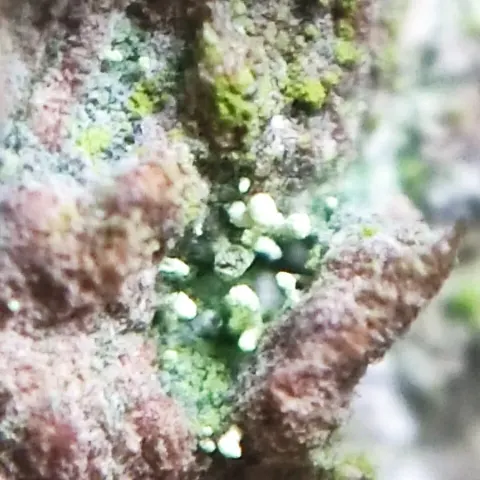
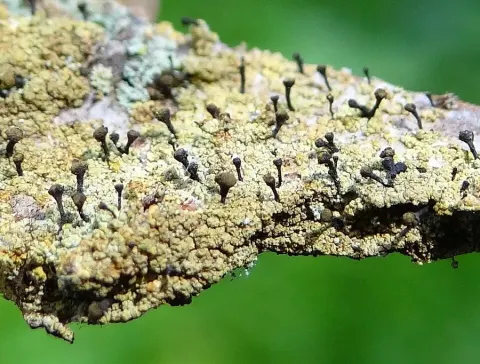
Chaenotheca furfuracea forms a loose, powdery (leprose) crust that spreads across bark as a vivid yellow-green stain. The photobiont—the lichen's algal partner—is a species of Stichococcus, whose tiny green cells sit just below the surface and provide photosynthate. Rising from the crust are pin-like fruiting bodies up to about 2 mm tall. Each comprises a hair-fine stalk (roughly one-tenth of a millimetre thick) that is sheathed in a yellow-green, frost-like coating of crystalline pigment called ; the stalk appears black where this coating wears away. At the tip sits a near-spherical head only 0.1–0.2 mm across. Its outer rim () is so poorly developed that it is scarcely visible, and the interior spore mass () begins life dusted with the same yellow-green pruina before ageing to a pale brown. Under the microscope the spore-producing sacs (asci) are irregular in outline and develop in chains rather than singly. Each ascus releases numerous microscopic ascospores that are spherical, only 2.3–3 μm in diameter, and ornamented with a maze of fine ridges () that may look like tiny warts under a light microscope. The lichen lacks specialised conidiomata—structures that many fungi use for asexual propagation—but does form simple, upright threads (conidiophores) that bud off colourless, ellipsoidal conidia in loose chains. Chemical spot tests reveal the presence of vulpinic acid, pulvinic acid, and pulvinic dilactone in both the crust and the pruina, compounds that lend the species its characteristic yellow-green hue.

Sebagian uraian ditampilkan dalam bahasa sumber; terjemahannya belum tersedia atau belum lolos pemeriksaan.

Rujukan: [1]

Pengukuran mengikuti objek, spesimen atau kultur, dan metode yang disebutkan sumber. Baca uraian asli untuk konteks lengkap.

02 / Kehidupan

Habitat dan peran ekologis

The species can be found in European countries like Belgium, Luxembourg, and Switzerland. The species are growing mostly on beeches and oaks, and on tree roots of spruces. They also grow on detritus or sand, and in rare cases on fissures of siliceous rocks. It does better in climates with high humidity and low luminosity. In Nepal, Chaenotheca furfuracea has been reported at 3,000 m elevation in a compilation of published records. Chaenotheca furfuracea usually occupies damp, deeply shaded nooks—tucked into crevices between tree roots or on rocky faces beneath overhangs—and is encountered most often in upland areas.

Sebagian uraian ditampilkan dalam bahasa sumber; terjemahannya belum tersedia atau belum lolos pemeriksaan.

Rujukan: [1]

Habitat atau konteks temuan
Informasi belum tersedia pada sumber rilis ini.
Substrat
Informasi belum tersedia pada sumber rilis ini.
Peran atau konteks
Pembentuk liken
Temukan hubungan serupa
03 / Siklus hidup

Reproduksi

Chaenotheca furfuracea forms a loose, powdery (leprose) crust that spreads across bark as a vivid yellow-green stain. The photobiont—the lichen's algal partner—is a species of Stichococcus, whose tiny green cells sit just below the surface and provide photosynthate. Rising from the crust are pin-like fruiting bodies up to about 2 mm tall. Each comprises a hair-fine stalk (roughly one-tenth of a millimetre thick) that is sheathed in a yellow-green, frost-like coating of crystalline pigment called ; the stalk appears black where this coating wears away. At the tip sits a near-spherical head only 0.1–0.2 mm across. Its outer rim () is so poorly developed that it is scarcely visible, and the interior spore mass () begins life dusted with the same yellow-green pruina before ageing to a pale brown.

Sebagian uraian ditampilkan dalam bahasa sumber; terjemahannya belum tersedia atau belum lolos pemeriksaan.

Rujukan: [1]

Sinonim menurut acuan taksonomi rilis: Baeomyces furfuraceus; Calicium capitellatum; Calicium furfuraceum; Calicium furfuraceum var. aciculare; Calicium furfuraceum var. fulvum; Calicium phaeocephalum subsp. aciculare; Clathrus fulvus; Clathrus virescens; Coniocybe acicularis; Coniocybe fulva; Coniocybe furfuracea; Coniocybe furfuracea f. acicularis; Coniocybe furfuracea f. denudata; Coniocybe furfuracea f. fulva; Coniocybe furfuracea f. sulphurella; Coniocybe furfuracea var. acicularis; Coniocybe furfuracea var. fulva; Coniocybe furfuracea var. sulphurella; Coniocybe sulphurella; Embolus furfuraceus; Lichen capitatus; Lichen fulvus; Lichen globularis; Mucor fulvus; Mucor furfuraceus; Sclerophora furfuracea
04 / Batas informasi

Catatan identitas dan cakupan

  • Nama diterima mengikuti Catalogue of Life Base2026-09-11; uraian mempertahankan konsep dan nama sumber aslinya.
  • Original geographic, specimen and life-cycle scope retained; source import awaits individual editorial review.
  • Impor dan terjemahan otomatis belum diperiksa editorial per profil. Struktur reproduktif yang disebutkan tidak membuktikan seluruh siklus hidup diketahui.
  • Pengukuran pada uraian mengikuti spesimen, kultur, dan metode sumber; angka tidak diperluas ke semua populasi.

Catatan distribusi dalam narasi mengikuti sumbernya. Dokumentasi spesimen atau foto mengikuti catatan sumber. Bukti wilayah Indonesia dan penilaian konservasi tidak disimpulkan dari gambar.

05 / Dokumentasi

Melihat dengan konteks

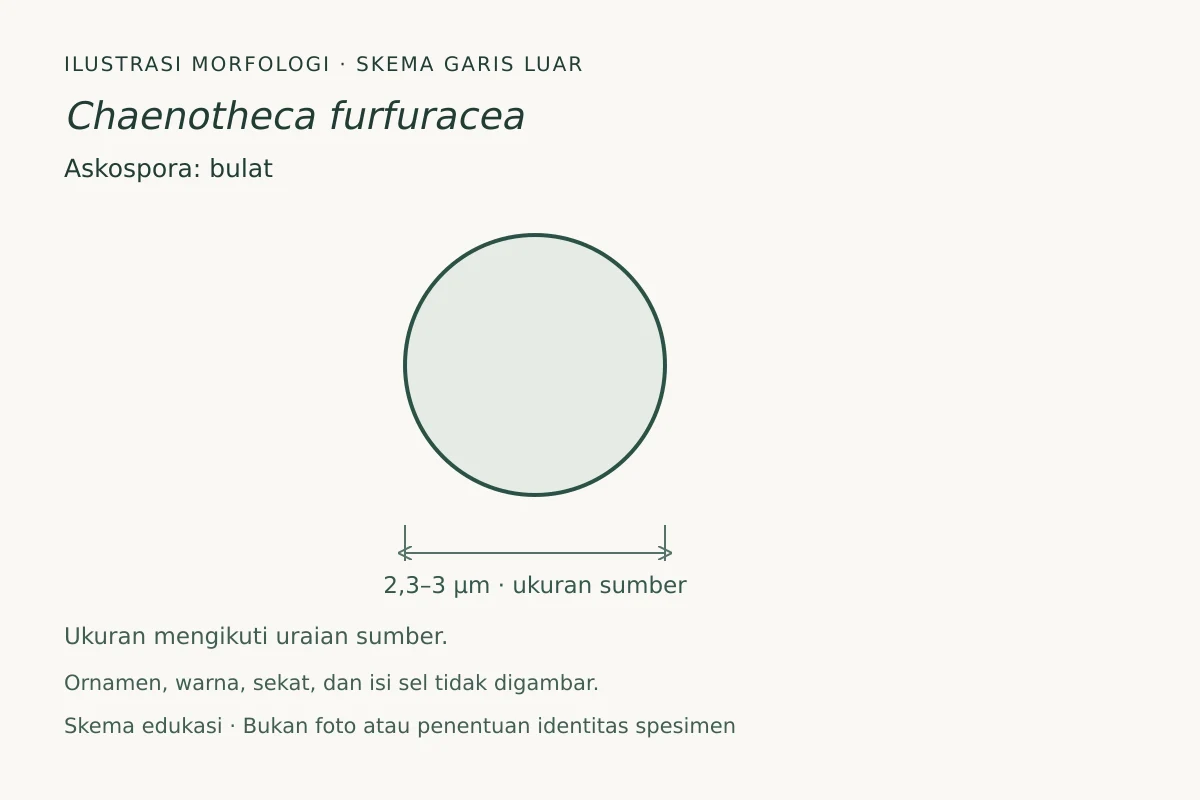
Ilustrasi skematis garis luar askospora Chaenotheca furfuracea, berdasarkan uraian sumber; ukuran yang dilaporkan 2,3–3 µm. Proporsi disederhanakan, bukan salinan satu spesimen. Ornamen permukaan, warna, sekat, dan isi sel tidak direkonstruksi. Askospora bulat berdiameter 2,3–3 µm. Punggung permukaan seperti labirin dan tonjolan kecil tidak digambar. Ornamen, warna, sekat, dan isi sel tidak digambar. Skema edukasi, bukan alat identifikasi.

Jenis
Ilustrasi skematis
Kredit
Fungi, ilustrasi orisinal (2026); fakta morfologi berdasarkan Wikipedia contributors
Sumber media
Buka entri sumber

Gambar menunjukkan objek menurut identifikasi sumber, bukan verifikasi independen spesimen oleh Fungi. Tidak ada skala baru yang ditambahkan.

06 / Rujukan

Sumber profil

  1. [1] Chaenotheca furfuracea — Wikipedia (en)Bagian sumber: Frozen revision 1342775493
    Tanggal penghimpunan sumber: 2026-10-12
    Media sumber: CC BY-SA4.0 · Wikipedia contributors
  2. [2] Catalogue of Life Base2026-09-11 — Chaenotheca furfuraceaBagian sumber: ColDP NameUsage.tsv ID 69N5T; accepted species; source 2073
    Tanggal penghimpunan sumber: 2026-10-12

Adaptasi teks: CC BY-SA 4.0. Wikipedia contributors — Chaenotheca furfuracea — Wikipedia (en)

Uraian asli dan riwayat sumber

Riwayat atau halaman sumber

Ringkasan sumber

Chaenotheca furfuracea is a mealy (farinaceous), bright yellow-green leprose pin lichen. It is in the family Coniocybaceae. This distinctive lichen forms vivid yellow-green powdery crusts on tree bark and produces tiny pin-like fruiting bodies up to 2 mm tall, each with a hair-thin stalk topped by a spherical head. It grows in damp, deeply shaded locations such as tree root crevices and rocky overhangs, particularly in upland areas of Europe where it grows mainly on beeches, oaks, and spruce roots.

Revisi sumber

Morfologi sumber

Chaenotheca furfuracea forms a loose, powdery (leprose) crust that spreads across bark as a vivid yellow-green stain. The photobiont—the lichen's algal partner—is a species of Stichococcus, whose tiny green cells sit just below the surface and provide photosynthate. Rising from the crust are pin-like fruiting bodies up to about 2 mm tall. Each comprises a hair-fine stalk (roughly one-tenth of a millimetre thick) that is sheathed in a yellow-green, frost-like coating of crystalline pigment called ; the stalk appears black where this coating wears away. At the tip sits a near-spherical head only 0.1–0.2 mm across. Its outer rim () is so poorly developed that it is scarcely visible, and the interior spore mass () begins life dusted with the same yellow-green pruina before ageing to a pale brown. Under the microscope the spore-producing sacs (asci) are irregular in outline and develop in chains rather than singly. Each ascus releases numerous microscopic ascospores that are spherical, only 2.3–3 μm in diameter, and ornamented with a maze of fine ridges () that may look like tiny warts under a light microscope. The lichen lacks specialised conidiomata—structures that many fungi use for asexual propagation—but does form simple, upright threads (conidiophores) that bud off colourless, ellipsoidal conidia in loose chains. Chemical spot tests reveal the presence of vulpinic acid, pulvinic acid, and pulvinic dilactone in both the crust and the pruina, compounds that lend the species its characteristic yellow-green hue.

Revisi sumber

Ekologi sumber

The species can be found in European countries like Belgium, Luxembourg, and Switzerland. The species are growing mostly on beeches and oaks, and on tree roots of spruces. They also grow on detritus or sand, and in rare cases on fissures of siliceous rocks. It does better in climates with high humidity and low luminosity. In Nepal, Chaenotheca furfuracea has been reported at 3,000 m elevation in a compilation of published records. Chaenotheca furfuracea usually occupies damp, deeply shaded nooks—tucked into crevices between tree roots or on rocky faces beneath overhangs—and is encountered most often in upland areas.

Revisi sumber

Struktur reproduksi sumber

Chaenotheca furfuracea forms a loose, powdery (leprose) crust that spreads across bark as a vivid yellow-green stain. The photobiont—the lichen's algal partner—is a species of Stichococcus, whose tiny green cells sit just below the surface and provide photosynthate. Rising from the crust are pin-like fruiting bodies up to about 2 mm tall. Each comprises a hair-fine stalk (roughly one-tenth of a millimetre thick) that is sheathed in a yellow-green, frost-like coating of crystalline pigment called ; the stalk appears black where this coating wears away. At the tip sits a near-spherical head only 0.1–0.2 mm across. Its outer rim () is so poorly developed that it is scarcely visible, and the interior spore mass () begins life dusted with the same yellow-green pruina before ageing to a pale brown.

Revisi sumber

Rujukan halaman ini

Fungi. Chaenotheca furfuracea. Rilis data fungi-2026-10-12-expansion-2. https://fungi-atlas.mgadib.chatgpt.site/jamur/chaenotheca-furfuracea/.

Status: impor sumber; pemeriksaan editorial per profil belum selesai. Untuk klaim biologis, gunakan rujukan pada bagian terkait dan periksa konteks sumber aslinya.