01 / Morfologi

Ciri dan struktur

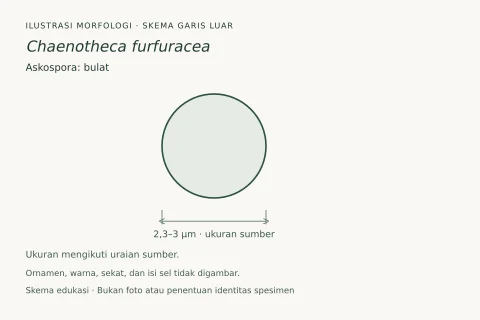
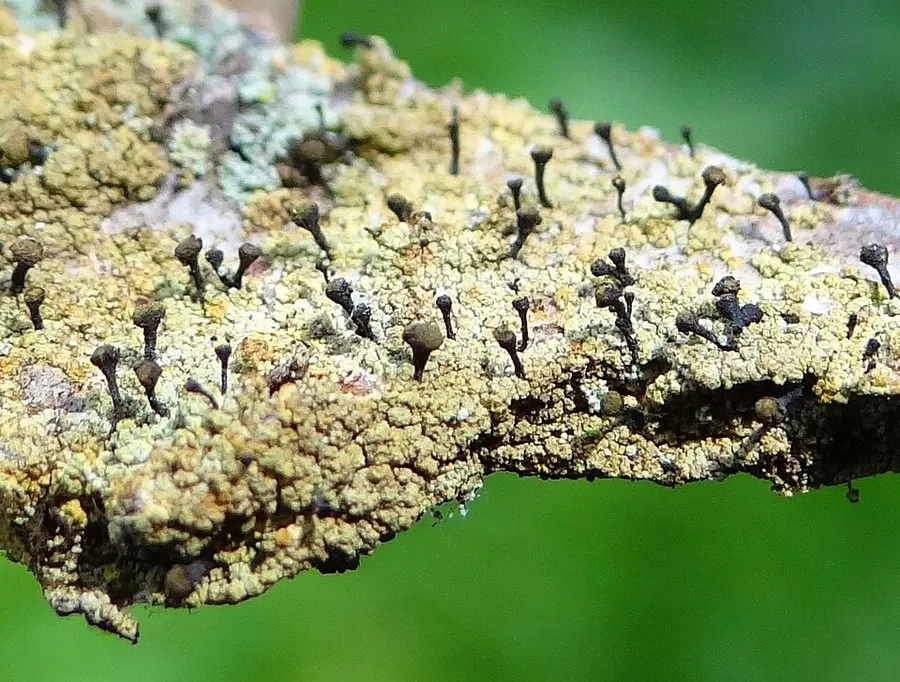
The macroscopic appearance of this lichen is quite distinct. It is recognizable by the apparent wart-like thallus and very apparent stalked apothecia that are quite small and have a pin or needle-like appearance. The thallus of this lichen is typically a light gray, with patches of yellow or red-orange as well. The appearance is verrucose, meaning that it has patches of thallus elevated above the substrate as well as growth beneath. The distinct convex apothecium contains groups of asci bundled together alongside sterile hyphae that grow from the center of the stalk. These asci tend to be cylindrical in shape and contain 8 ascospores each. Additionally, the arrangement of these ascospores can be either in 1 or 2 rows, still coming to a total of 8 ascospores per asci. The spores of this organism are distinct in their shape and coloration. The ascospores of this fungus are globose, or spherical and have a distinct yellow-brown coloration. Another notable characteristic of these spores is that they are fissured in their structure. Under a microscope this appears as defined creases in the spore. However, this fissured feature is mainly observed in mature spores. These spores tend to be 7 to 8 micrometers in diameter as well. The photobiont that this fungus forms a lichenized structure alongside is typically of the genus Trebouxia, which is a form of green algae. There are other genera that species in the genus Chaenotheca will form a lichen with, but still these are typically still other green algae. Trebouxia in particular is a green, globose algae that lives in conjunction with Chaenotheca ferruginea.

Sebagian uraian ditampilkan dalam bahasa sumber; terjemahannya belum tersedia atau belum lolos pemeriksaan.

Rujukan: [1]

Pengukuran mengikuti objek, spesimen atau kultur, dan metode yang disebutkan sumber. Baca uraian asli untuk konteks lengkap.

02 / Kehidupan

Habitat dan peran ekologis

Chaenotheca ferruginea is widely distributed across Europe and is also somewhat prolific on the East and West coasts of the United States. However, there have been observations of this species globally, including in Costa Rica, Argentina, Australia, and New Zealand.

Sebagian uraian ditampilkan dalam bahasa sumber; terjemahannya belum tersedia atau belum lolos pemeriksaan.

Rujukan: [1]

Habitat atau konteks temuan
Informasi belum tersedia pada sumber rilis ini.
Substrat
Informasi belum tersedia pada sumber rilis ini.
Peran atau konteks
Pembentuk liken
Temukan hubungan serupa
03 / Siklus hidup

Reproduksi

The distinct convex apothecium contains groups of asci bundled together alongside sterile hyphae that grow from the center of the stalk. These asci tend to be cylindrical in shape and contain 8 ascospores each. Additionally, the arrangement of these ascospores can be either in 1 or 2 rows, still coming to a total of 8 ascospores per asci. The spores of this organism are distinct in their shape and coloration. The ascospores of this fungus are globose, or spherical and have a distinct yellow-brown coloration. Another notable characteristic of these spores is that they are fissured in their structure. Under a microscope this appears as defined creases in the spore. However, this fissured feature is mainly observed in mature spores.

Sebagian uraian ditampilkan dalam bahasa sumber; terjemahannya belum tersedia atau belum lolos pemeriksaan.

Rujukan: [1]

Sinonim menurut acuan taksonomi rilis: Calicium ferrugineum; Calicium melanophaeum; Calicium melanophaeum var. ferrugineum; Calicium stemoneum var. ferrugineum; Calicium trichiale var. ferrugineum; Calicium trichiale var. melanophaeum; Chaenotheca melanophaea; Chaenotheca melanophaea f. flavocitrina; Chaenotheca melanophaea var. ferruginea; Chaenotheca melanophaea var. flavocitrina; Chaetocypha ferruginea; Cyphelium ferrugineum; Cyphelium melanophaeum; Cyphelium melanophaeum f. ferrugineum; Cyphelium melanophaeum var. ferrugineum; Cyphelium trichiale var. ferrugineum; Phacotium ferrugineum; Phacotium melanophaeum; Phacotrum ferrugineum
04 / Batas informasi

Catatan identitas dan cakupan

  • Nama diterima mengikuti Catalogue of Life Base2026-09-11; uraian mempertahankan konsep dan nama sumber aslinya.
  • Original geographic, specimen and life-cycle scope retained; source import awaits individual editorial review.
  • Impor dan terjemahan otomatis belum diperiksa editorial per profil. Struktur reproduktif yang disebutkan tidak membuktikan seluruh siklus hidup diketahui.
  • Pengukuran pada uraian mengikuti spesimen, kultur, dan metode sumber; angka tidak diperluas ke semua populasi.

Catatan distribusi dalam narasi mengikuti sumbernya. Dokumentasi spesimen atau foto mengikuti catatan sumber. Bukti wilayah Indonesia dan penilaian konservasi tidak disimpulkan dari gambar.

05 / Dokumentasi

Melihat dengan konteks

Dokumentasi Chaenotheca ferruginea dari Wikimedia Commons. Chaenotheca ferruginea (location: Poland, Gorce, Gorc) Identifikasi mengikuti record berkas sumber.

Jenis
Fotografi
Kredit
Jerzy Opioła
Sumber media
Buka entri sumber

Gambar menunjukkan objek menurut identifikasi sumber, bukan verifikasi independen spesimen oleh Fungi. Tidak ada skala baru yang ditambahkan.

06 / Rujukan

Sumber profil

  1. [1] Chaenotheca ferruginea — Wikipedia (en)Bagian sumber: Frozen revision 1364420920
    Tanggal penghimpunan sumber: 2026-10-12
    Teks sumber: CC BY-SA4.0 · Wikipedia contributors
  2. [2] Catalogue of Life Base2026-09-11 — Chaenotheca ferrugineaBagian sumber: ColDP NameUsage.tsv ID T9TD; accepted species; source 2073
    Tanggal penghimpunan sumber: 2026-10-12
  3. [3] Dokumentasi visual — Chaenotheca ferrugineaBagian sumber: Individual media record; identification follows the source, not independent determination
    Tanggal penghimpunan sumber: 2026-10-12
    Media sumber: CC BY-SA 4.0 · Jerzy Opioła

Adaptasi teks: CC BY-SA 4.0. Wikipedia contributors — Chaenotheca ferruginea — Wikipedia (en)

Uraian asli dan riwayat sumber

Riwayat atau halaman sumber

Ringkasan sumber

Chaenotheca ferruginea commonly known as the rusty stubble lichen, is a species of lichenized fungus that grows on willow tree bark as well as other sources of wood. This lichen species was originally discovered in the United Kingdom. However, there have since been many observations across the world, including in the United States, Europe, and in Australia. This species was originally described within the genus Calicium but has since been placed into the genus Chaenotheca.

Revisi sumber

Morfologi sumber

The macroscopic appearance of this lichen is quite distinct. It is recognizable by the apparent wart-like thallus and very apparent stalked apothecia that are quite small and have a pin or needle-like appearance. The thallus of this lichen is typically a light gray, with patches of yellow or red-orange as well. The appearance is verrucose, meaning that it has patches of thallus elevated above the substrate as well as growth beneath. The distinct convex apothecium contains groups of asci bundled together alongside sterile hyphae that grow from the center of the stalk. These asci tend to be cylindrical in shape and contain 8 ascospores each. Additionally, the arrangement of these ascospores can be either in 1 or 2 rows, still coming to a total of 8 ascospores per asci. The spores of this organism are distinct in their shape and coloration. The ascospores of this fungus are globose, or spherical and have a distinct yellow-brown coloration. Another notable characteristic of these spores is that they are fissured in their structure. Under a microscope this appears as defined creases in the spore. However, this fissured feature is mainly observed in mature spores. These spores tend to be 7 to 8 micrometers in diameter as well. The photobiont that this fungus forms a lichenized structure alongside is typically of the genus Trebouxia, which is a form of green algae. There are other genera that species in the genus Chaenotheca will form a lichen with, but still these are typically still other green algae. Trebouxia in particular is a green, globose algae that lives in conjunction with Chaenotheca ferruginea.

Revisi sumber

Ekologi sumber

Chaenotheca ferruginea is widely distributed across Europe and is also somewhat prolific on the East and West coasts of the United States. However, there have been observations of this species globally, including in Costa Rica, Argentina, Australia, and New Zealand.

Revisi sumber

Struktur reproduksi sumber

The distinct convex apothecium contains groups of asci bundled together alongside sterile hyphae that grow from the center of the stalk. These asci tend to be cylindrical in shape and contain 8 ascospores each. Additionally, the arrangement of these ascospores can be either in 1 or 2 rows, still coming to a total of 8 ascospores per asci. The spores of this organism are distinct in their shape and coloration. The ascospores of this fungus are globose, or spherical and have a distinct yellow-brown coloration. Another notable characteristic of these spores is that they are fissured in their structure. Under a microscope this appears as defined creases in the spore. However, this fissured feature is mainly observed in mature spores.

Revisi sumber

Rujukan halaman ini

Fungi. Chaenotheca ferruginea. Rilis data fungi-2026-10-12-expansion-2. https://fungi-atlas.mgadib.chatgpt.site/jamur/chaenotheca-ferruginea/.

Status: impor sumber; pemeriksaan editorial per profil belum selesai. Untuk klaim biologis, gunakan rujukan pada bagian terkait dan periksa konteks sumber aslinya.