Ciri dan struktur
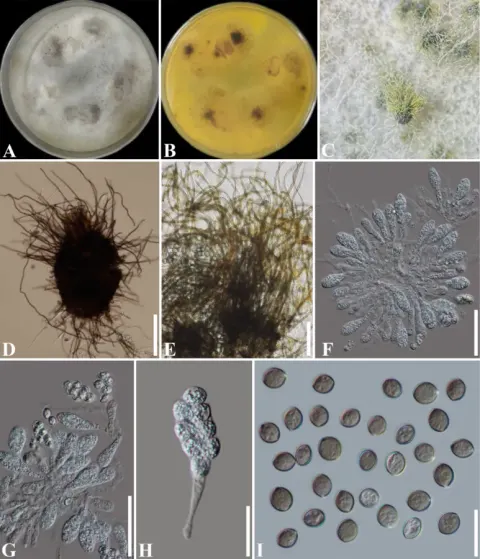
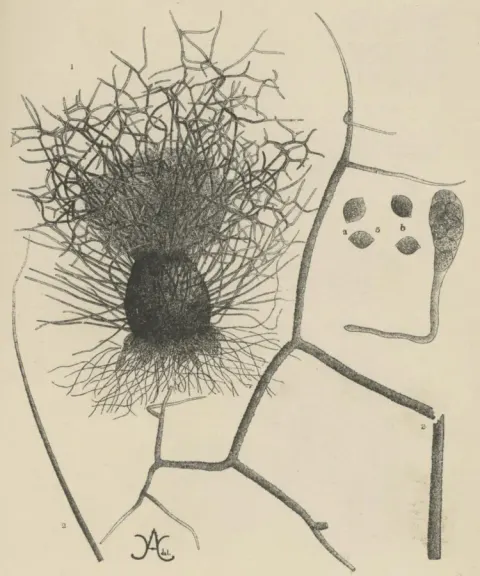
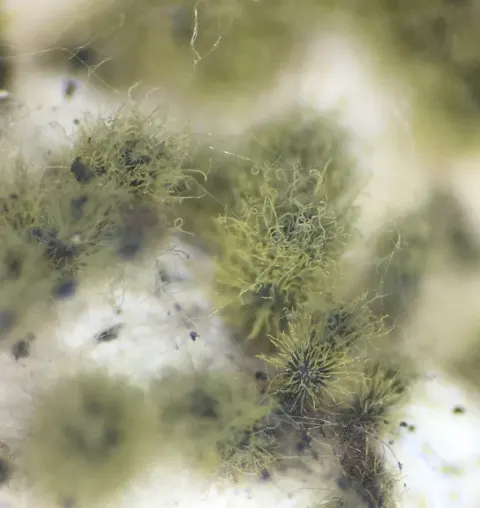
The colonies of B. piluliferum are fast-growing. They can spread from 2.0 to 4.3 cm in diameter in one week when grown at 20 C. The colonies start off as white aerial mycelium which can become a yellowish-beige colour by the subsequent production of brown, rough-walled sterile setae. These brown setae are about 250 x 2–5 μm and bumpy or encrusted near their base. The conidiophores branch at right angles to the main axis. They are smooth, colourless, and produce conidia at their ends. The conidia are thick-walled, hyaline (white), smooth, and spherical. They are approximately 9–16 μm in diameter. B. piluliferum also contains branched hyaline conidiophores that produce aleurioconidia in clusters. The aleurioconidia are globose and typically 3.0–3.5 μm thick. The fungus can produce chains of phialoconidia as well. Ascomata in B. piluliferum are rare and reach maturity in four weeks at 25 C. They are black, with a globose to subglobose shape. The lateral and terminal hairs of the ascomata are 500–1500 μm long, 4–6 μm wide with an olive-brown colour and may contain tips with are rolled in a flat coil towards the center. The pale brown ascospores are ellipsoidal (or football-shaped) and contain one germ pore that is roughly 13–16 x 8–10.5 μm. Mating behaviour of the fungus is unknown because single-spore cultures lose the ability to produce ascomata. The teleomorph C. piluliferum is made up of colonies containing brown hyphae with rough and bumpy hairs. C. piluliferum ascomata are superficial and spherical or obovate (oval-shaped with a narrow base, like a light bulb. They contain a small pore on the top called and ostiole that allow spores to pass through.
Habitat dan peran ekologis
Botryotrichum piluliferum is found worldwide. It has been isolated and recorded in many countries such as Canada, the United States, The Netherlands, and South Africa. It has been found on deer and goat dung in Denmark and field mouse dung in England. The fungus is rarely found in soils, however, it can be found at depths of 80 cm below soil. It has been reported in mountainous regions, salt marshes, and cedar forests. It has also been isolated from stems of Urtica dioica, hay, rhizospheres of groundnut, rice and wheat, paper products, and mouldy textiles, as well as in the seeds of chili pepper. B. piluliferum is a food source for Pygmephorus mesembrinae and P. quadratus. When in vitro, it can be parasitized by Pythium oligandrum.
- Habitat atau konteks temuan
- hutan
- Substrat
- Informasi belum tersedia pada sumber rilis ini.
- Peran atau konteks
- Belum dikategorikan pada rilis ini.
Reproduksi
The colonies of B. piluliferum are fast-growing. They can spread from 2.0 to 4.3 cm in diameter in one week when grown at 20 C. The colonies start off as white aerial mycelium which can become a yellowish-beige colour by the subsequent production of brown, rough-walled sterile setae. These brown setae are about 250 x 2–5 μm and bumpy or encrusted near their base. The conidiophores branch at right angles to the main axis. They are smooth, colourless, and produce conidia at their ends. The conidia are thick-walled, hyaline (white), smooth, and spherical. They are approximately 9–16 μm in diameter. B. piluliferum also contains branched hyaline conidiophores that produce aleurioconidia in clusters.
Catatan identitas dan cakupan
- Nama diterima mengikuti Catalogue of Life Base2026-09-11; uraian mempertahankan konsep dan nama sumber aslinya.
- Original geographic, specimen and life-cycle scope retained; source import awaits individual editorial review.
- Impor dan terjemahan otomatis belum diperiksa editorial per profil. Struktur reproduktif yang disebutkan tidak membuktikan seluruh siklus hidup diketahui.
- Pengukuran pada uraian mengikuti spesimen, kultur, dan metode sumber; angka tidak diperluas ke semua populasi.
Catatan distribusi dalam narasi mengikuti sumbernya. Dokumentasi spesimen atau foto mengikuti catatan sumber. Bukti wilayah Indonesia dan penilaian konservasi tidak disimpulkan dari gambar.
Melihat dengan konteks
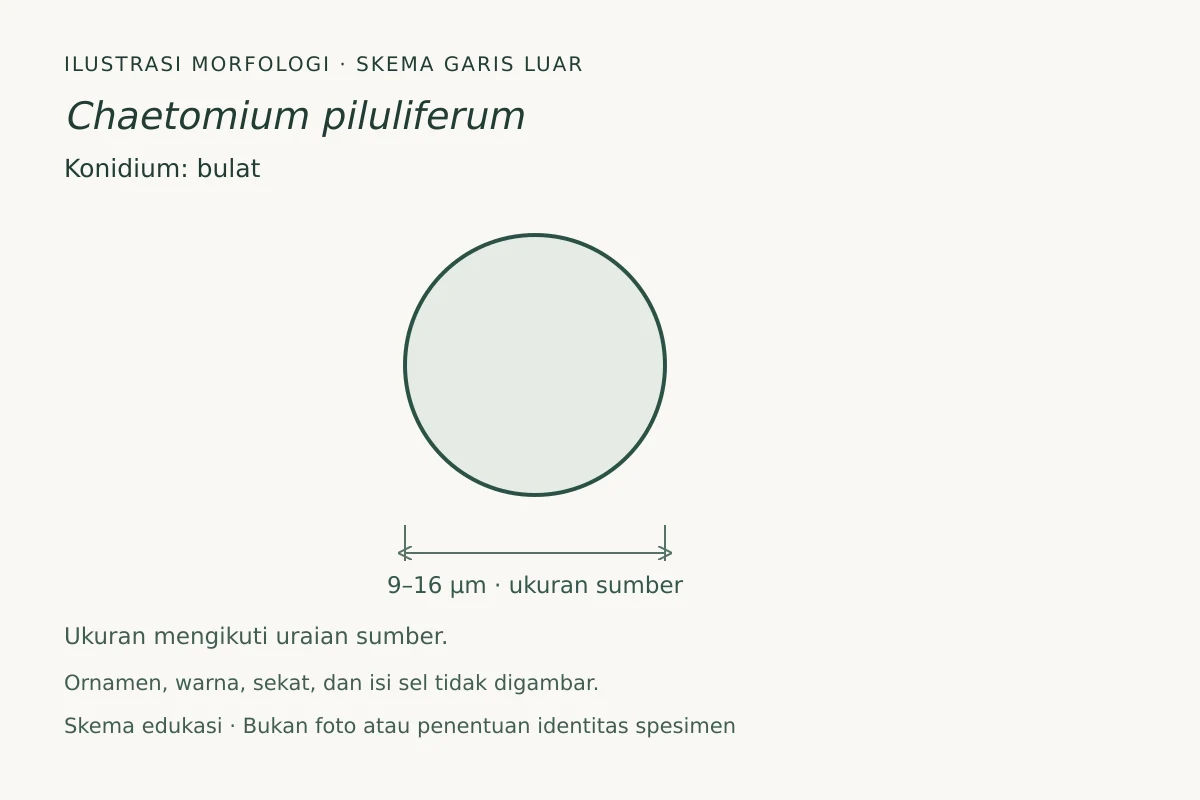
Ilustrasi skematis garis luar konidium Chaetomium piluliferum, berdasarkan uraian sumber; ukuran yang dilaporkan 9–16 µm. Proporsi disederhanakan, bukan salinan satu spesimen. Ornamen permukaan, warna, sekat, dan isi sel tidak direkonstruksi. Konidium bulat berdiameter sekitar 9–16 µm. Ketebalan dinding tidak direkonstruksi; ukuran aleuriokonidium yang lain tidak dipakai. Ornamen, warna, sekat, dan isi sel tidak digambar. Skema edukasi, bukan alat identifikasi.
- Jenis
- Ilustrasi skematis
- Kredit
- Fungi, ilustrasi orisinal (2026); fakta morfologi berdasarkan Wikipedia contributors
- Lisensi
- CC BY-SA 4.0
- Sumber media
- Buka entri sumber
Sumber profil
- [1] Botryotrichum piluliferum — Wikipedia (en)
- [2] Catalogue of Life Base2026-09-11 — Chaetomium piluliferum
Rujukan halaman ini
Fungi. Chaetomium piluliferum. Rilis data fungi-2026-10-12-expansion-2. https://fungi-atlas.mgadib.chatgpt.site/jamur/chaetomium-piluliferum/.
Status: impor sumber; pemeriksaan editorial per profil belum selesai. Untuk klaim biologis, gunakan rujukan pada bagian terkait dan periksa konteks sumber aslinya.