Ciri dan struktur
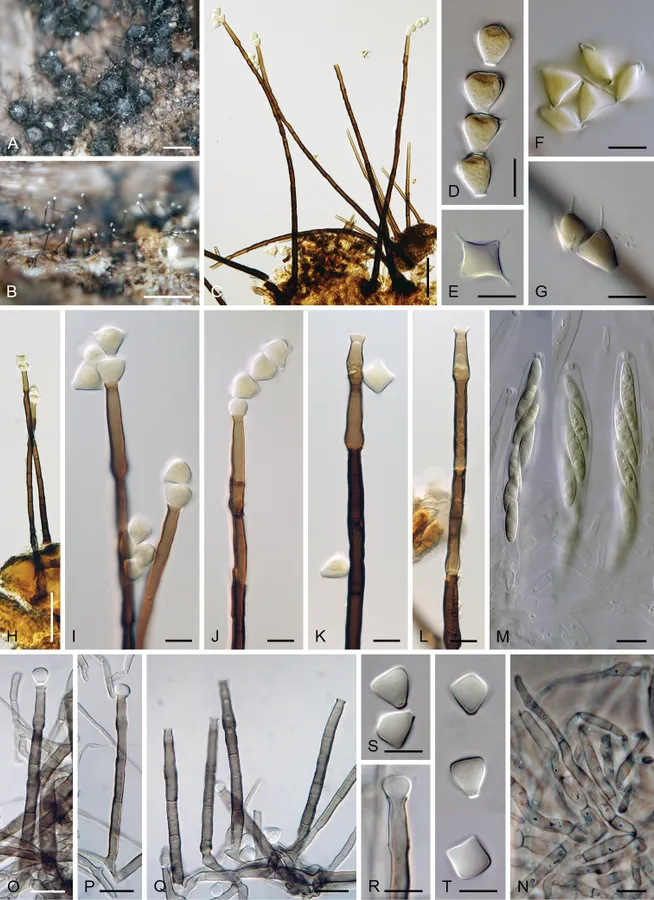
Colonies on natural substrate effuse, hairy, dark brown to black, mycelium partly superficial, partly immersed, brown; colonies composed of conidiophores and sometimes ascomata. Anamorph. Setae present, mostly associated with ascomata (see below). Conidiophores 195–360 × 5–7.5 μm, 7–8.5 μm wide above the base, mononematous, macronematous, solitary, erect, straight or flexuous, unbranched, thick-walled, dark brown, paler towards the apex. Conidiogenous cells 20–54 × 5–6.5(–8) μm tapering to 3.5–4.5 μm below the collarette, integrated, terminal, monophialidic, extending percurrently, cylindrical to cylindrical-lageniform, brown, producing conidia successively; collarettes 6–7.5 μm wide, 2.5–3(–4) μm deep, funnel-shaped, pale brown. Conidia 10.5–12 μm long, 8.5–12 μm wide, 2.5–3.5 μm wide at the basal hilum (mean ± SD = 11.2 ± 0.5 × 10.3 ± 1.0 × 2.9 ± 0.3 μm), obpyramidal, in side view cuneiform to obtriangular, with four corners when viewed from above, truncate at the basal scar, with straight or curved setulae inserted at each corner 5–8 μm long, aseptate, hyaline, thin-walled, smooth; formed singly, adhered in basipetal chains. Teleomorph. Ascomata 120–140 μm diam, 130–160 μm high, subglobose, dark brown to black, superficial, solitary or aggregated, subglobose, papillate, setose. Setae 37–157 × 3.5–5.5 μm, simple, straight, cylindrical, brown, pale brown towards the apex, extending percurrently, apical cell sterile, 3.5–4 μm wide, broadly rounded, pale brown to subhyaline, similar setae arise around ascomata on the substrate. Ostiole periphysate. Ascomatal wall fragile, carbonaceous, 20–24 μm thick, two-layered.
Habitat dan peran ekologis
New Zealand – West Coast region • Westland district, Ross, Totara forest, Totara River valley; on decaying wood of a branch; 7 Mar. 2003; M. Réblová MR 2734/NZ 236 (holotype PDD 119363). New Zealand – West Coast region • Buller district, Victoria Forest Park, Reefton, Big River Inanganua track; on decaying wood of Nothofagus sp. (associated with C. novae-zelandiae PDD 119362 and Zanclospora falcata PDD 119365); 6 Mar. 2003, M. Réblová MR 2724/ NZ 225 (PDD 119364). Saprobe on decaying wood, known only in New Zealand.
- Habitat atau konteks temuan
- hutan
- Substrat
- kayu
- Peran atau konteks
- Belum dikategorikan pada rilis ini.
Reproduksi
Colonies on natural substrate effuse, hairy, dark brown to black, mycelium partly superficial, partly immersed, brown; colonies composed of conidiophores and sometimes ascomata. Anamorph. Setae present, mostly associated with ascomata (see below). Conidiophores 195–360 × 5–7.5 μm, 7–8.5 μm wide above the base, mononematous, macronematous, solitary, erect, straight or flexuous, unbranched, thick-walled, dark brown, paler towards the apex. Conidiogenous cells 20–54 × 5–6.5(–8) μm tapering to 3.5–4.5 μm below the collarette, integrated, terminal, monophialidic, extending percurrently, cylindrical to cylindrical-lageniform, brown, producing conidia successively; collarettes 6–7.5 μm wide, 2.5–3(–4) μm deep, funnel-shaped, pale brown.
Catatan identitas dan cakupan
- Nama diterima mengikuti Catalogue of Life Base2026-09-11; uraian mempertahankan konsep dan nama sumber aslinya.
- Preserve original treatment localities, hosts and substrate scope. Materials examined describe documented specimens, not the full global range.
- Impor dan terjemahan otomatis belum diperiksa editorial per profil. Struktur reproduktif yang disebutkan tidak membuktikan seluruh siklus hidup diketahui.
- Pengukuran pada uraian mengikuti spesimen, kultur, dan metode sumber; angka tidak diperluas ke semua populasi.
Catatan distribusi dalam narasi mengikuti sumbernya. Dokumentasi spesimen atau foto mengikuti catatan sumber. Bukti wilayah Indonesia dan penilaian konservasi tidak disimpulkan dari gambar.
Melihat dengan konteks
Chalarodes obpyramidata A ascomata B colony composed of conidiophores C, H, O–Q conidiophores D–G, S, T conidia I–L, R upper parts of conidiophores with conidia M asci with ascospores N paraphyses. Images: PDD 119363 (A–L); PDD 119364 (M–T); on natural substrate (A–N); in PCA culture after 4 wk (O–T). Scale bars: 250 μm (A, B); 50 μm (C, H); 10 μm (D–G, M, N, R–T); 20 μm (I–L, O–Q).
- Jenis
- Pelat ilmiah
- Kredit
- Martina Réblová, Jana Nekvindová, Andrew N. Miller
- Lisensi
- CC BY 4.0
- Sumber media
- Buka entri sumber
Sumber profil
- [1] Phylogeny and taxonomy of Catenularia and similar fungi with catenate conidia — Chalarodes obpyramidata
- [2] Catalogue of Life Base2026-09-11 — Chalarodes obpyramidata
- [3] Dokumentasi visual — Chalarodes obpyramidata
Rujukan halaman ini
Fungi. Chalarodes obpyramidata. Rilis data fungi-2026-10-12-expansion-2. https://fungi-atlas.mgadib.chatgpt.site/jamur/chalarodes-obpyramidata/.
Status: impor sumber; pemeriksaan editorial per profil belum selesai. Untuk klaim biologis, gunakan rujukan pada bagian terkait dan periksa konteks sumber aslinya.