01 / Morfologi

Ciri dan struktur

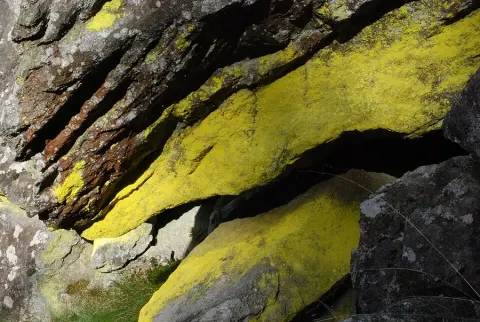
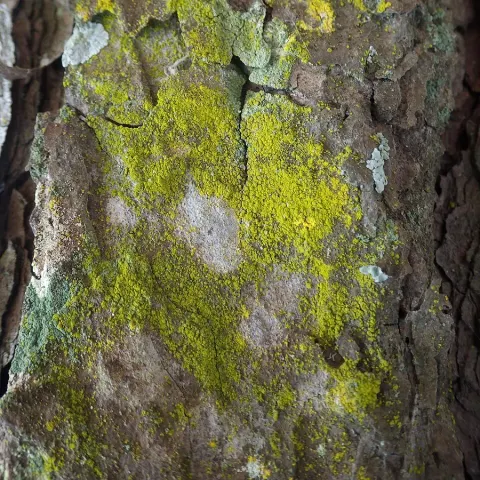
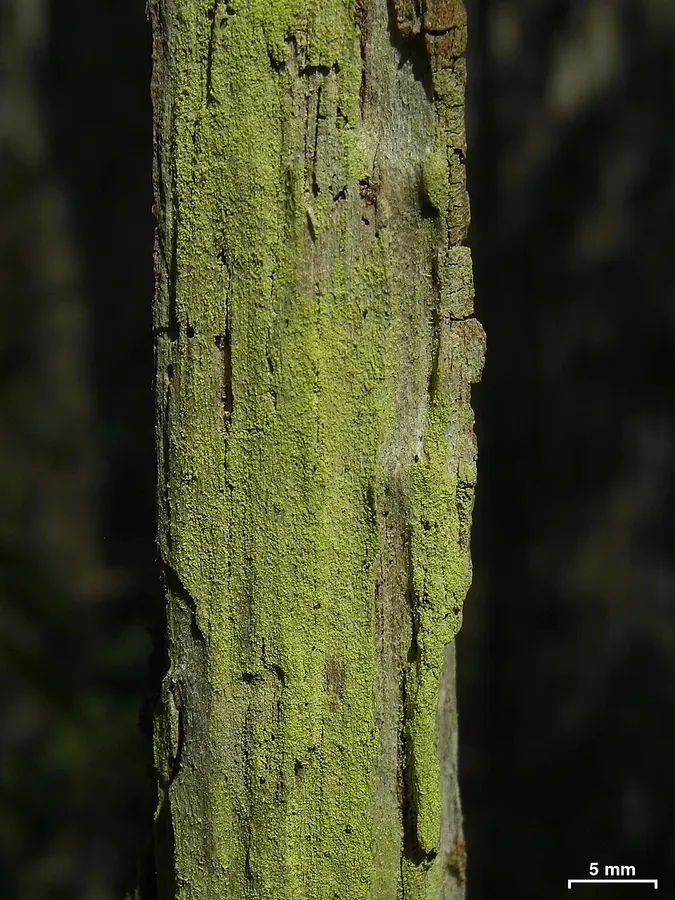
The lichen Chrysothrix chamaecyparicola is distinguished by its crustose, leprose thallus – a thin layer that often forms on the bark of conifer trees. It manifests as an array of dull yellow or greenish-yellow that, over time, may fade to a whitish-yellow, particularly in preserved herbarium specimens. These granules, which can vary between spherical and irregular shapes, have a size range of approximately 15 to 30 μm across. Unlike some other lichen species, Chrysothrix chamaecyparicola does not have (root-like hyphae that can penetrate the ). Its granules are loosely connected, meaning they lack the fungal hyphae that usually link granules together in many lichen species. Instead, the granules coalesce to form either small, discontinuous patches or more extensive regions that are typically one to a few granules thick. The lichen is supports to a photobiont, which are green algae that can reach up to 8.5 μm in diameter. Chrysothrix chamaecyparicola does not develop apothecia or , which are reproductive structures commonly found in many lichen species. Its chemistry is noteworthy as well: despite testing negative in typical lichen spot tests, it exhibits a dull to bright orange glow when exposed to ultraviolet (UV) light due to the presence of rhizocarpic acid. Chrysothrix chamaecyparicola closely resembles Chrysothrix flavovirentis, but the absence of diffractaic acid sets it apart.

Sebagian uraian ditampilkan dalam bahasa sumber; terjemahannya belum tersedia atau belum lolos pemeriksaan.

Rujukan: [1]

Pengukuran mengikuti objek, spesimen atau kultur, dan metode yang disebutkan sumber. Baca uraian asli untuk konteks lengkap.

02 / Kehidupan

Habitat dan peran ekologis

Chrysothrix chamaecyparicola is a conspicuous member of the lichen biota in conifer swamps across temperate and subtropical eastern North America. It is often the most conspicuous lichen, coating the trunks of trees in these high-humidity, low-light environments. While particularly evident in cedar swamps near the coast, it is also found on a diverse range of other conifers in inland swamps, including cypress, hemlock, and pine. The species is most prevalent in the mid-Atlantic region of the United States, namely in New Jersey, Maryland, and Pennsylvania. This is also the core distribution area of its preferred host plant, Chamaecyparis thyoides. Chrysothrix chamaecyparicola has also been recorded in North Carolina.

Sebagian uraian ditampilkan dalam bahasa sumber; terjemahannya belum tersedia atau belum lolos pemeriksaan.

Rujukan: [1]

Habitat atau konteks temuan
Informasi belum tersedia pada sumber rilis ini.
Substrat
Informasi belum tersedia pada sumber rilis ini.
Peran atau konteks
Pembentuk liken
Temukan hubungan serupa
03 / Siklus hidup

Reproduksi

Unlike some other lichen species, Chrysothrix chamaecyparicola does not have (root-like hyphae that can penetrate the ). Its granules are loosely connected, meaning they lack the fungal hyphae that usually link granules together in many lichen species. Instead, the granules coalesce to form either small, discontinuous patches or more extensive regions that are typically one to a few granules thick. The lichen is supports to a photobiont, which are green algae that can reach up to 8.5 μm in diameter. Chrysothrix chamaecyparicola does not develop apothecia or , which are reproductive structures commonly found in many lichen species. Its chemistry is noteworthy as well: despite testing negative in typical lichen spot tests, it exhibits a dull to bright orange glow when exposed to ultraviolet (UV) light due to the presence of rhizocarpic acid.

Sebagian uraian ditampilkan dalam bahasa sumber; terjemahannya belum tersedia atau belum lolos pemeriksaan.

Rujukan: [1]

04 / Batas informasi

Catatan identitas dan cakupan

  • Nama diterima mengikuti Catalogue of Life Base2026-09-11; uraian mempertahankan konsep dan nama sumber aslinya.
  • Original geographic, specimen and life-cycle scope retained; source import awaits individual editorial review.
  • Impor dan terjemahan otomatis belum diperiksa editorial per profil. Struktur reproduktif yang disebutkan tidak membuktikan seluruh siklus hidup diketahui.
  • Pengukuran pada uraian mengikuti spesimen, kultur, dan metode sumber; angka tidak diperluas ke semua populasi.

Catatan distribusi dalam narasi mengikuti sumbernya. Dokumentasi spesimen atau foto mengikuti catatan sumber. Bukti wilayah Indonesia dan penilaian konservasi tidak disimpulkan dari gambar.

05 / Dokumentasi

Melihat dengan konteks

Dokumentasi Chrysothrix chamaecyparicola dari Wikimedia Commons. on cypress stump, Alligator River National Wildlife Refuge, North Carolina, 20140323 ver. J. Lendemer 6257, at NY Identifikasi mengikuti record berkas sumber.

Jenis
Fotografi
Kredit
Jason Hollinger
Lisensi
CC BY 2.0
Sumber media
Buka entri sumber

Gambar menunjukkan objek menurut identifikasi sumber, bukan verifikasi independen spesimen oleh Fungi. Tidak ada skala baru yang ditambahkan.

06 / Rujukan

Sumber profil

  1. [1] Chrysothrix chamaecyparicola — Wikipedia (en)Bagian sumber: Frozen revision 1374660807
    Tanggal penghimpunan sumber: 2026-10-12
    Teks sumber: CC BY-SA4.0 · Wikipedia contributors
  2. [2] Catalogue of Life Base2026-09-11 — Chrysothrix chamaecyparicolaBagian sumber: ColDP NameUsage.tsv ID V2DC; accepted species; source 2073
    Tanggal penghimpunan sumber: 2026-10-12
  3. [3] Dokumentasi visual — Chrysothrix chamaecyparicolaBagian sumber: Individual media record; identification follows the source, not independent determination
    Tanggal penghimpunan sumber: 2026-10-12
    Media sumber: CC BY 2.0 · Jason Hollinger

Adaptasi teks: CC BY-SA 4.0. Wikipedia contributors — Chrysothrix chamaecyparicola — Wikipedia (en)

Uraian asli dan riwayat sumber

Riwayat atau halaman sumber

Ringkasan sumber

Chrysothrix chamaecyparicola is a species of corticolous (bark-dwelling), crustose lichen in the family Chrysotrichaceae. Found in the eastern United States, it was formally described as a new species in 2010 by lichenologist James Lendemer. Initially thought to be a North American population of the lookalike Chrysothrix flavovirens, it is now recognized as a separate species due to its distinguishing characteristics. It is particularly noted for its strong affinity for the bark of Atlantic white cedar trees and its dominance in conifer swamps across eastern North America.

Revisi sumber

Morfologi sumber

The lichen Chrysothrix chamaecyparicola is distinguished by its crustose, leprose thallus – a thin layer that often forms on the bark of conifer trees. It manifests as an array of dull yellow or greenish-yellow that, over time, may fade to a whitish-yellow, particularly in preserved herbarium specimens. These granules, which can vary between spherical and irregular shapes, have a size range of approximately 15 to 30 μm across. Unlike some other lichen species, Chrysothrix chamaecyparicola does not have (root-like hyphae that can penetrate the ). Its granules are loosely connected, meaning they lack the fungal hyphae that usually link granules together in many lichen species. Instead, the granules coalesce to form either small, discontinuous patches or more extensive regions that are typically one to a few granules thick. The lichen is supports to a photobiont, which are green algae that can reach up to 8.5 μm in diameter. Chrysothrix chamaecyparicola does not develop apothecia or , which are reproductive structures commonly found in many lichen species. Its chemistry is noteworthy as well: despite testing negative in typical lichen spot tests, it exhibits a dull to bright orange glow when exposed to ultraviolet (UV) light due to the presence of rhizocarpic acid. Chrysothrix chamaecyparicola closely resembles Chrysothrix flavovirentis, but the absence of diffractaic acid sets it apart.

Revisi sumber

Ekologi sumber

Chrysothrix chamaecyparicola is a conspicuous member of the lichen biota in conifer swamps across temperate and subtropical eastern North America. It is often the most conspicuous lichen, coating the trunks of trees in these high-humidity, low-light environments. While particularly evident in cedar swamps near the coast, it is also found on a diverse range of other conifers in inland swamps, including cypress, hemlock, and pine. The species is most prevalent in the mid-Atlantic region of the United States, namely in New Jersey, Maryland, and Pennsylvania. This is also the core distribution area of its preferred host plant, Chamaecyparis thyoides. Chrysothrix chamaecyparicola has also been recorded in North Carolina.

Revisi sumber

Struktur reproduksi sumber

Unlike some other lichen species, Chrysothrix chamaecyparicola does not have (root-like hyphae that can penetrate the ). Its granules are loosely connected, meaning they lack the fungal hyphae that usually link granules together in many lichen species. Instead, the granules coalesce to form either small, discontinuous patches or more extensive regions that are typically one to a few granules thick. The lichen is supports to a photobiont, which are green algae that can reach up to 8.5 μm in diameter. Chrysothrix chamaecyparicola does not develop apothecia or , which are reproductive structures commonly found in many lichen species. Its chemistry is noteworthy as well: despite testing negative in typical lichen spot tests, it exhibits a dull to bright orange glow when exposed to ultraviolet (UV) light due to the presence of rhizocarpic acid.

Revisi sumber

Rujukan halaman ini

Fungi. Chrysothrix chamaecyparicola. Rilis data fungi-2026-10-12-expansion-2. https://fungi-atlas.mgadib.chatgpt.site/jamur/chrysothrix-chamaecyparicola/.

Status: impor sumber; pemeriksaan editorial per profil belum selesai. Untuk klaim biologis, gunakan rujukan pada bagian terkait dan periksa konteks sumber aslinya.